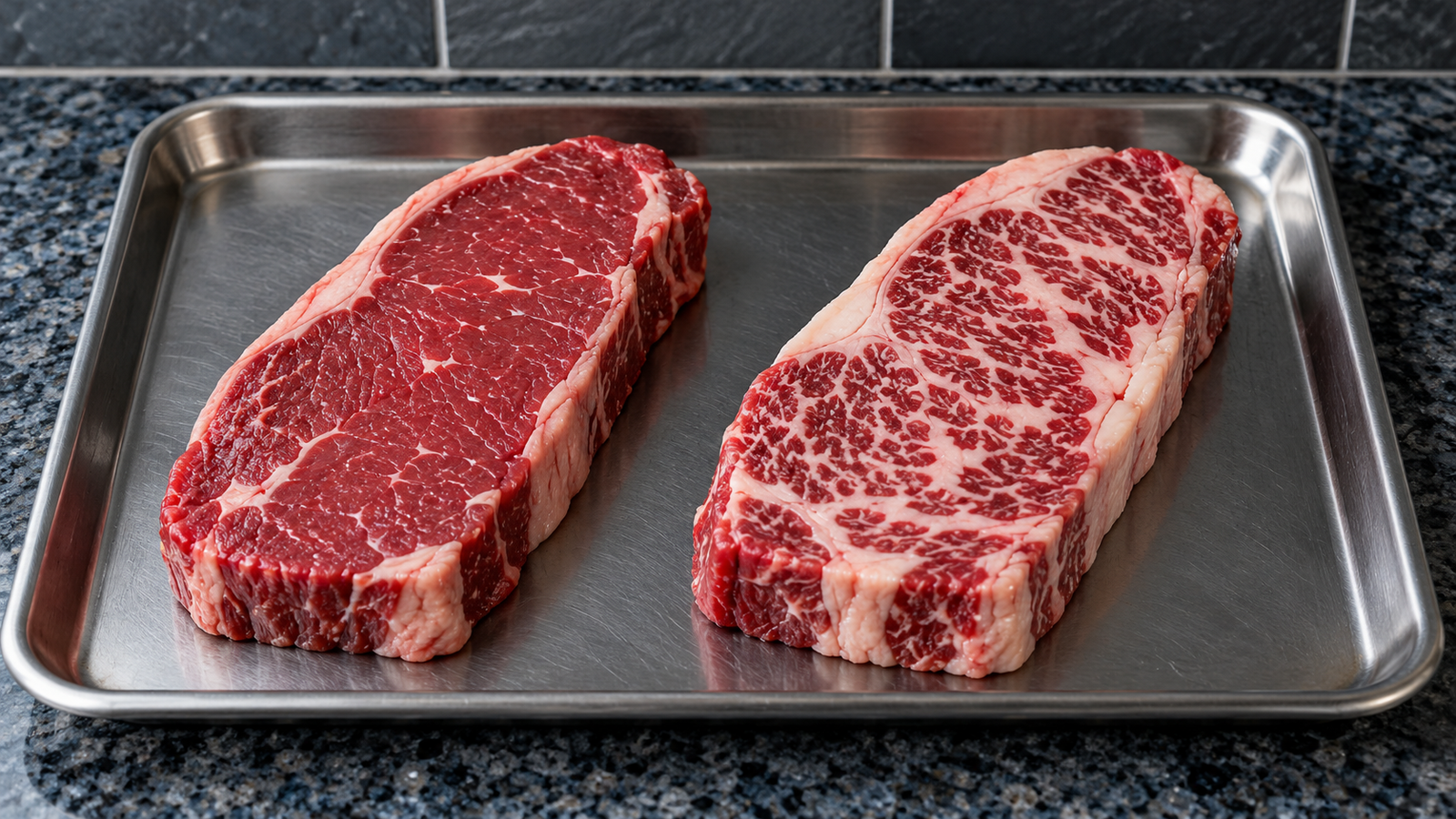
“Grass-fed” sells for more at nearly every meat counter, and most people buying it couldn’t say exactly why beyond a vague sense that it’s somehow better. The actual differences are specific and measurable: fat composition, flavor, cooking behavior, and price, each driven by a real difference in diet. None of them make one option simply correct.
What the terms actually mean
Nearly all cattle raised for beef in the U.S. start on grass. The real split happens at the end of life, in what’s called the finishing period, the last several months before slaughter when the animal puts on most of its final weight and fat.
| Label | What actually happens |
|---|---|
| Grain-finished (often just called “beef”) | Moved to a feedlot and finished on a corn- and soy-based diet for the last 4 to 6 months, which speeds weight gain and builds marbling |
| Grass-fed, grass-finished | Stays on pasture or stored forage (hay) for its entire life, including finishing, with no grain-based feedlot period |
| Grass-fed, grain-finished | Grass for most of its life, then moved to a feedlot for finishing. Can legally be labeled “grass-fed” in places that don’t require “grass-finished” specifically |
That middle row is the gap most shoppers never learn about. A carton or package stamped “grass-fed” without the word “finished” may still have spent its last months on grain. If the distinction matters to you, look for “100% grass-fed” or “grass-finished” specifically, or buy from a source that can answer the question directly.
Why the fat is where you’ll actually taste the difference
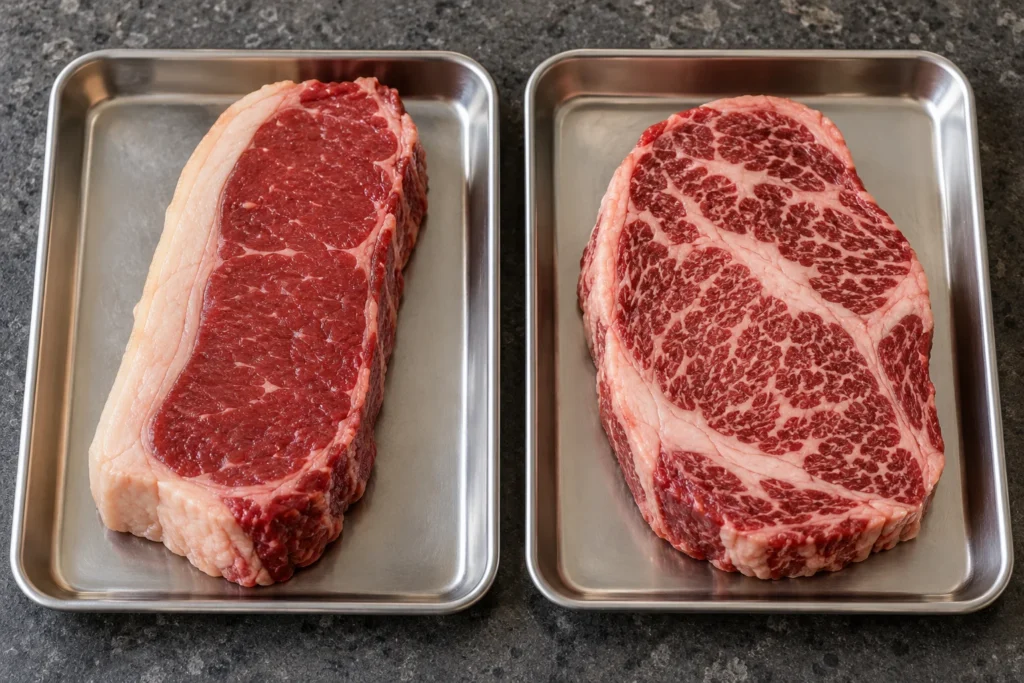
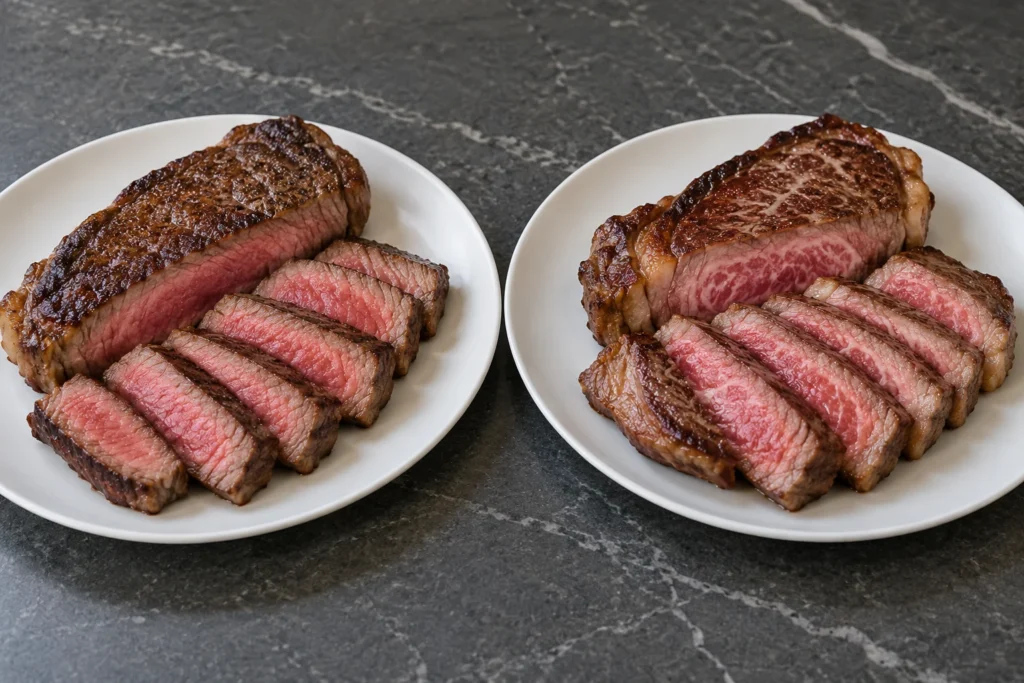
Diet changes the fat an animal builds, and fat carries most of beef’s flavor. Grain, especially corn, is calorie-dense and promotes faster, more even fat deposition throughout the muscle, which is what creates heavy marbling, the white flecks running through a well-marbled steak. That marbling bastes the meat internally as it cooks, which is a real part of why grain-finished beef tends to taste richer and feel more forgiving to cook.
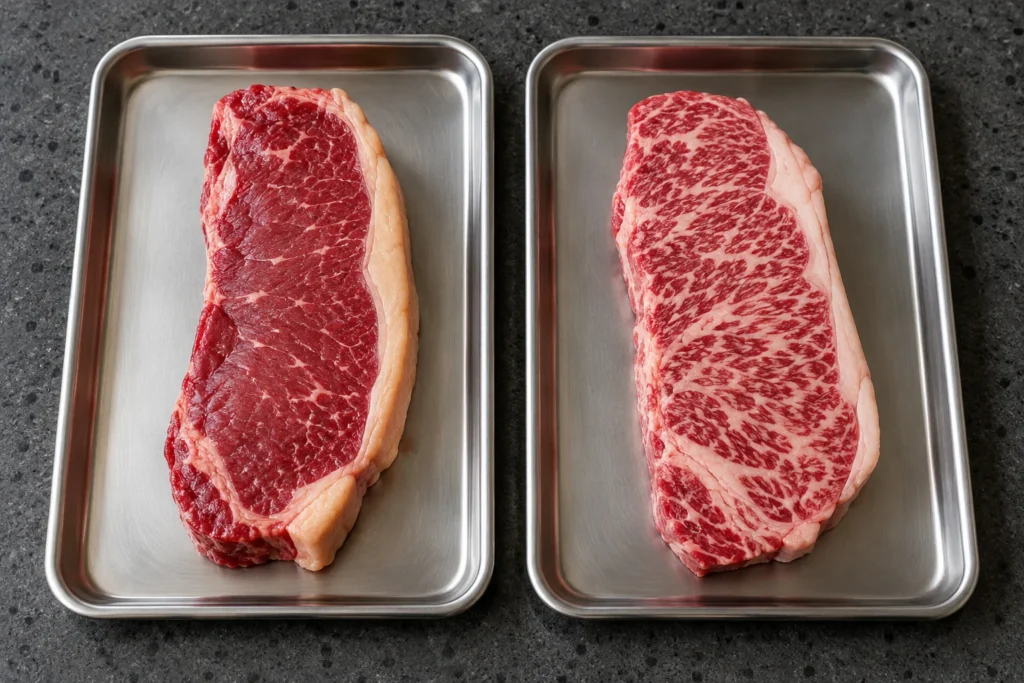
Grass-finished beef carries less marbling and a different fat profile overall, often described as leaner, with a more mineral, sometimes gamier flavor that depends heavily on exactly what the animal grazed. A cow finished on a diverse pasture tastes different from one finished on a single grass species, in a way that doesn’t really have a grain-finished equivalent, since feedlot diets are far more standardized.
Cooking each one for what it actually is
Less marbling means less internal fat to buffer against overcooking, and that single fact should change how grass-finished beef gets handled in the pan. It cooks faster than a grain-finished cut of the same thickness and dries out faster past medium. Pulling it a few degrees earlier than habit suggests, and resting it properly before cutting, matters more here than with a heavily marbled cut that has more margin for error built in.
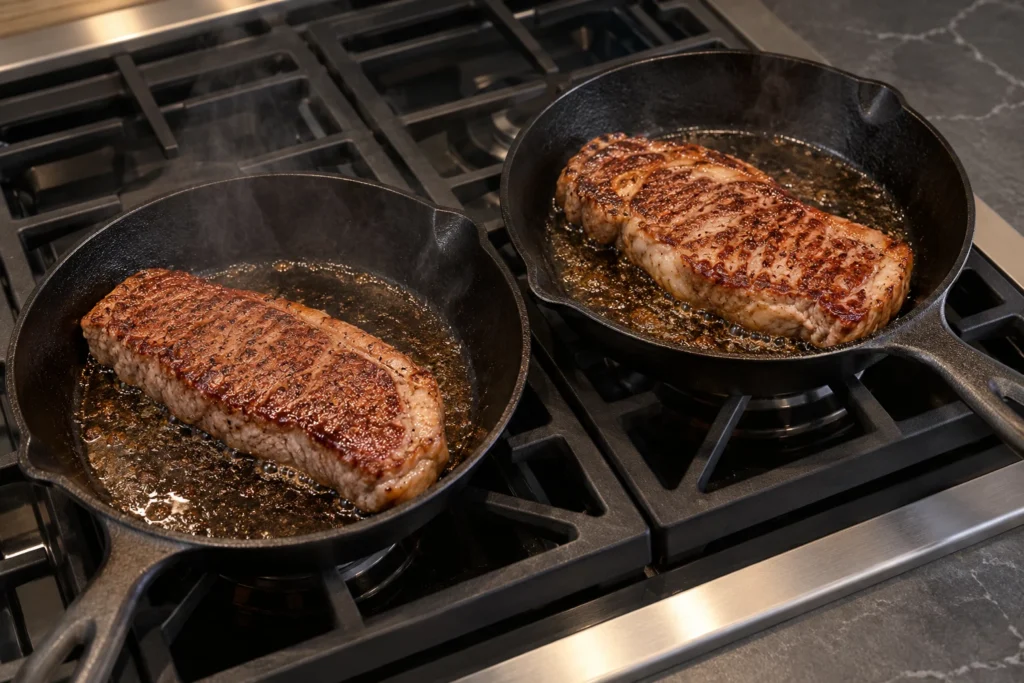
- Grass-finished steaks do better with a shorter sear and a lower finishing temperature target, since there’s less fat to render and protect the meat from drying.
- Grain-finished cuts with heavy marbling tolerate higher heat and a longer cook, since the internal fat keeps rendering and basting even as the surface browns hard.
- Either way, a thermometer beats a clock. The leaner the cut, the less forgiving guesswork becomes.
Matching the method to the cut, not just the finishing type
A reverse sear suits a thick, well-marbled grain-finished steak particularly well, since the slow initial roast gives all that internal fat time to render gently before the hard sear at the end. A leaner grass-finished steak of the same thickness benefits more from a quicker, hotter approach where less time at temperature means less opportunity to lose moisture it doesn’t have much of to begin with. A real crust is still achievable on either, but a grass-finished cut needs a drier surface and a hotter pan to get there fast, since there’s less fat helping that crust along.
Resting matters for both, but for slightly different reasons. Resting redistributes the juices that heat pushes toward the center of any cut, and a leaner grass-finished steak has less margin to lose through that process, which makes skipping the rest a more costly mistake on a lean cut than on a heavily marbled one.
What actually changes in the fat itself
Beyond how much fat an animal carries, diet changes the composition of that fat. Grass-finished beef tends to carry a higher proportion of omega-3 fatty acids and conjugated linoleic acid relative to grain-finished beef, a difference tied directly to a forage diet versus a grain diet. This is a documented compositional difference between the two, not a claim about health outcomes, and it’s a separate question from flavor or texture. Anyone making a decision based on fat composition specifically should look at primary agricultural research rather than marketing copy on either side of the grass-fed debate.

Verifying a claim instead of just trusting the sticker
A sticker is only as good as whoever printed it. At a farmers market or a local butcher counter, asking a direct question gets further than reading a label: how long is the animal finished, and on what. A seller who can answer specifically, down to the number of months and the feed, is a more credible source than a package claim alone, regardless of which finishing type they sell. A vague or evasive answer to a direct question is worth paying attention to.
Third-party certification exists for exactly this reason. A certifying body that physically audits farms carries more weight than a producer’s own label copy, since the producer has no outside check on a self-applied claim. A certification mark on the package is a shortcut past the conversation at a counter, which matters at a supermarket where asking the question directly usually isn’t an option the way it is at a farmers market or a butcher shop that sources its own animals.
Mistakes worth avoiding
- Assuming “grass-fed” means “grass-finished.” Without the word “finished” or a “100%” qualifier, the animal may have been grain-finished regardless of how it started.
- Cooking grass-finished beef exactly like grain-finished beef. Using the same timing and temperature on a leaner cut is the single most common reason people try grass-finished beef once and decide they don’t like it, when the real issue was overcooking.
- Paying a premium with no verification. A high price doesn’t confirm a claim. Ask the actual question rather than assuming the price tag is doing that work.
- Treating one bad experience as final. Grass-finished beef varies more from source to source than grain-finished beef does, since pasture composition isn’t standardized the way feedlot diets are. One disappointing package doesn’t represent every grass-finished option available.
Why the price gap is real, not just marketing
Grass-finished beef usually costs more, and the reason is mostly about time and land, not a markup for the word on the label. Grain finishing in a feedlot packs weight onto an animal in months; grass finishing on pasture can take a year or more longer to reach the same slaughter weight, since grass is simply a lower-calorie feed than grain. That extra year of feeding, land, and labor is a real cost that gets passed through, not an invented premium.
Pasture requirements also limit how many cattle a given piece of land can support compared to a feedlot, where animals are concentrated and fed a calorie-dense diet. More land per animal for a longer period is the actual math behind the price tag.
Why grain-finishing became the American default
Grain-finishing wasn’t always the standard. It became the dominant model in the U.S. over the second half of the twentieth century, as cheap, abundant corn from an expanding agricultural system made feedlot finishing far more economical than it had been, and consumer demand shifted toward the consistently marbled, tender beef a grain diet reliably produces. Feedlots also let producers finish cattle faster and on a predictable schedule, which matters enormously at the scale of a national supply chain that has to deliver a consistent product to thousands of stores every week.
Grass-finishing never disappeared, but it stayed the smaller, more regional, more variable side of the industry precisely because it resists that kind of standardization. A given field’s grass changes with the season and the rainfall in a way a feed mill’s grain ration doesn’t, which is part of why grass-finished beef is harder to produce at consistent scale and, in turn, part of why it costs more. Smaller, regional producers are also why grass-finished beef is more commonly sold direct, through farmers markets, local butchers, or a producer’s own online store, rather than through the same national distribution chains that stock a supermarket’s grain-finished beef case.

Neither one is automatically the better buy
Grain-finished beef gives a more consistent, forgiving eating experience at a lower price, which is exactly why it’s the default at most supermarkets. Grass-finished beef costs more and asks for more attention in the pan, in exchange for a different flavor and a different fat profile that some people actively prefer and others find too lean or too strong. Trying a small amount of each from a source you trust is a more useful test than any general rule about which one is “better.”
Cut choice narrows the gap in both directions. A naturally fattier cut like ribeye or chuck carries enough of its own marbling that a grass-finished version still cooks with some margin for error, while a naturally lean cut like eye of round turns unforgiving fast on a grain-finished animal too if it’s cooked past medium. The finishing type matters, but it’s never the only variable deciding how a given cut behaves on the heat.
Reading a label that’s trying not to tell you much
“Grass-fed” alone is a weak claim for the reasons above. A few terms are worth knowing on sight:
- Grass-finished or 100% grass-fed: the strongest version of the claim, meaning no grain finishing at all.
- American Grassfed Association certified: a third-party verification with real audited standards, rather than a producer’s own claim.
- Grain-finished or “grain-fed”: the conventional default, rarely printed on the label since it doesn’t need to be. Beef with no grass or grain claim at all is almost always grain-finished.
- Natural: a USDA term that only means minimally processed with no artificial ingredients added after slaughter. It says nothing about diet, pasture access, or hormone and antibiotic use.
Where this fits into buying meat without overthinking every trip
Most of the value question in buying beef isn’t grass versus grain at all. It’s cut selection and portioning, which is where the real money gets saved or wasted regardless of how the animal was finished. Treating the grass-fed decision as one variable among several, rather than the single thing that determines whether a purchase was a good one, keeps a grocery trip from turning into a research project every time.
A practical approach: pick a primary source for everyday cooking, whichever finishing type fits the budget and the way you actually cook, and treat the other type as an occasional change of pace rather than a decision to relitigate every week. The label is a starting point, not the final word; the better question is always what a specific piece of meat, from a specific source, is actually going to do on the heat.
For cuts bought mainly for weeknight cooking, where the priority is a forgiving cook and a predictable result, a reliable grain-finished source is usually the lower-friction choice. For an occasional cut bought specifically for its flavor, where the cooking itself is part of the point rather than a chore to get through, grass-finished beef from a source that can answer real questions about how the animal was raised is worth the extra attention it asks for. Neither choice needs to be permanent, and switching between them as the occasion calls for it is a perfectly normal way to shop.
Visual steps
