
Prime, Choice, Select. Three words stamped on a package that most shoppers treat as a simple ranking, best to worst, without knowing what they actually measure, how the stamp gets applied, or how much of the beef sold in the U.S. never gets stamped with any of them at all. The grading system is useful once you know what it’s really scoring and where its limits are.
Grading measures one thing: marbling
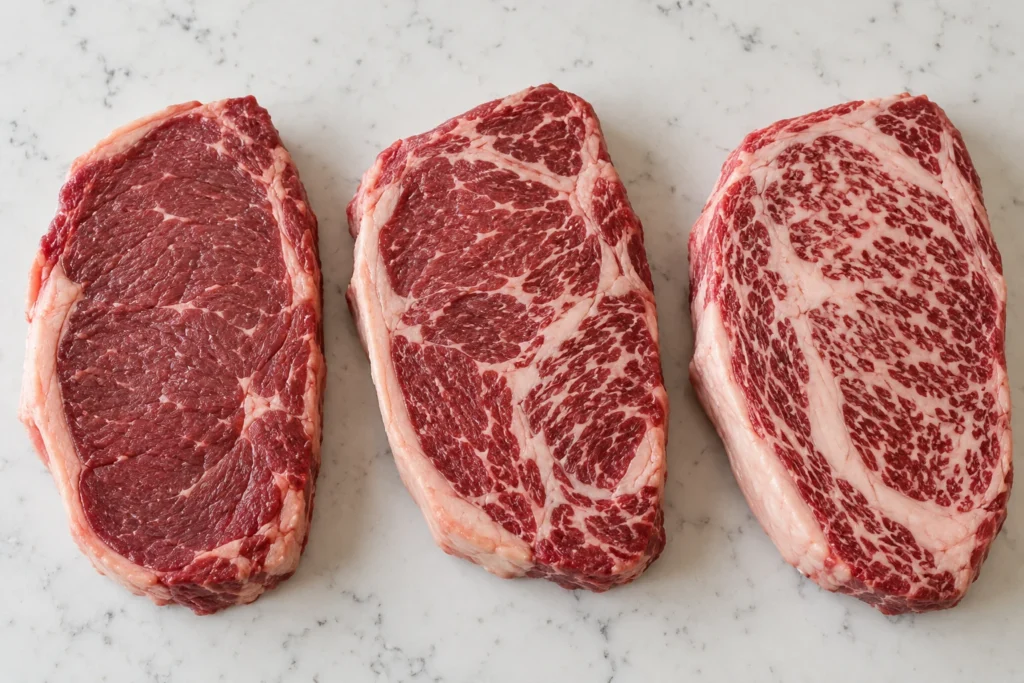
USDA quality grades are built almost entirely around marbling, the flecks and streaks of intramuscular fat running through a cut, evaluated at the ribeye muscle on the carcass along with the animal’s estimated maturity. More marbling at a younger estimated maturity earns a higher grade. That’s the whole system in one sentence: it is a marbling and maturity score, not a measure of safety, freshness, humane treatment, or origin. A package with no grade stamped on it at all can still be perfectly safe and fresh; grading is optional and paid for by the processor, not a requirement to sell beef legally.

| Grade | What it signals | Where you’ll typically find it |
|---|---|---|
| Prime | Highest marbling of the eight USDA grades, from young, well-fed cattle | Steakhouses, specialty butchers; roughly the top few percent of graded beef |
| Choice | High marbling, one step down from Prime | The most common grade in supermarkets |
| Select | Noticeably less marbling, leaner overall | Common in supermarkets, usually priced below Choice |
| Standard and Commercial | Little to no marbling, often from older or leaner cattle | Rarely sold as graded beef to consumers directly |
| Ungraded | Never submitted for grading at all | Common at local butchers, farm-direct sellers, and some store brands |
Why “ungraded” isn’t a red flag
Grading costs the processor money per carcass, and a lot of beef, especially from smaller or regional producers, skips it entirely without that meaning anything negative about the meat. A local butcher selling a whole or half animal direct from a known farm has a far more specific picture of that individual animal’s history than any grade stamp provides, since the grade only describes marbling and maturity at one point in time, not the animal’s full story. Ungraded beef from a source you trust and can ask questions of is not a downgrade from Select; it’s simply a different kind of information.
What grade actually predicts in the pan
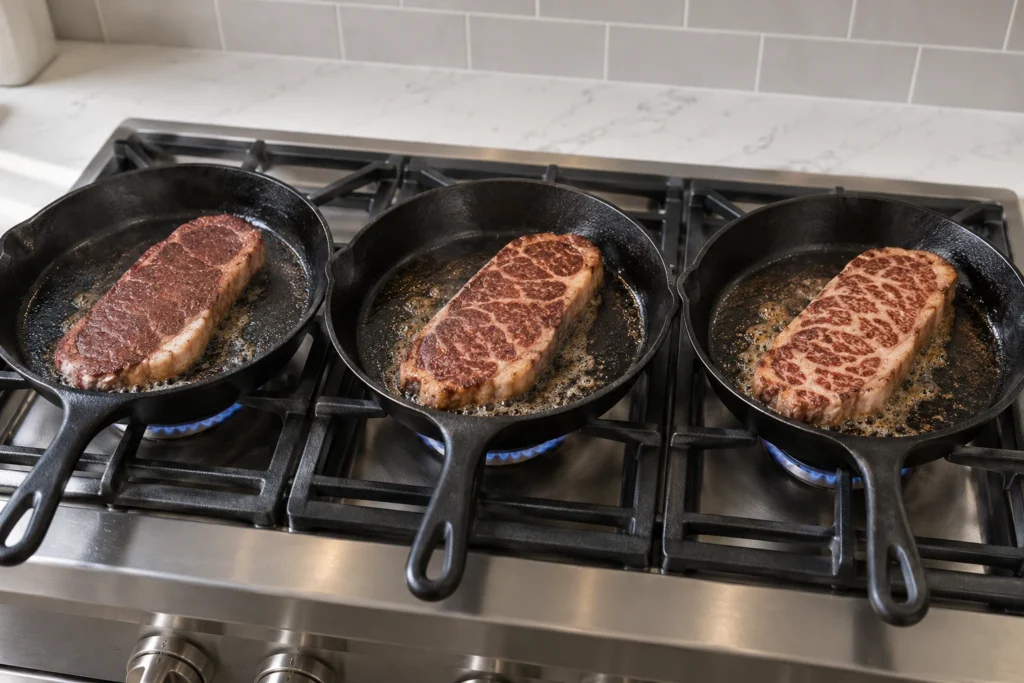
Marbling fat melts as a cut cooks, basting the meat internally and keeping it moist even if the cooking isn’t perfectly timed. That is the real, practical reason Prime and Choice tend to taste richer and feel more forgiving than Select: there is simply more internal fat providing a buffer against overcooking. A Select-grade steak cooked exactly like a Prime one, with the same timing and the same heat, will come out drier more often, not because anything was done wrong, but because it started with less margin for error.
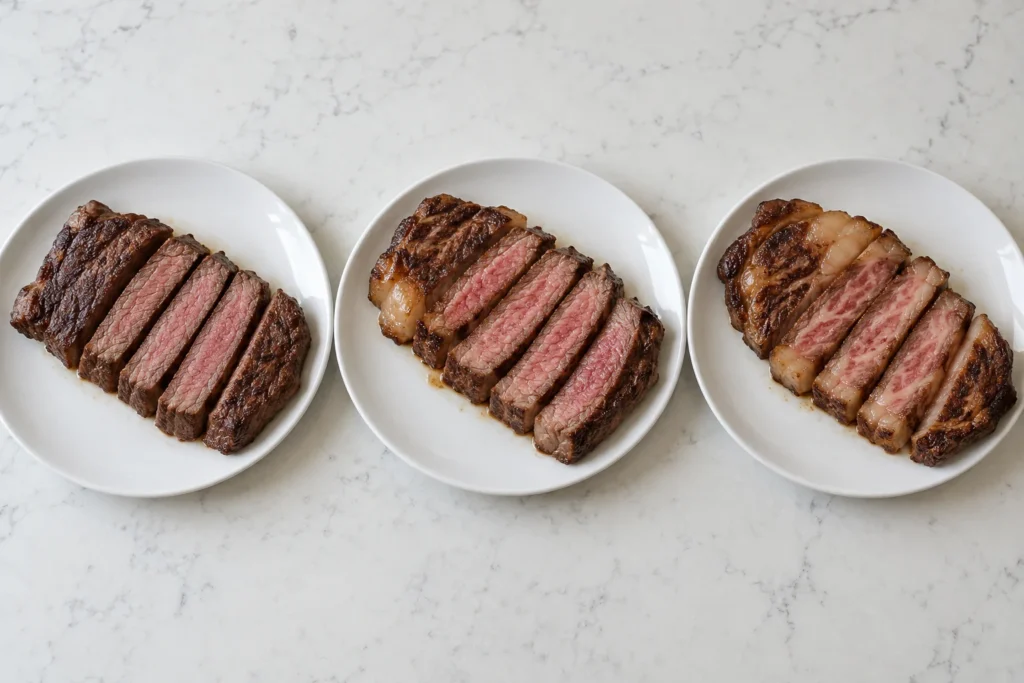
This changes how a cut is worth approaching at the stove. A well-marbled Prime or Choice cut tolerates a longer rest and a slightly later pull off the heat without much penalty. A leaner Select cut rewards closer attention: pulling it a few degrees before the target temperature and leaning on a flavorful marinade or a fat-based finishing touch, like a pat of butter or a drizzle of rendered fat, does more work on a lean cut than on a heavily marbled one that’s already basting itself.
Where grade matters most, and where it barely matters at all
Grade matters most on cuts meant to be cooked quickly over high heat with marbling doing real work: ribeye, strip steak, T-bone, tenderloin. These are exactly the cuts where the difference between Choice and Select shows up clearly on the plate.
Grade matters far less on cuts meant for low, slow, moist cooking: chuck roast, brisket, short ribs. Braising and slow roasting break down connective tissue over hours, and that process does more to determine the final texture than the starting marbling grade ever will. Paying up for Prime chuck roast is rarely worth it, since the cooking method itself is already doing the work marbling would otherwise provide.
There’s a middle group too, cuts like sirloin, flank, and skirt steak, where grade has a real but smaller effect than it does on a ribeye. These cuts carry naturally less fat regardless of grade, so a Choice sirloin is still a leaner eating experience than a Choice ribeye, and the jump to Prime closes some but not all of that gap. For this middle group, technique, a hot pan, a short cook, slicing thin against the grain, does more to improve the result than chasing a higher grade does.
Store brands that borrow grading language without using it
Some retailers print their own quality tiers, with names like “premium,” “ultimate,” or “reserve,” that sound official but aren’t USDA grades at all. These are internal store-brand labels, and while some do correspond to real marbling standards the retailer applies consistently, there’s no outside certifier checking the claim the way the USDA grading system works. The only way to know what a store’s own label actually requires is to ask or look it up directly, since the name alone doesn’t carry the same guarantee an official USDA shield does.
The actual USDA shield, a small circular or shield-shaped stamp printed directly on the package, is the way to confirm a grade is real rather than a marketing name designed to sound like one. If that shield isn’t printed anywhere on the packaging, the beef hasn’t been officially graded, regardless of what else the label says.
Ground beef plays by slightly different rules
Ground beef is rarely sold with a USDA quality grade at all, since grading happens on the whole carcass before it’s broken down into cuts, and trim destined for grinding typically isn’t graded individually. What actually governs ground beef’s richness is the fat percentage printed on the label, most commonly expressed as a ratio like 80/20 or 90/10, meaning 80% lean meat to 20% fat, or 90% lean to 10% fat.
Higher-fat ground beef (80/20 or even 73/27) browns better and holds together more easily in a burger, since the fat renders out and bastes the meat as it cooks, much like the marbling effect on a whole cut. Leaner ground beef (90/10 or 93/7) produces less shrinkage and less rendered fat left in the pan, which suits a dish like chili or a sauce where that extra fat would otherwise need to be drained off anyway. Neither ratio is a better default; they’re suited to different dishes, and keeping both on hand, a fattier blend for burgers and meatballs and a leaner one for sauces and taco filling, covers most of what ground beef gets used for in a given week.
Grade versus cut: two separate decisions that get confused
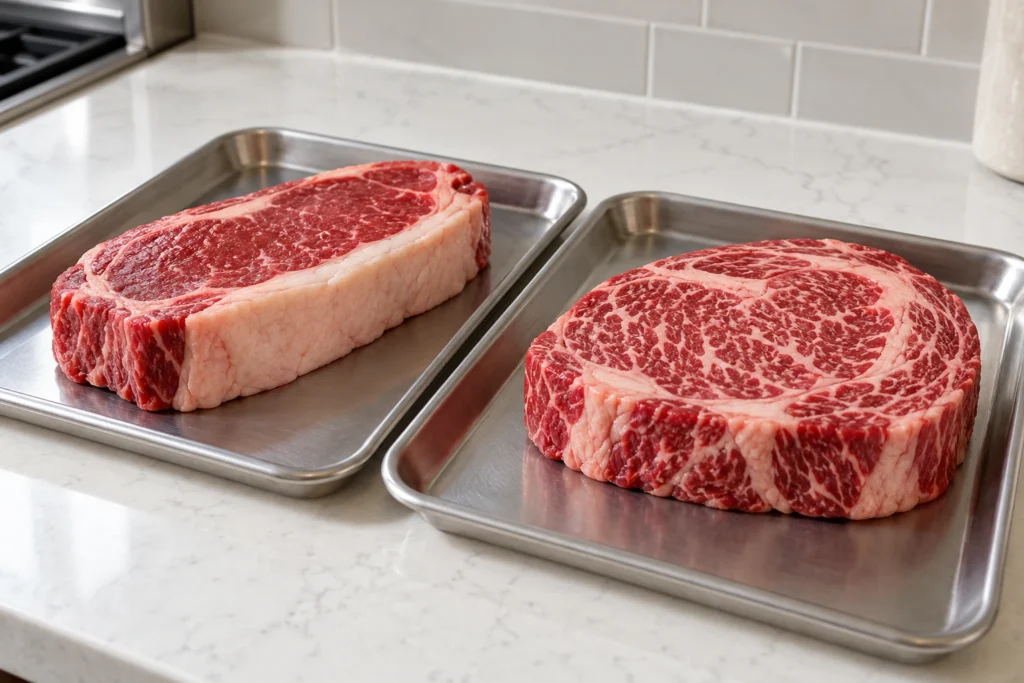
A common mix-up is treating “grade” and “cut” as one decision instead of two independent ones. A Select-grade ribeye still has more natural marbling built into the cut itself than a Prime-grade eye of round, since ribeye comes from a naturally fattier section of the animal regardless of grade. Cut determines the baseline; grade adjusts it up or down from there. Knowing both variables, not just the grade stamp, is what actually predicts how a specific piece of meat will behave.
Deciding when the upgrade is actually worth paying for
- Worth it: a special-occasion steak dinner where a quick sear is the entire cooking method, and the extra marbling will be the difference the whole meal is judged on.
- Rarely worth it: anything braised, stewed, or slow-roasted for hours, where connective tissue breakdown matters more than marbling.
- Worth testing once: ground beef, where a higher grade sometimes claims a richer flavor, though fat percentage (80/20 versus 90/10, for example) usually has a bigger effect on texture and juiciness than the quality grade does.
- A genuine toss-up: everyday weeknight steaks, where Select cooked with a bit more attention often performs close enough to Choice that the price difference isn’t buying much.
Where the grading system came from
The USDA began grading beef in the 1920s, originally as a wholesale tool to give packers and buyers a shared vocabulary for describing carcass quality over telegraph and phone, long before any of it reached a shopper reading a label. The system expanded to consumer-facing grades over the following decades as supermarkets grew and shoppers needed a quick way to compare packages without seeing the whole carcass a cut came from. The eight current grades, from Prime down through Canner, replaced an even larger set of regional and informal standards that varied from one part of the country to another, which is part of why a single national standard mattered enough for the USDA to formalize it in the first place.
That wholesale origin is still visible in how the system works today: grading happens once, at the carcass level, before any cutting or packaging decisions are made, which is why a single grade can end up printed on cuts as different in how they cook as a ribeye and a round roast from the same animal. A trained USDA grader, not an automated system, still makes that call by eye at the carcass, assessing marbling against official photographic standards, a surprisingly manual process for something that ends up as a single word on a label.
Misconceptions worth clearing up
- “Higher grade means safer.” Grade has nothing to do with food safety. USDA inspection for safety is a separate, mandatory process that every piece of beef sold in the U.S. goes through regardless of whether it’s graded at all.
- “Ungraded means lower quality.” Grading is optional and paid for by the processor. A lot of excellent beef, especially from small or regional producers, is never submitted for grading simply because it isn’t economical to do so at that scale.
- “Grade predicts tenderness directly.” Grade measures marbling and maturity, which correlates with tenderness in the cuts where marbling matters most, but it isn’t a direct tenderness score, and cut, aging, and cooking method all affect tenderness independently of grade.
- “A store’s house brand name is a USDA grade.” As covered above, only the official shield confirms an actual USDA grade. A clever brand name is not the same claim.
A quick path to checking if a price is fair
Grade alone doesn’t tell you whether a price is reasonable, since location, cut, and local demand swing prices as much as the grade stamp does. Where the actual value is when buying meat comes down to comparing price per usable pound across cuts and grades side by side, not assuming a higher grade number automatically means a better deal. A Select ribeye can still cost more per pound than a Choice chuck roast, and knowing what each grade is actually predicting is what makes that comparison meaningful instead of arbitrary.
The grade stamp is one data point among several worth checking before a purchase, alongside the cut itself, the color and texture visible through the packaging, and, where it’s an option, a direct conversation with whoever is behind the counter. Color is worth a specific mention: beef that looks deep purplish-red through the package, rather than bright cherry-red, hasn’t necessarily gone bad. That color shift happens because meat hasn’t yet been exposed to oxygen inside sealed packaging, and it turns bright red within minutes of being opened and exposed to air. Judging freshness by color alone through unopened packaging is a common and understandable mistake, but it isn’t a reliable test on its own.
Put together, grade, cut, and a direct conversation with a seller tell a much more complete story than any single stamp can on its own. Treating the grade as the whole answer is how a shopper ends up either overpaying for marbling a braised dish doesn’t need, or underpaying attention to a lean cut that actually needed a gentler hand on the heat.
Visual steps
