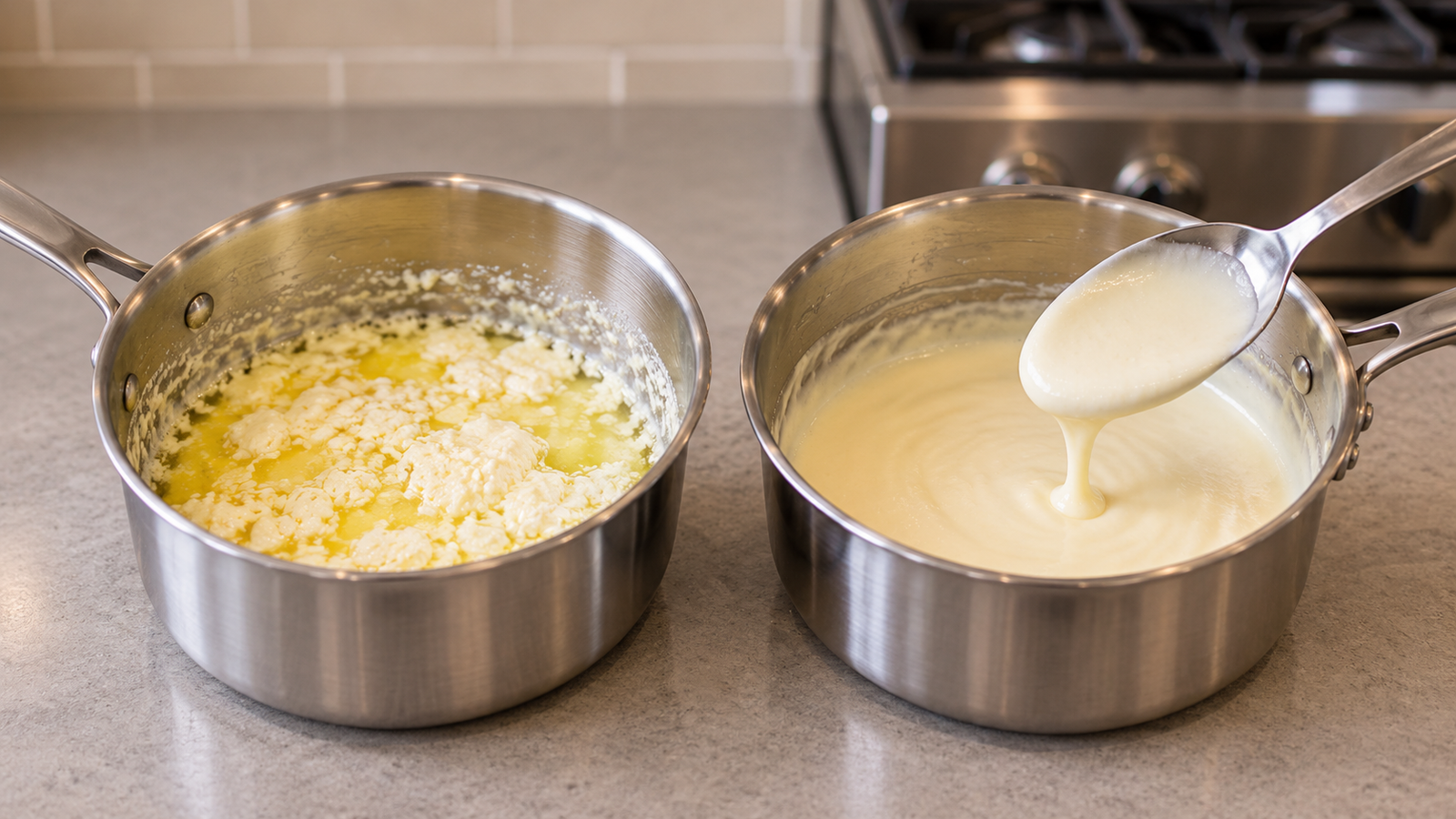
A broken cream sauce looks like curdled milk floating in a thin, greasy liquid instead of one smooth, glossy mixture. It happens because the proteins and fat in cream are more fragile under heat, acid, and salt than most cooks assume, and almost every case traces back to one of four specific triggers: too much direct heat, added acid, high salt concentration meeting the cream too fast, or the wrong cream for the job in the first place. Knowing which trigger caused a specific break is what actually lets you avoid it next time, instead of just hoping a lower flame fixes everything.
What breaking actually is, chemically
Cream is an emulsion: tiny fat globules suspended evenly in a water-based liquid, held apart from each other by a thin protein layer (mostly casein) coating each fat droplet. Heat, acid, and salt can all damage that protein coating. Once enough droplets lose their coating, the fat clumps together with other fat, and the proteins clump together separately with other proteins, and the two groups separate out from the water they were suspended in. That visible separation, fat pooling one way and grainy curds floating the other way, is what “breaking” or “curdling” actually looks like at a kitchen level.
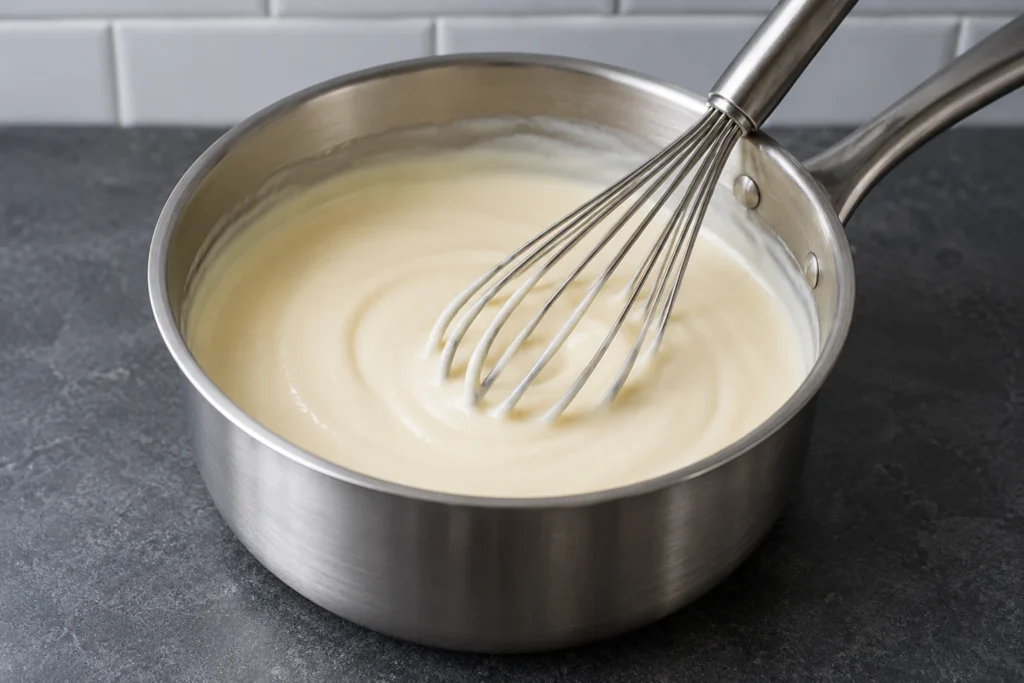
This is different from a sauce simply reducing and thickening, which is supposed to happen as water evaporates. A reduced sauce stays smooth and glossy as it thickens. A broken sauce looks separated and loses its smooth sheen, often within seconds of crossing whatever threshold caused it.
Fat content sets how much risk you’re starting with
Heavy cream (36% milkfat or higher) is the most stable option for a hot sauce because the higher fat content physically dilutes the proteins relative to the fat, so there’s less protein available to clump when heat or acid hits. Half-and-half (around 10-18% fat) and whole milk (around 3.5% fat) are both considerably more prone to breaking under the same heat or acid, because there’s proportionally more protein and less fat buffering it.
This is why a recipe that calls specifically for heavy cream usually breaks if whole milk is swapped in without any other adjustment (like adding a starch), and it’s also why restaurant cream sauces default to heavy cream rather than lighter dairy: it’s simply more forgiving under the heat and acid a sauce actually goes through.
Heat: the most common trigger
A hard boil is the single most common way a cream sauce breaks. Sustained high heat denatures the casein proteins faster than they can redistribute evenly, and the vigorous bubbling physically agitates the fat and protein apart from each other at the same time. A simmer, with small bubbles breaking gently at the surface rather than rolling boil, keeps the proteins from denaturing too fast and gives the sauce time to thicken gradually instead of seizing.
Direct, uneven heat from a thin-bottomed pan makes this worse, because the cream touching the hot spot can scorch and break locally even while the rest of the pan looks fine. A heavier pan that distributes heat more evenly, and stirring consistently rather than leaving the sauce sitting, both reduce the chance of a localized break that then spreads through the whole pot once stirred in.
Acid: why wine and tomato sauces break so easily
Acid lowers the pH of the cream, and casein proteins are least stable right around the pH where milk naturally curdles (close to its isoelectric point, around pH 4.6). Wine, tomatoes, lemon juice, and vinegar all push a sauce toward that range, which is why a cream-and-wine pan sauce or a creamy tomato sauce breaks far more easily than a plain cream reduction with no acid at all.
The fix isn’t avoiding acid, since it’s often doing real flavor work. It’s sequencing: reduce the wine or deglaze with it and let some of the sharpest acidity cook off before the cream goes in, rather than adding cream and acid to the pan at the same time. Adding the cream last, off the highest heat, and letting the sauce come together gently rather than at a boil, gives the proteins a better chance to hold together even with acid already in the pan.
Salt and salty ingredients added too fast
A sudden high concentration of salt, like dropping a very salty reduction, a hard aged cheese, or a briny ingredient straight into cream, can destabilize the protein coating in a similar way to acid, especially if the cream is already near a simmer when it happens. This is a common, underrated cause of breaking in sauces built around parmesan or other hard, salty cheeses: the cheese itself is fine, but adding a large amount all at once, over high heat, is what tips the sauce over.
Adding salty ingredients gradually, off the highest heat, and stirring continuously as they melt in gives the sauce time to absorb the change instead of being hit with it all at once.
A starch buys real insurance
A small amount of flour or cornstarch, whisked into a slurry with a little cold liquid before it goes into the pan, physically coats the fat and protein particles and gets in the way of them clumping together, which is why a roux-based or cornstarch-thickened cream sauce is noticeably more forgiving of heat, acid, and salt than a sauce made from cream alone. This is standard in almost every classic cream-based sauce for exactly this reason, not just for thickness. A sauce built on heavy cream with no starch at all is working with the least margin for error, which is fine for a short, carefully controlled reduction, but risky for anything simmering longer or taking on acid and salty ingredients along the way.
Ultra-pasteurized cream behaves differently than you’d expect
Most heavy cream sold in grocery stores today is ultra-pasteurized (heated briefly to around 280°F for extended shelf life) rather than regular-pasteurized (heated to roughly 161°F). The higher heat used in ultra-pasteurization already denatures some of the whey proteins before the cream ever reaches a kitchen, which actually makes it somewhat more heat-stable in a sauce than old-fashioned regular-pasteurized cream, since the proteins most prone to curdling have already been partly altered once. The tradeoff is flavor: ultra-pasteurized cream tends to taste flatter and slightly cooked compared to regular-pasteurized cream, which is why some bakers and sauce cooks seek out the regular-pasteurized version specifically, usually sold at a shorter shelf life and found more often at smaller dairies or specialty grocers.
For a cream sauce specifically, the more heat-stable behavior of ultra-pasteurized cream is a practical advantage, even if it isn’t the reason most people buy it. If a sauce keeps breaking despite following every other precaution, checking whether the cream was fresh regular-pasteurized cream, which curdles more readily, is worth ruling out.
How this plays out in specific classic sauces
An alfredo sauce (cream, butter, and parmesan, with little to no acid) is one of the more forgiving cream sauces precisely because it skips the acid trigger entirely. Most alfredo breaks trace back to the cheese being added too fast over too much heat, not the cream itself, which is why melting the parmesan in gradually, off the highest heat, solves the vast majority of alfredo problems.
A vodka sauce or any tomato-cream hybrid carries real acid risk from the tomato, so the usual fix applies directly: let the tomato component reduce and mellow before the cream goes in, and add the cream off the highest heat rather than letting the whole pot keep boiling once it’s in.
A mushroom cream sauce built with a splash of white wine for deglazing carries both an acid risk and, if using a particularly salty stock or bouillon, a salt risk at the same time, which is why this particular sauce breaks more often than people expect. Reducing the wine fully before adding cream, and checking the saltiness of any stock before adding more salt separately, removes both triggers at once.
Storing and reheating leftover cream sauce
A finished cream sauce that cooled and set in the fridge doesn’t behave exactly like it did fresh off the stove, and reheating it carries its own break risk even if the original sauce never had a problem. Reheating gently, in a pan over low heat with a small splash of added cream or milk whisked in to loosen it, works far better than microwaving on high or dumping it straight into a hot pan, both of which apply the same kind of sudden heat shock that causes a fresh sauce to break.
A sauce that was already thickened with a starch holds up to reheating noticeably better than a plain cream reduction with nothing else added, which is one more practical reason to build in a starch slurry for any sauce that’s being made ahead rather than served immediately.
Refrigerated cream sauce is generally good for about 3 to 4 days, stored in a sealed container. A sauce that smells sour beyond its usual tang, or shows any mold, should be discarded rather than reheated and tasted to check.
Troubleshooting by what actually happened
| What happened | Likely cause | Prevention next time |
| Sauce broke right after it started boiling hard | Heat too high, sustained boil | Keep it at a gentle simmer, use a heavier pan, stir regularly |
| Broke right after adding wine or tomato | Acid shock | Reduce the acidic ingredient first, add cream last off high heat |
| Broke right after adding cheese or a salty reduction | Salt shock | Add gradually, off the highest heat, stirring continuously |
| Broke using milk or half-and-half in a recipe meant for heavy cream | Fat content too low for the technique | Use heavy cream, or add a starch slurry to compensate |
Can a broken sauce be saved?
A mild break, where the sauce looks slightly grainy but hasn’t fully separated into visible fat and curds, can sometimes be rescued by pulling it off the heat immediately and whisking in a small splash of cold cream or cold water, which can shock the emulsion back together. This works more often than not for a break caught early, right as it starts.
A fully broken sauce, with distinct curds floating in a thin, greasy liquid, is harder to fully recover, though blending it briefly with an immersion blender can sometimes re-emulsify it into something usable, even if the final texture is a little thinner than it would have been if it never broke. If blending doesn’t bring it back together, straining out the solid curds and starting a fresh base with the strained liquid, adding new cream and a starch slurry this time, usually produces a better result than trying to force a badly broken sauce back into shape.
Tempering cold cream before it hits a hot pan
Pulling cream straight from the fridge and pouring it into a pan that’s already hot creates a sharp temperature gap that stresses the emulsion right at the moment it enters the pot, on top of whatever other triggers are already in play. Letting the cream sit out for 10 to 15 minutes before it’s needed, or warming it gently in a separate small pan first, closes that gap and gives the sauce one less thing working against it. This matters most in sauces that are already carrying some acid or salt risk, where the cream doesn’t have much margin left to also absorb a sudden temperature shock.
The same logic applies in reverse when a sauce is finished and needs a splash of cold cream whisked in at the end to loosen it, a common restaurant technique for adjusting consistency right before plating. That final addition works specifically because the sauce has already come off the highest heat by that point, so the shock is mild rather than severe.
The pattern across nearly every fix, and every prevention method, is the same: lower and steadier heat, acid and salt introduced gradually rather than all at once, cream brought closer to room temperature before it meets high heat, and a starch in the mix for anything beyond a short, closely watched reduction. Those habits cover almost every common cause of a broken cream sauce before it has the chance to happen.
For a related dairy technique problem, see Why Brown Butter Goes From Perfect to Burnt So Fast, or for the base ingredient itself, Butter, Ghee, Cream, and Cheese: What Each One Actually Is.
Visual steps
