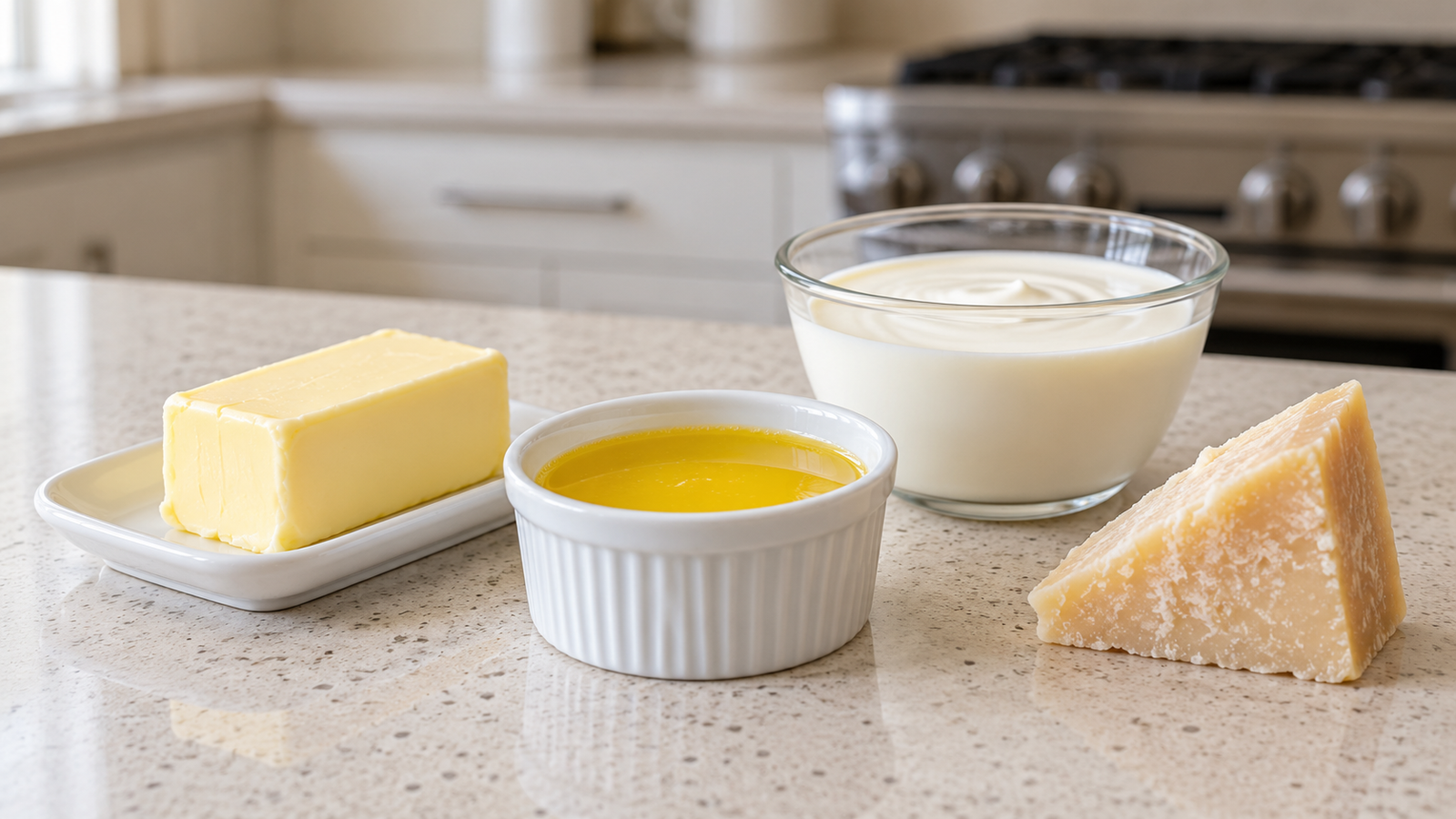
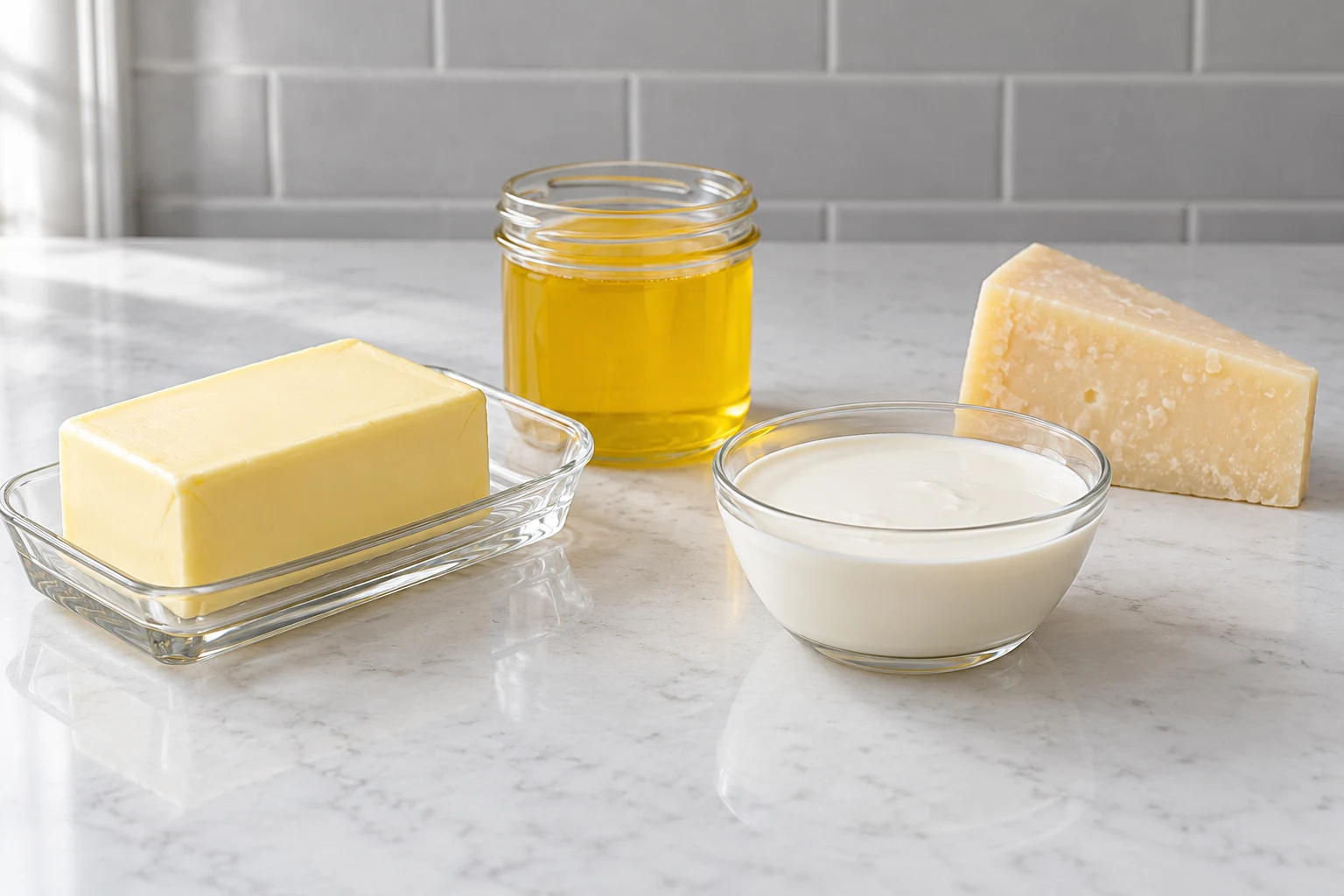
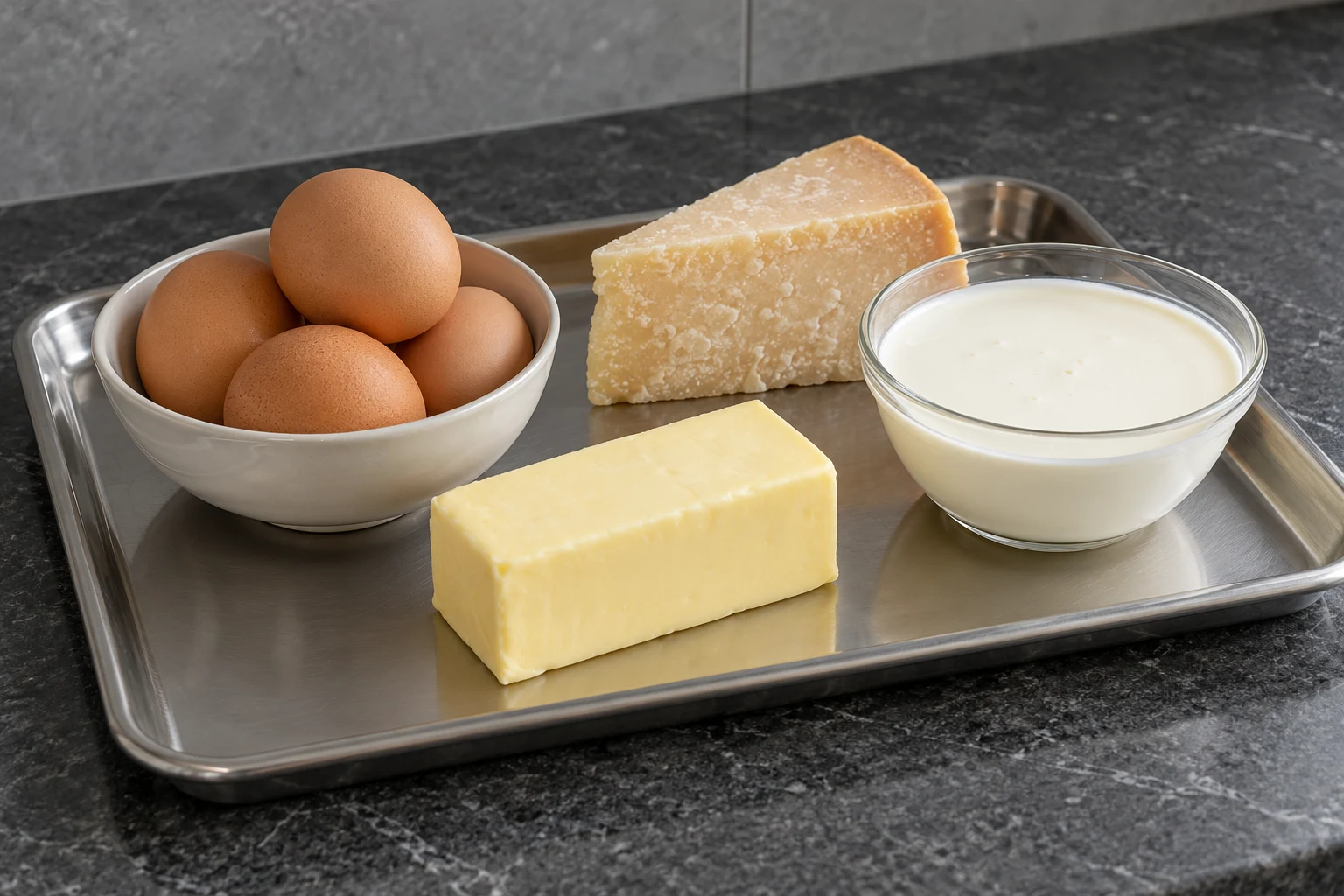
Butter, ghee, cream, and cheese get treated as interchangeable fats in a lot of kitchens, and they aren’t. Each one is made differently, behaves differently under heat, and holds differently in the fridge. Knowing what separates them is the difference between reaching for the right one and reaching for whichever tub is closest.

Butter is simpler than the label makes it look
Butter is cream, churned until the fat separates from the liquid (buttermilk) and clumps together. That’s the entire process. Everything on the label after that is a variation on the same base.
- Salted vs. unsalted: salt was originally a preservative, now mostly a flavor choice. Unsalted butter gives more control in cooking, since you’re not guessing how much salt is already baked in.
- Cultured butter: made from cream fermented with live bacterial cultures before churning, the same idea as yogurt. It has a sharper, tangier flavor than regular sweet-cream butter.
- European-style butter: churned longer and held to a higher minimum butterfat content (typically 82–85% versus 80% for standard U.S. butter). Less water, more fat, which is why it tastes richer and performs differently in pastry, where water content changes how dough behaves.
- Grading (AA/A/B): a USDA quality grade based on flavor, body, and texture at the time of grading, not a freshness or safety measure, the same logic as egg grading.
Ghee is butter with the water and milk solids removed
That single difference changes everything about how the fat behaves. Butter is roughly 80% fat, with the rest made up of water and milk solids (proteins and lactose). To make ghee, butter is simmered until the water evaporates and the milk solids separate out and sink to the bottom, where they slowly toast in the remaining fat. Once those solids turn golden-brown and the fat on top runs clear, it’s strained out, leaving pure butterfat behind: nothing but fat, with a deeper, nuttier flavor than butter ever had, because that flavor comes directly from the milk solids browning before they’re removed, the same Maillard reaction that browns a seared steak.
Removing the milk solids is also why ghee behaves so differently in a hot pan. Those solids are what burn first in regular butter, the dark flecks that turn bitter and black well before the fat itself is anywhere near smoking. Without them, ghee can go much hotter before it breaks down.
| Fat | Approximate smoke point | Best use |
|---|---|---|
| Butter | 302°F | Low to medium heat, finishing sauces, baking |
| Ghee | 485°F | High-heat searing, frying, roasting |
| Clarified butter (not fully browned) | 450°F | High heat, but without ghee’s nuttier flavor |
Clarified butter is a close relative, not the same thing: fat and water are separated the same way, but the process stops as soon as the milk solids are removed, before they’ve had time to brown. Ghee is clarified butter taken one deliberate step further, cooked until those solids toast. If a recipe wants the nutty, almost caramel-like depth ghee is known for, stopping early at plain clarified butter won’t get there.
Making a small batch of ghee at home
- Melt unsalted butter in a heavy-bottomed pot over low heat. Salted butter works too, but the salt concentrates as the water cooks off, which can overseason the finished ghee.
- Let it simmer gently. It will foam first as the water boils away, then the foam will subside and milk solids will start to separate and sink.
- Watch for the solids at the bottom to turn from white to golden to light brown, and for the fat on top to turn clear and golden. This is usually 15 to 25 minutes for a pound of butter, depending on the heat.
- Remove from heat the moment the solids are golden-brown, not dark brown. A few extra seconds is the difference between nutty and burnt.
- Strain through a fine-mesh strainer lined with cheesecloth into a clean, dry jar. Discard the toasted solids, or save them; some cooks stir them into a skillet for flavor.
Properly strained and stored in a sealed container, ghee doesn’t need refrigeration the way butter does. With the water and milk solids gone, there’s little left for bacteria to use. A cool, dark pantry keeps it stable for months; refrigeration extends that further.
If the finished ghee looks cloudy rather than clear and golden once it’s cooled, that’s almost always a sign some water wasn’t fully cooked off before it was strained, or a few milk solids slipped through the cheesecloth. Cloudy ghee isn’t unsafe on its own, but it won’t keep at room temperature as reliably as properly clarified ghee. Refrigerate it rather than leaving it in the pantry, and treat the next batch to a few extra minutes of simmering before pulling it off the heat.
Cream, by fat content, not by the vague label on the carton
| Type | Butterfat content | What it does |
|---|---|---|
| Half-and-half | 10–18% | Too low in fat to whip; richens coffee or a sauce without heaviness |
| Light/table cream | 18–30% | Pours well, enriches soups and sauces, still won’t whip reliably |
| Whipping cream | 30–36% | Whips, but less stable and less rich than heavy cream |
| Heavy cream / heavy whipping cream | 36%+ | Whips into stable peaks, reduces into sauces without breaking as easily |
The fat percentage is what actually determines whether a cream whips. Fat globules need a minimum concentration to trap enough air and hold a stable structure; below roughly 30% fat, there simply isn’t enough fat present to do that job, no matter how long you beat it. That’s a mechanical limit, not a matter of technique. No amount of extra beating time turns half-and-half into whipped cream. For cooking a sauce down without it splitting under heat, more fat also means more stability: heavy cream tolerates a hard simmer that would break light cream apart.
Reading a cheese label without getting fooled by it
“Cheese product” or “pasteurized process cheese” on a label means something different from “cheese” alone. Process cheese is real cheese blended with emulsifiers, extra water, and sometimes vegetable oils to make it melt smoother and last longer on the shelf. That’s useful for a specific texture, but it’s a different product from a block of aged cheddar, not a cheaper version of the same thing. If the goal is cheese as an animal product in as close to its original form as possible, the ingredient list is the tell: a short list naming milk, cultures, salt, and enzymes is traditional cheese; a long list with oils, starches, and stabilizers is process cheese wearing a cheese label.
“Raw milk cheese” on a label is different from raw milk itself. U.S. rules require cheese made from unpasteurized milk to be aged at least 60 days before sale, a window long enough for the cheese’s own acidity and salt content to make most harmful bacteria unable to survive. That’s part of why certain aged raw-milk cheeses are legal to sell even though drinking raw milk itself is tightly restricted in many states. This is a different risk profile from raw milk, not an extension of it.
Cheese, in two broad categories that explain most of the confusion
Nearly every cheese question comes down to one variable: how much moisture is left in it, and how long it’s been aged. Fresh cheeses, such as mozzarella, ricotta, cottage cheese, and fresh chèvre, are made and eaten within days, with high moisture content and mild flavor. Aged cheeses, such as cheddar, parmesan, gouda, and aged gruyère, lose moisture over months or years as bacterial cultures and enzymes slowly break down proteins and fat, which is what builds the sharper, more concentrated flavor and firmer, sometimes crumbly texture of a cheese aged a year or more.
Aging also matters for something most people don’t connect to cheese at all: lactose content. Lactose is milk sugar, and it’s consumed by the bacterial cultures during fermentation and aging. A fresh cheese retains meaningfully more lactose than a cheese aged a year or more. A hard, well-aged cheese like a two-year cheddar or parmesan contains only trace amounts, close to none, because the aging process has already broken nearly all of it down. This is a compositional fact about fermentation, not a recommendation for managing any particular sensitivity.
Mistakes that waste good dairy fat
- Walking away while making ghee. The jump from golden milk solids to burnt ones happens fast in the last few minutes. Stay close once the foam has subsided and the solids are visibly browning.
- Straining ghee poorly. Any stray milk solids left behind in the jar will eventually spoil, even in fat that would otherwise keep for months. A fine-mesh strainer and cheesecloth, not a quick pour through a regular strainer, is what actually gets them all out.
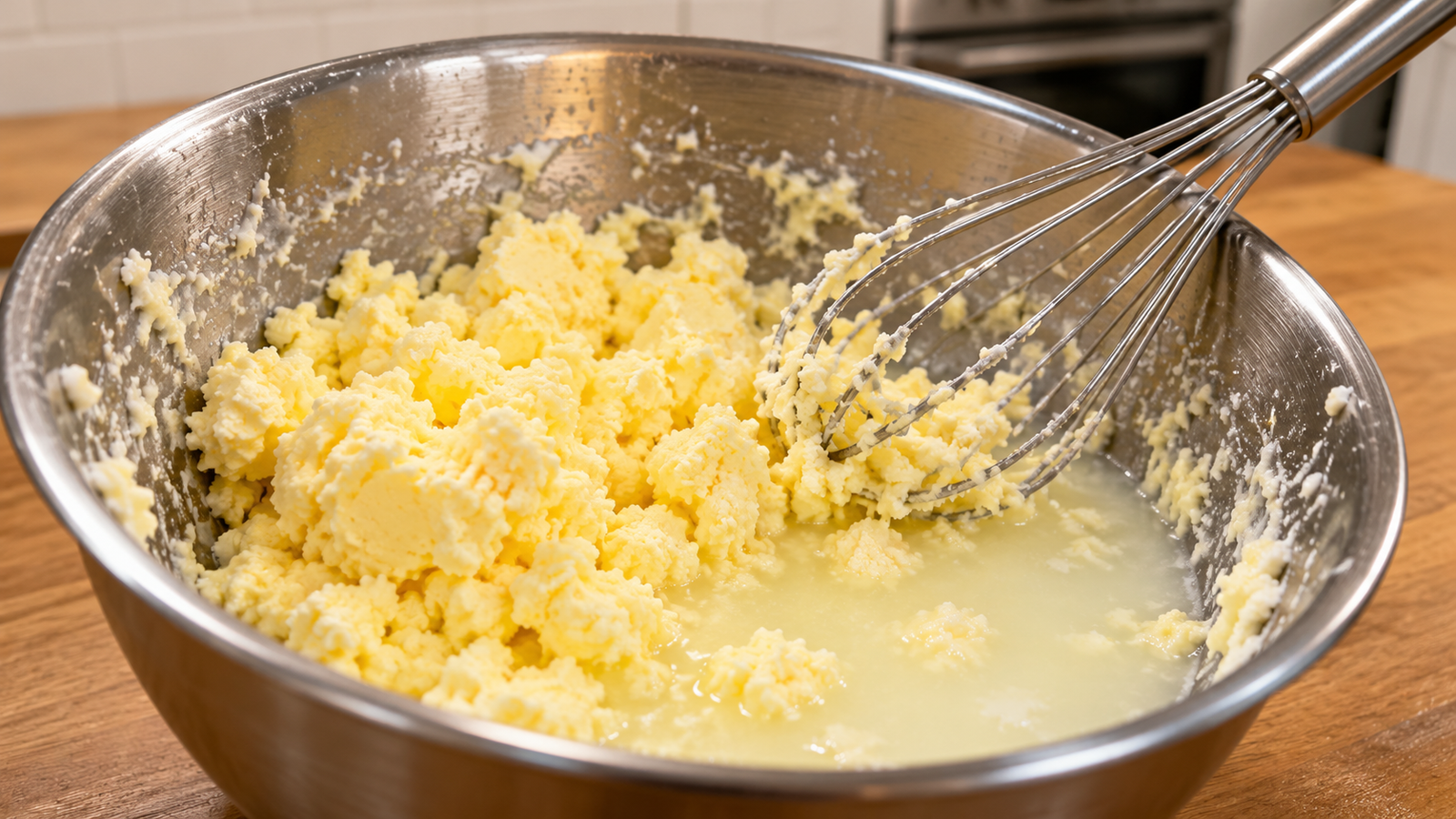
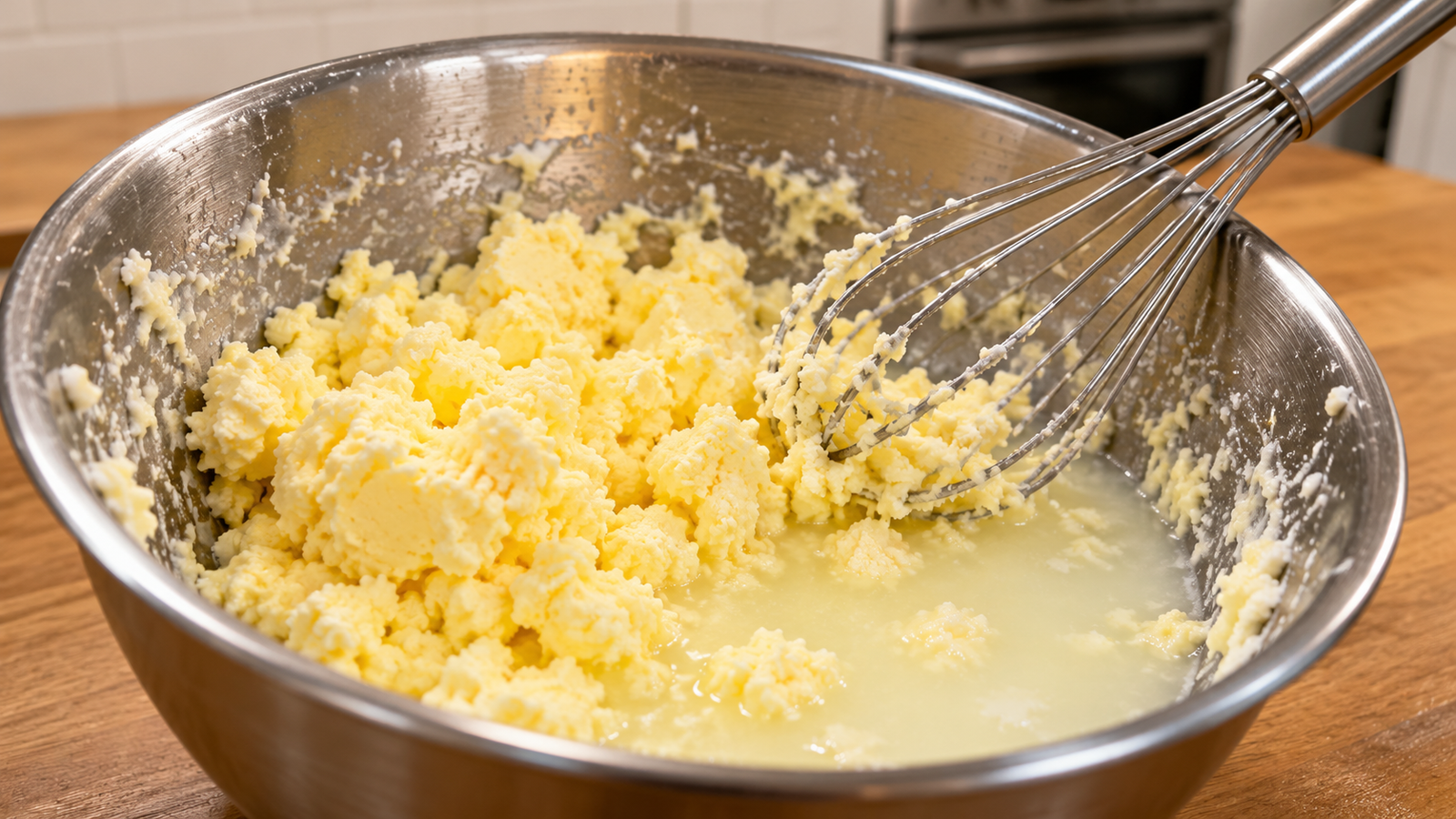
- Over-whipping cream. Keep beating cream past stiff peaks and the fat structure collapses further, separating into butter and buttermilk right in the bowl. It isn’t ruined, since that’s genuinely how butter is made, but it’s no longer whipped cream, and recovering the texture you wanted means starting over with a fresh batch.
- Melting cold cheese too fast. High, sudden heat makes cheese’s fat and protein separate instead of melting smoothly, leaving a greasy, stringy mess instead of a silky sauce. Let cheese come closer to room temperature first, and melt it over gentler heat than instinct suggests.
- Buying “ghee” that’s just clarified butter. Some commercial products labeled ghee are pulled from the heat before the milk solids actually brown, which skips the step that gives ghee its signature nutty flavor. If a jar of ghee tastes close to plain butter with nothing special happening, that’s likely why.
Storage that actually extends shelf life
- Butter: refrigerated, 1 to 2 months past the sell-by date if sealed; frozen, up to a year. Keep it wrapped tightly, since butter absorbs odors from the fridge easily.
- Ghee: a cool pantry for several months once properly strained; refrigerated, closer to a year. Always use a dry, clean utensil; introducing any moisture or food residue into the jar is what actually spoils it.
- Cream: 5 to 7 days refrigerated once opened; unopened, check the sell-by date, usually 1 to 2 weeks out. Cream does not freeze well for whipping afterward, since the fat structure that lets it whip breaks down in the freezer.
- Fresh cheese: 1 to 2 weeks refrigerated, tightly wrapped.
- Aged, hard cheese: several weeks to months refrigerated, wrapped in wax or parchment rather than plastic, which traps moisture and encourages unwanted mold.
Where this fits alongside the other animal fats in the kitchen
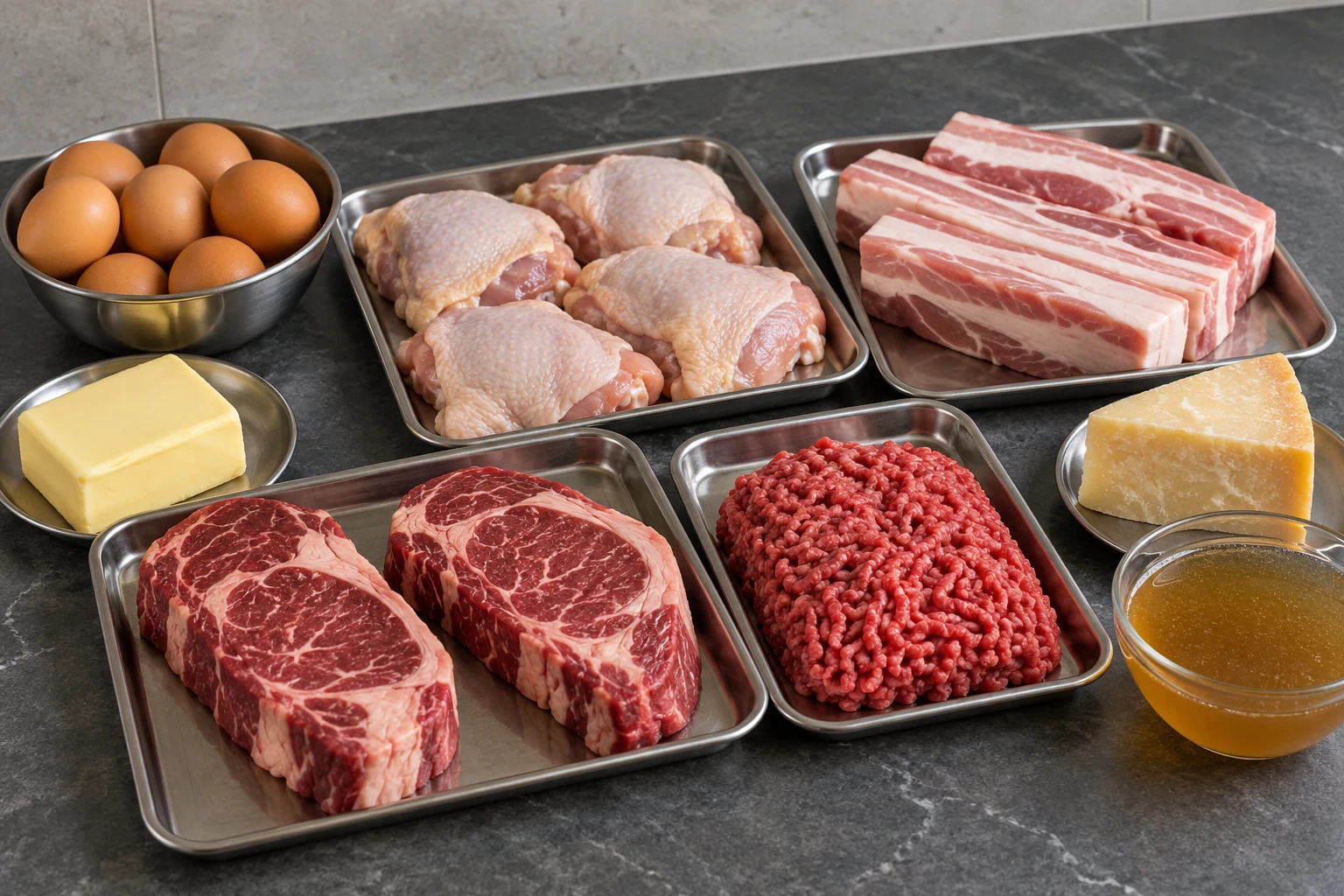
Ghee and rendered animal fats like tallow and lard solve the same basic problem in a kitchen built around animal products: a high-smoke-point fat for searing and frying that holds up to real heat. The two aren’t really competitors, more a matched set. Tallow and lard bring a savory, meat-forward flavor that suits a sear meant to taste like what you’re cooking, while ghee brings a lighter, nuttier flavor better suited to finishing a dish, basting, or anywhere butter’s flavor is wanted without butter’s low smoke point getting in the way. Keeping both on hand covers nearly every high-heat cooking situation without reaching for a seed oil at all.
A fresh cheese or a splash of heavy cream, meanwhile, is less about high heat and more about finishing: folded into pan sauce off the heat, or eaten plain as a dense, fast source of fat when a meal needs more of it and there’s no time to cook anything else.
Cottage cheese and ricotta deserve a specific mention here, because they solve a different problem than butter or ghee ever will: zero-cook, zero-prep bulk. Both come straight out of the tub ready to eat, with no pan, no heat, and no timing to get right, closer in convenience to a hard-boiled egg than to a cooking fat. On a day when nothing else is thawed and there’s no time to sear anything, a bowl of full-fat cottage cheese is a complete stopgap, not a compromise.
Visual steps