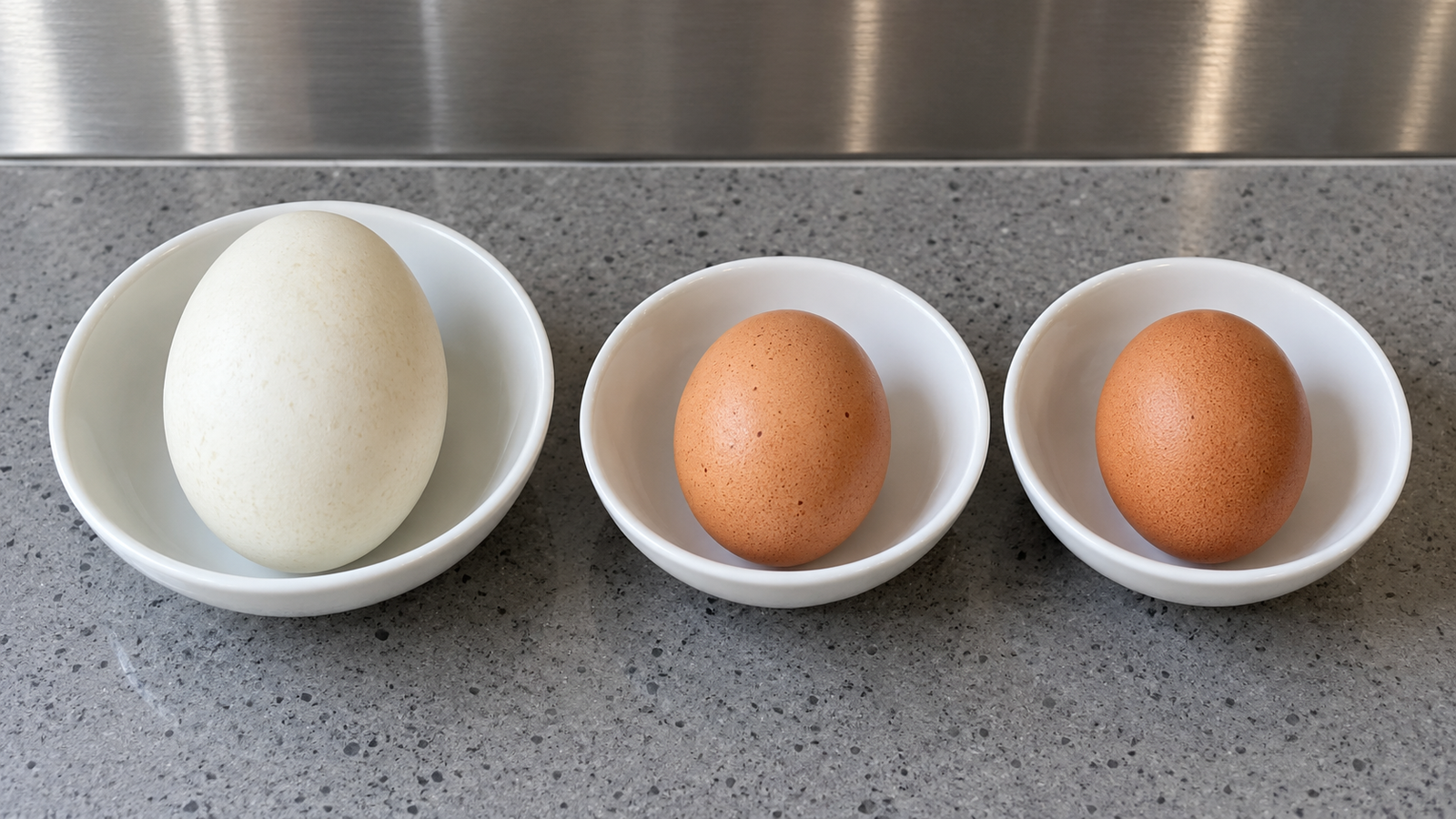
A duck egg sitting next to a chicken egg on the counter looks like a simple size upgrade, nothing more, and treating it that way is the single most common way to get a genuinely unexpected result somewhere in the kitchen. The size difference is real, but it is not the actual story. Duck eggs carry a genuinely different ratio of yolk to white, a richer fat content, and a different protein structure in the white, and each of those differences changes how the egg behaves well before it ever reaches a pan or a mixing bowl.
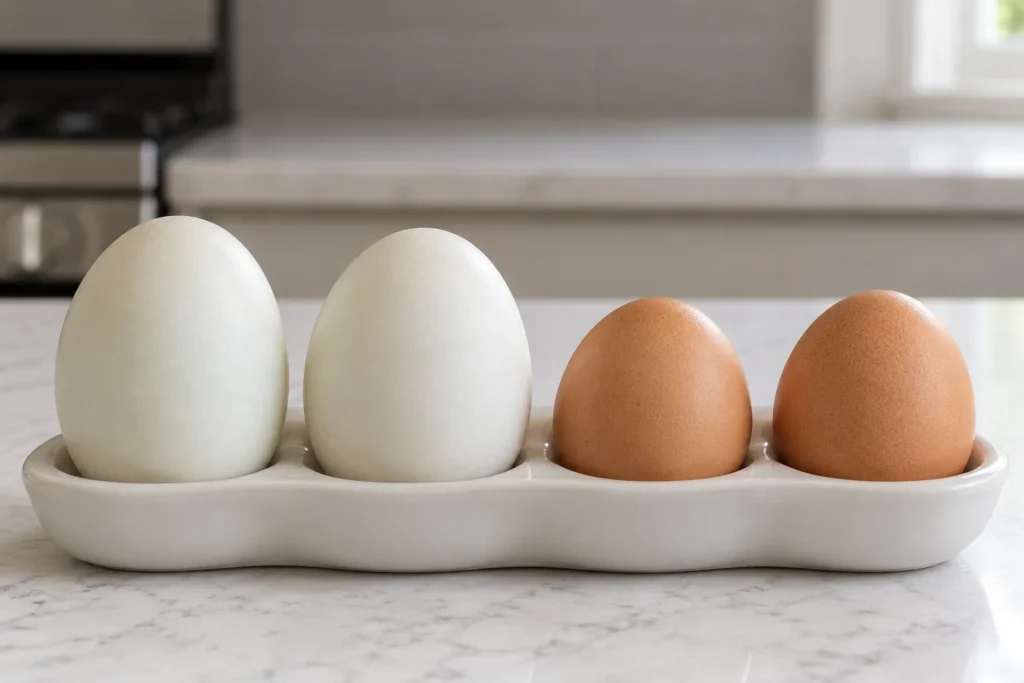
The size difference is the least interesting part
A duck egg typically weighs 25 to 35 percent more than a standard large chicken egg, which is a meaningful but fairly intuitive difference: more egg, roughly proportioned the same way. The part that actually surprises people is what happens to that extra volume once it is cracked open. A duck egg’s yolk makes up a noticeably larger share of the total egg than a chicken egg’s yolk does, which means the richness difference between the two is considerably bigger than the size difference alone would suggest.
| Chicken egg (large) | Duck egg | |
|---|---|---|
| Typical weight | About 50g | About 65 to 75g |
| Yolk share of total egg | Roughly a third | Noticeably higher, closer to 40 percent or more |
| Fat content | Standard | Meaningfully higher |
| Shell | Thinner, more porous | Thicker, less porous |
Why that extra fat changes everything it touches
Fat carries flavor and richness the same way it does in meat, and a duck egg’s higher fat content is the real reason people describe them as tasting noticeably richer and more custard-like than a chicken egg, not just bigger. That richness shows up most clearly in anything where the yolk is the star: a soft-boiled duck egg, a fried duck egg sunny-side up, or a carbonara-style sauce where the yolk is doing most of the work. In a straightforward scramble, where the egg is mixed and cooked through evenly, the richness difference is still noticeable but less dramatic than it is in a preparation that showcases the yolk directly.
The white behaves differently, and bakers notice first
Duck egg whites carry a different protein structure than chicken egg whites, generally described as thicker and more gelatinous even before cooking. That thicker structure is part of why duck eggs have a strong reputation in baking specifically: the extra protein and fat combine to produce a richer crumb and better structure in cakes and other baked goods, which is the main reason professional and dedicated home bakers specifically seek duck eggs out rather than treating them as simply a novelty.
That same thicker white behaves differently when whipped. Duck egg whites can be slower to reach full volume than chicken egg whites, since the denser protein structure takes more mechanical work to break down and incorporate air, but once whipped, they tend to hold a stable peak well. For a meringue or anything depending heavily on whipped whites specifically, this is worth knowing ahead of time rather than discovering mid-recipe that the whites are taking considerably longer to whip than expected.
Does a 1:1 substitution actually work
Swapping one duck egg for one chicken egg in a recipe is a common shortcut, and it works more often than it fails, but it is not a true like-for-like substitution given the real differences in size, fat, and protein covered above. A single duck egg in place of a single chicken egg generally adds more total volume and considerably more richness than the recipe’s original ratio accounted for, which shows up most noticeably in anything delicate, a light sponge cake or a simple scramble meant to taste clean rather than rich.
Weighing rather than counting is the more reliable approach for anything where precision actually matters. A reasonable rule of thumb worth keeping on hand: one duck egg replaces roughly one and a quarter to one and a half chicken eggs by volume, not a flat one-to-one swap the way the two might otherwise seem interchangeable, and adjusting other liquid ingredients slightly downward compensates for the duck egg’s extra moisture and fat if a recipe ends up tasting too rich or feeling too wet with a straight, unadjusted substitution.
Shell thickness changes handling, not just appearance
A duck egg’s shell is noticeably thicker and less porous than a chicken egg’s, a structural difference that affects more than how hard the egg is to crack. That lower porosity means a duck egg exchanges air and moisture more slowly through the shell than a chicken egg does, which is part of why duck eggs often keep slightly longer under proper refrigeration than chicken eggs of a comparable age. The thicker shell also means genuinely more effort to crack cleanly, and a firmer tap than a chicken egg needs is often required before the shell actually gives way, worth knowing so the first attempt is not mistaken for a particularly fresh or particularly tough individual egg.
A food-safety note specific to duck eggs
Ducks are commonly raised with outdoor access to ponds and wet ground in a way many commercial chicken operations are not, and that difference in environment is part of why food-safety guidance for duck eggs leans slightly more cautious than it does for standard commercial chicken eggs. Cooking duck eggs fully, rather than serving them raw or very runny the way a soft-boiled or sunny-side chicken egg is often served, is the more conservative and more commonly recommended approach specifically for duck eggs. This is a real distinction worth taking seriously rather than assuming identical handling applies across both.
Washing a duck egg’s shell just before use, rather than storing it already washed, follows the same logic that applies to any egg: washing removes a natural protective coating and should happen close to when the egg is actually used, not well ahead of time. Sourcing from a farm or seller that can answer direct questions about how the ducks are raised and how the eggs are handled after collection is worth more here than it is for a mass-produced chicken egg from a large commercial operation with standardized processing.
What actually changes in baked goods specifically
A cake or quick bread made with duck eggs in place of chicken eggs tends to rise slightly differently and bake into a denser, moister crumb, a direct result of the extra fat and the thicker, more protein-rich white working through the batter. Bakers who specifically seek out duck eggs for pastry and cake work are usually chasing that exact texture difference rather than treating it as an incidental side effect. A recipe built and tested specifically around duck eggs, rather than a chicken-egg recipe with a straight substitution dropped in, will generally produce a more predictable, more intentional result for anyone baking with them regularly.
Custards and curds in particular benefit from duck eggs’ higher fat and protein content, setting into a noticeably silkier, richer texture than the same recipe made with chicken eggs. The same overcooking risk that applies to any baked custard still applies here, and if anything duck eggs’ richer yolk makes the margin for error slightly tighter rather than more forgiving, since there is more fat and protein present to seize and separate if the bake runs too hot.
Where to actually find them
Duck eggs are rarely stocked at a standard supermarket the way chicken eggs are, since commercial duck egg production operates at a far smaller scale. A farmers market, a specialty grocer, or a local farm selling direct are the most realistic sources, and availability often varies seasonally depending on the specific flock being raised nearby. Asian grocery stores carry duck eggs with some regularity too, including salted and preserved versions used in specific traditional preparations, which are a separate product from fresh duck eggs and not a direct substitute for them in a recipe calling for fresh.
Price reflects that smaller-scale production: duck eggs typically cost noticeably more per egg than chicken eggs, sometimes two to three times as much, which is worth factoring in before committing to a recipe that calls for several of them.
Storing a duck egg once it’s home
Duck eggs generally keep comparably to chicken eggs once refrigerated, roughly three to five weeks from the pack or collection date, though the thicker, less porous shell covered earlier can give them a slight edge in how well they hold up over that window. Storing them the same way as chicken eggs, in the main body of the refrigerator rather than the door, in the carton rather than loose, applies here without any real adjustment needed.
Freezing works for duck eggs the same way it does for chicken eggs, with whole beaten eggs holding up better in the freezer than an attempt to freeze them in the shell. Given the higher price per egg, freezing a surplus from a larger farm purchase rather than letting extras go to waste is a genuinely practical habit for anyone buying duck eggs in any real quantity.
Other less common egg types worth knowing exist
Duck eggs are the most commonly available alternative to chicken eggs, but they are not the only one. Quail eggs run considerably smaller than chicken eggs, roughly a fifth the size, with a proportionally larger yolk-to-white ratio similar in spirit to the duck egg comparison above, just taken further in the same direction. They show up most often in specific preparations, pickled, soft-boiled as a garnish, or in some Asian cuisines, rather than as a general cooking substitute, largely because their small size makes them impractical for most recipes written around a standard chicken egg.
Goose eggs sit at the opposite extreme: considerably larger than even a duck egg, often two to three times the size of a chicken egg, with an even richer yolk and an even thicker shell. They are rare outside of specialty farms and a short seasonal window, and the size makes the same substitution math covered above even more important to get right, since a single goose egg can genuinely throw off a recipe’s proportions if treated as a simple one-for-one swap.
Cooking them simply, where the difference actually shows
A fried duck egg, cooked the same way as a well-handled chicken egg, sunny-side up with a runny yolk, is one of the clearest ways to actually taste the difference between the two, since the technique is simple enough that nothing else is masking the egg’s own character. The larger, richer yolk sits at the center of the whole experience here in a way it does not in a dish with many other ingredients competing for attention.
For scrambled eggs or an omelet specifically, duck eggs benefit from slightly gentler heat and noticeably more patience than chicken eggs typically do, since the thicker, richer mixture can scorch on the bottom before the rest has had a real chance to set if the pan runs too hot too early. The same low, patient heat that keeps a chicken egg scramble from turning rubbery matters even more here, simply because there’s genuinely more egg and more fat in the pan reacting to that heat all at once, with a smaller margin for recovery if things move too fast.
A single duck egg can comfortably serve as a filling breakfast on its own, cooked simply and without much else competing for attention, in a way a single chicken egg rarely quite manages at the same modest level of effort.
Mistakes worth avoiding on a first attempt
- Treating the substitution as a flat 1:1 swap in a precise recipe. Weighing the eggs and adjusting the ratio produces far more consistent results than counting eggs alone.
- Using high heat out of habit. The extra fat and protein in a duck egg scorch more easily than a standard chicken egg under the same aggressive heat.
- Buying preserved or salted duck eggs expecting them to work like fresh ones. These are a different product entirely, built for specific traditional dishes, not a general-purpose substitute.
- Assuming they keep exactly as long as chicken eggs. The thicker shell often means a slightly longer safe window, but assuming an identical timeline without checking is still a guess rather than a fact worth relying on.
Visual steps
