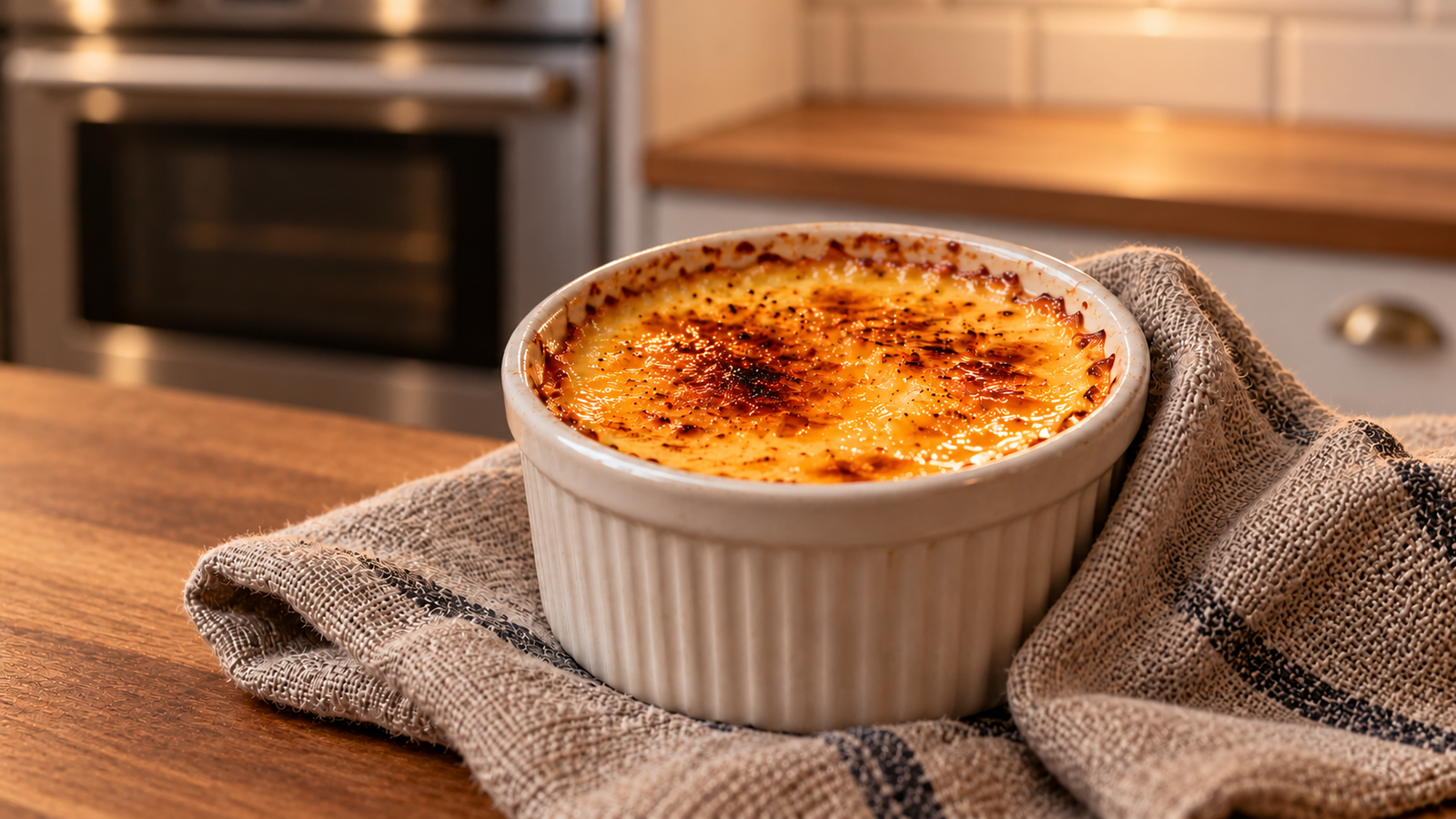
A quiche or a crustless baked custard comes out of the oven looking perfect, golden and set on top, and then the first slice weeps a pool of liquid onto the plate anyway. Or it holds together fine but eats dense and rubbery instead of silky, which feels like an entirely different failure even though it almost never is. Both outcomes trace back to the same underlying cause: the oven ran hotter, or the bake ran longer, than egg proteins can actually tolerate before they squeeze themselves dry.
What a baked custard actually is
A baked egg custard, whether it is a crustless quiche, a frittata finished in the oven, or a savory flan, is egg proteins setting around a liquid (cream, milk, or a dairy-free equivalent) and holding it in suspension rather than letting it separate out. Those proteins start linking together and firming up gradually as they warm, the same coagulation process that governs a soft-boiled egg or a gently scrambled one. The difference here is that the proteins are diluted by a large volume of liquid, which means the whole mixture needs considerably more time at a lower temperature to set evenly all the way through a deep dish.
Push the temperature too high and the proteins race past that gentle setting point. They tighten hard and fast, squeezing out the liquid they were supposed to be holding, which is exactly what produces that pool of watery liquid on the plate even when the top of the custard looked perfectly done going into the final minutes.

The ratio that actually determines texture
A workable starting ratio for a savory baked custard is one whole egg to roughly a half cup of dairy liquid. Too little liquid relative to egg and the result sets firm and rubbery almost no matter how carefully it is baked, since there simply is not enough liquid in the mix to keep the structure soft. Too much liquid and the custard struggles to set at all within a reasonable bake time, staying loose and underdone in the center long after the edges have firmed.
| Egg to liquid ratio | Result |
|---|---|
| 1 egg to 1/4 cup liquid | Dense, firm, more rubbery than silky |
| 1 egg to 1/2 cup liquid | The reliable target for a silky, sliceable custard |
| 1 egg to 3/4 cup or more liquid | Loose, slow to set, risks staying underdone in the center |
Oven temperature is the single biggest lever
A standard 350°F oven is already too aggressive for a deep custard dish, even though it is a completely reasonable temperature for plenty of other baking. Somewhere around 325°F gives the proteins enough time to set gradually rather than seizing, and for a particularly deep or rich custard, dropping to 300°F and accepting a longer bake produces a noticeably smoother final texture. The tradeoff is time: a gentler oven takes longer to finish the center, which is exactly the patience that actually prevents the dry, weeping result in the first place.
A water bath, and when it genuinely matters
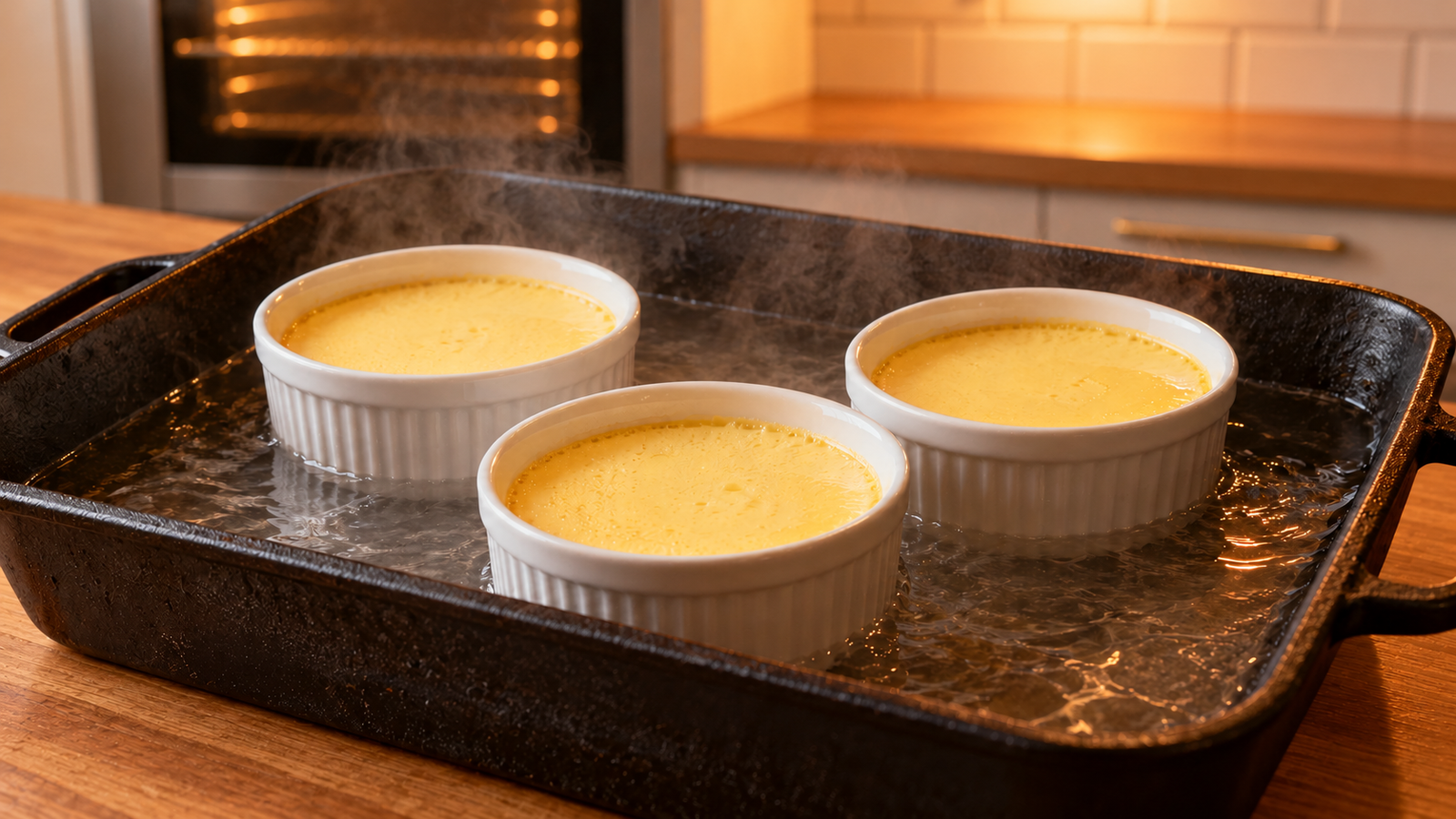
Setting the baking dish inside a larger pan filled partway with hot water insulates the custard from the oven’s direct, harsher heat, keeping the outer edge from overcooking long before the center catches up. This matters most for a deep, straight-sided dish where the distance from edge to center is considerable, less so for a shallow, wide dish like a typical quiche where that distance is already short. For a crustless quiche baked in a standard pie dish, a careful oven temperature alone is usually enough; for a deeper custard, a flan, or anything baked in a tall ramekin, the water bath genuinely earns its extra step.
The water should sit roughly halfway up the sides of the custard dish and stay hot, not boiling, throughout the bake. A pan of water that is still cold when the custard goes into the oven defeats the purpose, since it takes time to come up to temperature itself and does not insulate anything during that lag.
Knowing when it is actually done
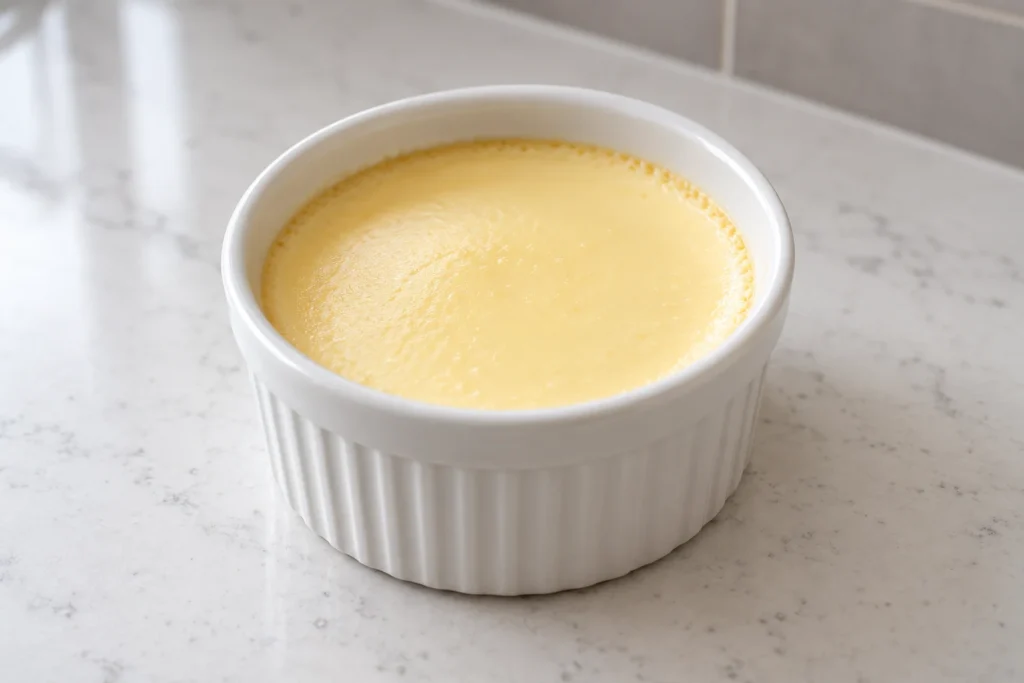
A fully set custard should have a slight, deliberate jiggle in the very center when the dish is nudged gently, not a liquid wobble that sloshes visibly, and not perfectly rigid and still either. Pulling it the moment the center stops looking actively liquid, rather than waiting for it to look completely still and settled, accounts for carryover cooking: residual heat keeps firming the custard for several more minutes after it leaves the oven entirely, and a custard pulled at what looks like “completely set” while still inside the oven is usually already overdone by the time it has fully cooled on the counter afterward.
This same logic, trusting the carryover rather than chasing a perfectly still center in real time, is the exact same patience that governs a properly rested steak or a pulled brisket. The specific mechanism differs, but the underlying lesson about pulling food from heat slightly before it looks fully finished repeats constantly across very different techniques for a genuine, consistent reason.

A thin knife inserted an inch or so from the center is a more precise check than the jiggle test alone. It should come out mostly clean with perhaps a faint trace of moisture, not wet custard clinging to the blade, and not bone dry either.
Which dairy actually changes the result
The specific liquid chosen for a custard changes both richness and how forgiving the bake is. Whole milk produces the lightest, least rich custard and also the one most prone to a watery texture if the bake runs even slightly too hot, since there is comparatively little fat to buffer against that overcooking. Heavy cream, at the other end, produces a noticeably richer, more stable custard that tolerates a bit more margin for error, since the higher fat content slows how fast the proteins seize and helps carry more of the structure even if the bake runs a touch long. Half-and-half sits in between, and is a reasonable default for anyone without a strong preference either way.
| Dairy used | Result | Forgiveness |
|---|---|---|
| Whole milk | Light, less rich | Least forgiving; overcooks into watery texture easily |
| Half-and-half | Balanced richness | A reasonable middle ground |
| Heavy cream | Rich, dense, silky when done right | More forgiving of a slightly long bake |
Mixing two eggs with a yolk or two extra added on top of the base ratio is a common way to boost richness without changing the liquid at all, since yolks carry fat and emulsifying proteins that whites alone do not. A custard built entirely from whites, by contrast, sets firmer and leaner, with none of the silky quality that makes a well-made quiche feel indulgent rather than merely cooked through.
Straining, a small step that fixes a surprisingly common problem
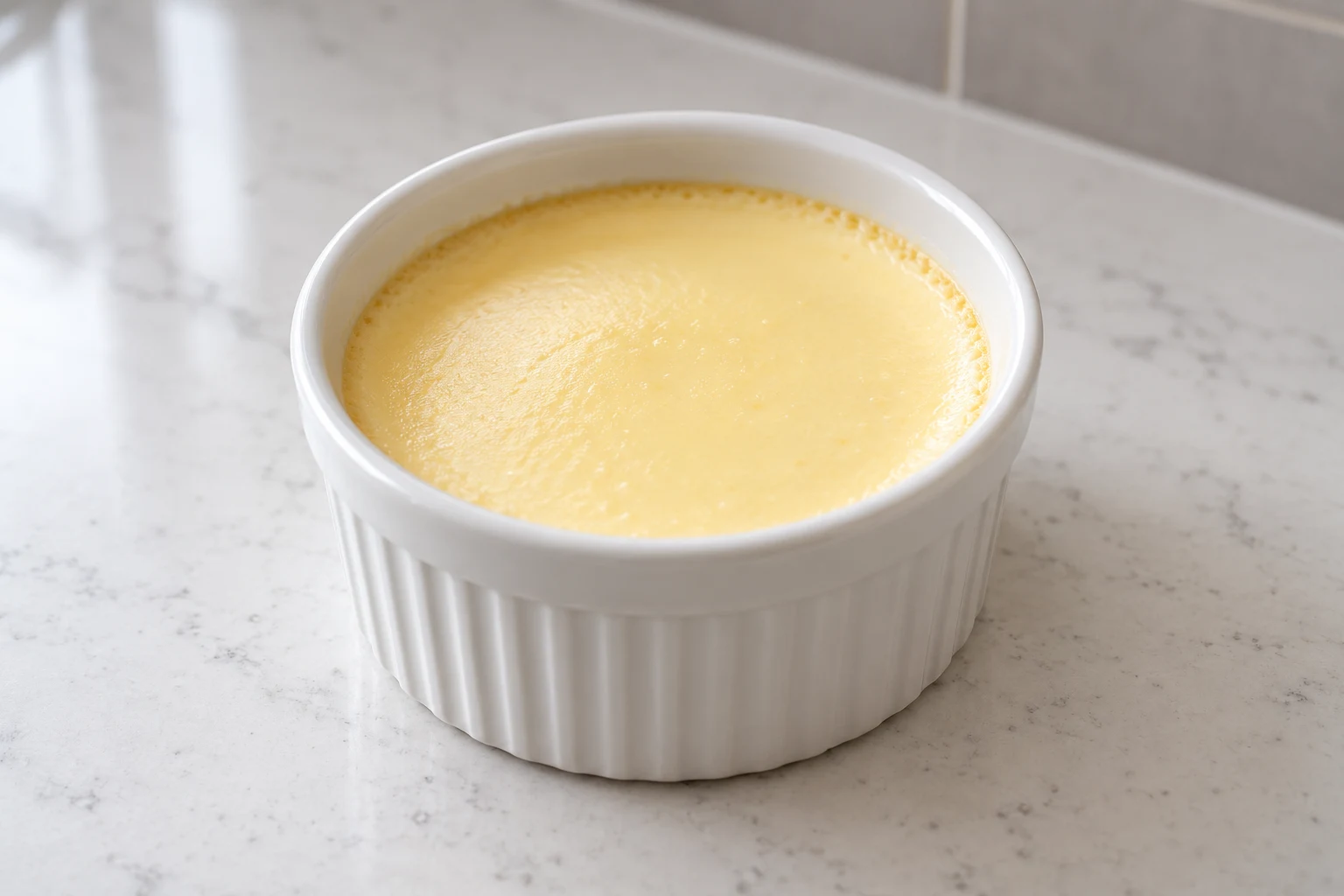
Whisking eggs and dairy together inevitably creates small bits of coagulated egg white that never fully blend into the liquid, along with occasional air bubbles. Passing the mixture through a fine-mesh strainer before it goes into the dish catches both, and the difference shows up directly in the finished texture: a strained custard bakes into a noticeably smoother, more uniform result than an unstrained one, where small lumps and air pockets can create uneven texture even when the overall temperature and timing were handled correctly. This step takes under a minute and is worth building into the habit rather than skipping it as optional.
Scaling up without breaking the ratio
Doubling or tripling a custard recipe for a crowd works cleanly as long as the egg-to-liquid ratio scales proportionally, which the measurements above are built to do directly. What does not scale as cleanly is the bake time: a larger dish with more total volume and a greater distance from edge to center needs meaningfully longer in the oven than the math might suggest, not simply the same percentage increase as the ingredient volume. Checking a larger custard’s doneness the same way as a smaller one, by nudging for a slight center jiggle and confirming with a thin knife near the center, remains the reliable method regardless of batch size; trusting a scaled-up time estimate alone risks pulling a larger dish before the center has actually caught up.
Mistakes that show up again and again
- Baking at a standard 350°F or higher out of habit. This is the single most common cause of a rubbery, weeping custard, since it pushes the proteins past their gentle setting range.
- Overbaking because the center still looks slightly loose. Carryover cooking finishes the center after the dish leaves the oven; waiting for zero wobble in the oven itself almost guarantees overcooking.
- Skipping the water bath on a deep dish. A shallow quiche can usually get away without one, but a deep custard dish without that insulation overcooks at the edges before the center sets.
- Adding mix-ins straight from the fridge. Cold vegetables or cheese stirred into a custard right before baking drop the overall mixture’s temperature and extend the bake unevenly, which can leave pockets that cook differently than the rest of the dish.
- Using the wrong egg-to-liquid ratio for the dish’s depth. A deeper dish generally wants a slightly higher proportion of egg relative to liquid than a shallow one, simply to help it set through that greater distance.
Storing and reheating it without redoing the damage
A properly set custard keeps for three to four days refrigerated, covered to keep the surface from drying out. Reheating it carelessly is one of the most common ways to ruin a custard that came out of the oven perfectly the first time: a microwave on full power drives the same overcooking reaction that ruined a too-hot first bake, just compressed into a minute or two instead of thirty. A low oven, around 300°F, loosely covered with foil, brings a slice back to temperature far more gently, and a few minutes is usually enough for a single portion rather than the full original bake time.
Serving a custard cold or at room temperature, rather than reheating it at all, sidesteps the reheating risk entirely and is a completely legitimate way to eat a quiche or a savory flan the next day. Plenty of versions of this dish are traditionally served that way regardless of leftovers.
Resting it before the first slice
A baked custard genuinely benefits from sitting for ten to fifteen minutes after it leaves the oven, longer than the brief rest a seared steak gets but working on the same underlying principle: the structure is still settling, and cutting into it immediately disrupts that process before it finishes. A custard sliced the moment it comes out of the oven is far more likely to spill liquid than the same custard sliced after a short rest on the counter.
Mix-ins carry their own moisture, and that matters
Vegetables, especially watery ones like mushrooms, spinach, or zucchini, release a meaningful amount of liquid as they cook, and that liquid does not disappear once they are folded into a custard raw. It leaches out during the bake and dilutes the custard right at the spots where that vegetable sits, which is a common, specific cause of a soggy patch in an otherwise properly set dish. Cooking watery vegetables separately first, until most of their moisture has already evaporated off in a pan, before adding them to the egg mixture, removes this problem at the source rather than fighting it inside the oven.
Meat and cheese mix-ins behave differently and generally need less pre-treatment, though a cheese with a high moisture content, fresh mozzarella in particular, can contribute some of the same watery-patch problem if used in large amounts. A firmer, lower-moisture cheese, shredded rather than left in thick slices, distributes more evenly through the custard and interferes less with how it sets.
Where this fits with the rest of the egg techniques on this site
This is a slower, gentler cousin of the same coagulation mechanism covered in the basic buying and cooking guide, just applied to a much larger volume of diluted egg held in an oven rather than a hot pan. The patience this method asks for is closer in spirit to a reverse sear than to a quick scramble: low, controlled heat and a willingness to pull the dish a little before it looks completely finished, trusting carryover to close the gap.
Visual steps
