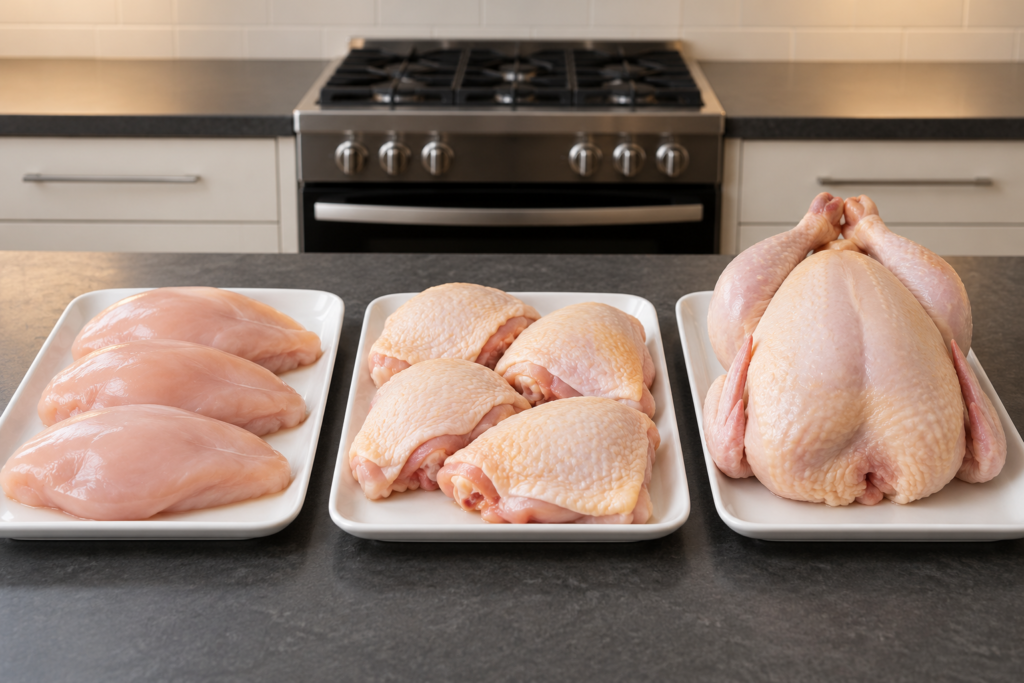
Chicken is the most forgiving bird on this site and the one people still manage to get wrong most often, usually by treating the breast and the thigh as the same piece of meat with different names. They are not. One carries almost no fat and punishes a few extra minutes on the heat; the other carries enough fat and connective tissue to shrug off real mistakes and actually improve well past the minimum safe temperature. Nearly everything in this category comes back to that one distinction, in one form or another.
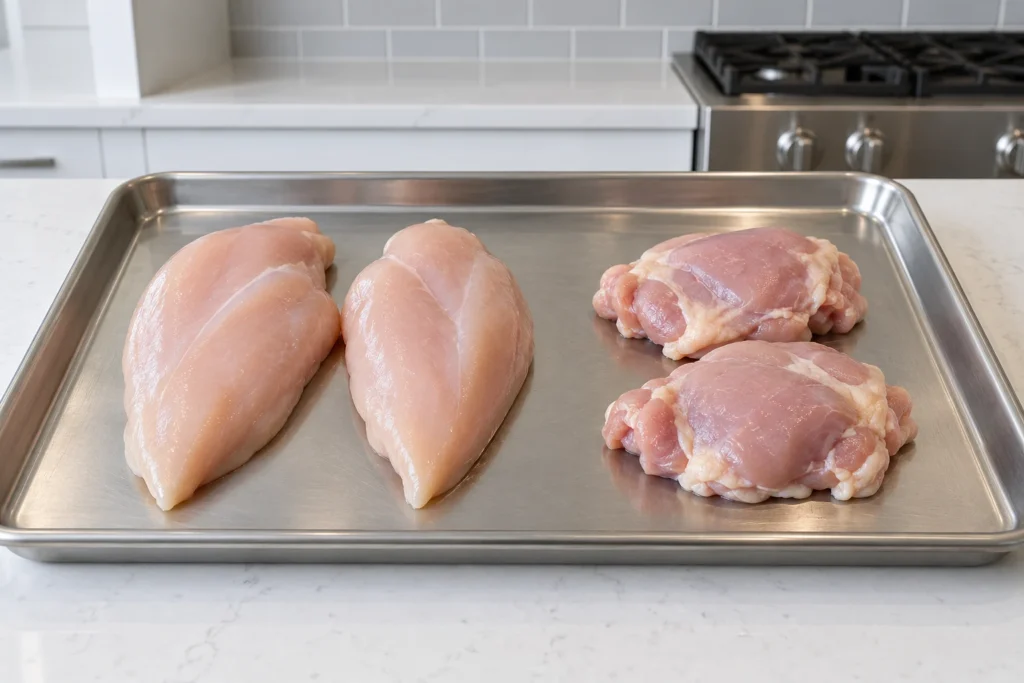
White meat: the cut with no margin for error
Why chicken breast turns out dry, and how to stop it is the real starting point here: the exact pull temperature that actually works, why an uneven thickness is usually the real culprit behind one bite being perfect and the next bite dry, and the pan, oven, and poaching methods that each handle that narrow margin differently. If chicken breast has a consistent bad reputation at a given table, this is where that reputation gets fixed.

Roasting a whole chicken when the breast and legs won’t cooperate takes the same underlying tension and applies it to an entire bird at once, where the breast and legs are physically attached and have to be solved together rather than separately. It’s a genuinely different problem than cooking a breast on its own, and worth reading specifically when the whole-bird version of this conflict is the actual question.
Dark meat and the parts built to be forgiving
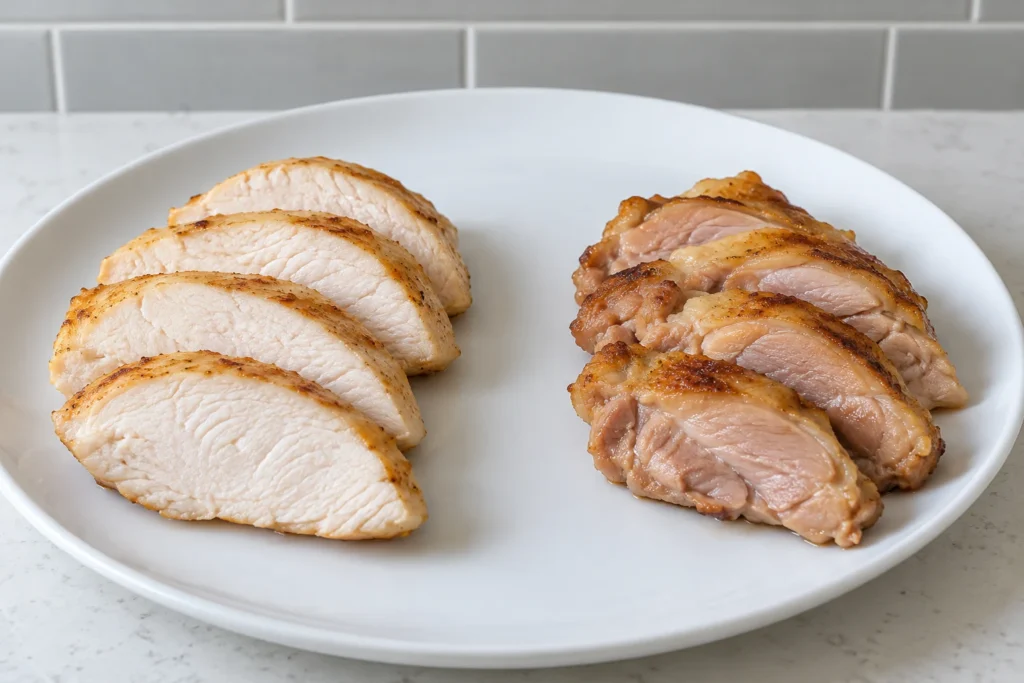
Chicken thighs are safe at 165°F, and better past 180°F explains the mechanism behind that forgiveness directly: real fat and connective tissue that keeps improving in texture well past the point where a breast would already be dry. It’s the clearest contrast to everything above, and worth reading right alongside the breast guide specifically to see the same heat doing two different things to two different kinds of muscle.

Chicken wings that crisp instead of steam covers a smaller, high-fat part that fails for a completely different reason than either of the above: too much surface moisture trapped against the skin, not an internal temperature problem at all. It’s the one post in this category that’s really about surface texture rather than doneness.
The underlying difference, side by side
| Breast (white meat) | Thigh and leg (dark meat) | |
|---|---|---|
| Fat content | Very low | Meaningfully higher |
| Safe minimum | 165°F, and that’s close to the texture ceiling too | 165°F, but keeps improving well past it |
| Margin for error | Narrow, a few degrees matters | Wide, genuinely forgiving |
| Best suited to | Quick, precise cooking with a thermometer in hand | Slower cooking, braising, or anywhere timing is approximate |
That table is really the entire category in miniature. Every post above is either explaining how to work within the breast’s narrow window or explaining why the thigh and leg don’t have that same problem in the first place.
Buying it with the right cut already in mind
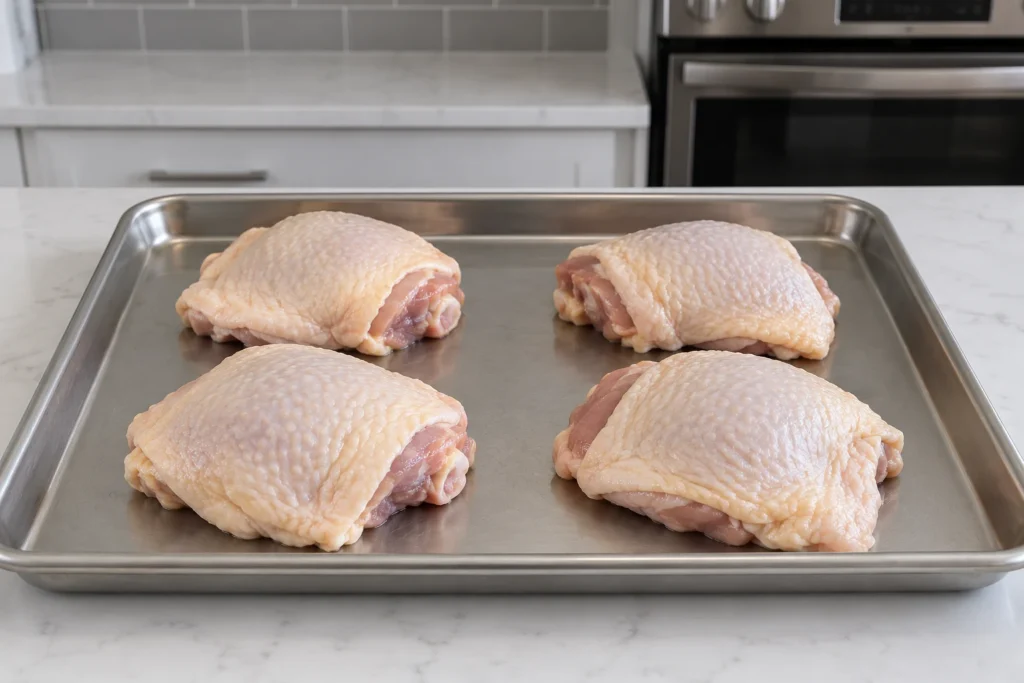
Bone-in parts generally cost less per pound than boneless, skinless cuts of the same bird, since the butchering labor that produces a boneless cut gets priced into it. Bone-in also holds moisture more reliably during cooking: the bone slows heat transfer through the center, and skin, left on until after cooking even if it won’t be eaten, acts as a physical barrier against direct, drying heat. For anyone who’s struggled specifically with dry chicken breast, switching to bone-in, skin-on breast for a few attempts is a genuinely useful way to separate a technique problem from a starting-cut problem.
A whole chicken, broken down at home rather than bought as pre-cut parts, is almost always the better per-pound value of all, and it comes with a carcass worth turning into broth afterward, which a package of pre-cut parts never provides.
Reading the label without getting distracted by it
“Free-range” means a bird had some access to the outdoors, which can range from a genuinely open pasture to a small door that’s technically unlocked; the label alone doesn’t distinguish between those two very different realities. “Organic” requires organic feed and outdoor access under a real certification standard, a more verifiable claim than free-range on its own. “Air-chilled” describes the processing method (cooled with air rather than a chilled water bath), which tends to leave less water weight in the final product and a drier surface that browns and crisps more readily in a hot pan, a genuinely useful detail for anyone chasing crispy skin or a hard sear specifically. None of these terms say anything about flavor on their own; they describe how the bird was raised and processed, and the actual cooking still does the rest of the work.
Size matters for planning more than people account for. A smaller bird, often labeled a “fryer,” cooks faster and more evenly than a large roaster, simply because there’s less mass for heat to travel through to reach the center. For a first attempt at any whole-bird technique in this category, a smaller bird is the more forgiving starting point.
Handling raw chicken safely, regardless of which cut
Raw chicken carries a real risk of cross-contamination that applies the same way across every cut covered in this category. A separate cutting board and knife for raw poultry, never the same board used for anything eaten raw afterward, is the single most important habit. Wash hands, surfaces, and any utensil that touched raw chicken with hot soapy water before they touch anything else, and never rinse raw chicken under the tap, since that spreads bacteria-carrying water droplets around a sink rather than removing anything useful. None of the technique guides above repeat this discipline individually; it applies to all of them equally, every time.
Where to start
Cooking mostly boneless breast on a regular basis: start with the breast guide, since that single piece solves most of what goes wrong across every method. Working with a whole bird or bone-in parts most of the time: the thigh and whole-roast posts matter more, since dark meat behaves closer to how most other meat on this site behaves, forgiving of a slightly late pull rather than punishing it. Cooking a whole bird specifically for the crispy-skin result: the wings post explains the surface-moisture mechanism that applies there too, just scaled up to an entire bird. Either way, the underlying lesson is the same: chicken is not one ingredient with one set of rules, it’s at least two, and treating them identically is where most chicken goes wrong before the pan is even hot.
Mistakes that show up across every cut in this category
- Trusting color instead of a thermometer. Chicken can look fully opaque well before it’s actually reached a safe temperature, and the reverse is also true on bone-in cuts near the joint. A reliable instant-read thermometer settles the question a visual check can’t, on any cut covered here.
- Cooking straight from the fridge. A cold center takes longer to come up to temperature on any chicken cut, which gives the outside more time to overcook or the skin more time to turn rubbery before the inside catches up. Letting meat sit at room temperature for 15 to 20 minutes before cooking applies just as much to a whole bird as it does to a single breast.
- Flipping or checking too often. Every time a pan or oven is opened, heat escapes and the surface loses the chance to actually brown. This shows up across wings, breast, and whole-bird roasting alike.
- Skipping the rest. A rested piece of chicken, breast or thigh, holds its juices better than one cut into immediately off the heat. The margin matters more on breast specifically, but the principle holds everywhere in this category.
Where to start
A default that works on a night with no real plan
Bone-in, skin-on thighs, salted at least 30 minutes ahead and seared skin-side down in a hot pan before finishing in a 400°F oven until they hit 175°F or so, cover most of what makes this category approachable on a weeknight with no extra planning. The fat and connective tissue in a thigh absorb the kind of timing imprecision a rushed weeknight actually produces, which is exactly why it’s the more reliable default than breast on a night where attention is already split three other ways. Breast earns its place once the technique in the dedicated guide above has actually been read and practiced once or twice; thighs work from day one.
This is a technique overview, not a food-safety substitute. Always cook chicken to a safe internal temperature using a reliable thermometer. Reference: USDA/FoodSafety.gov safe minimum cooking temperatures.
Visual steps