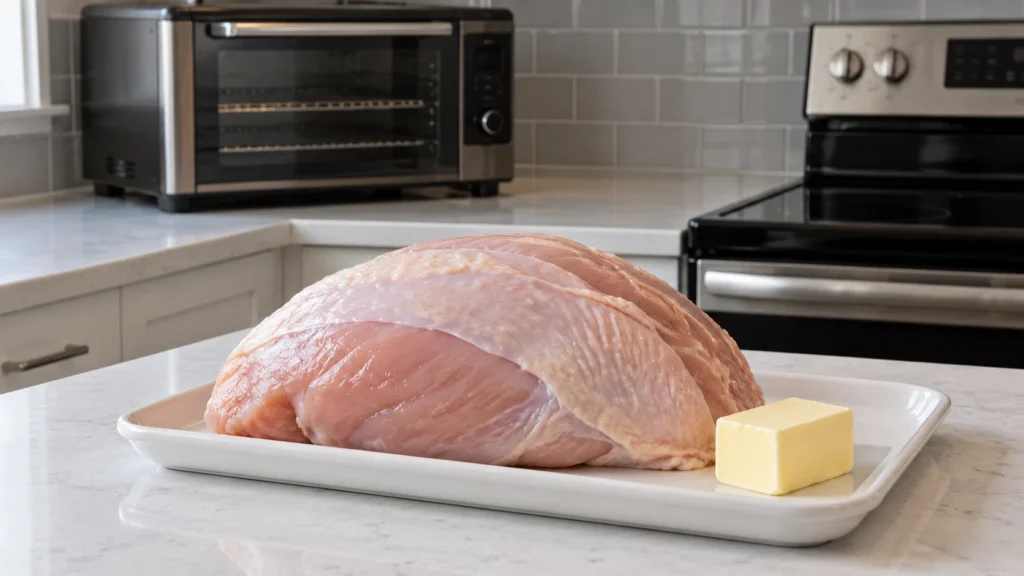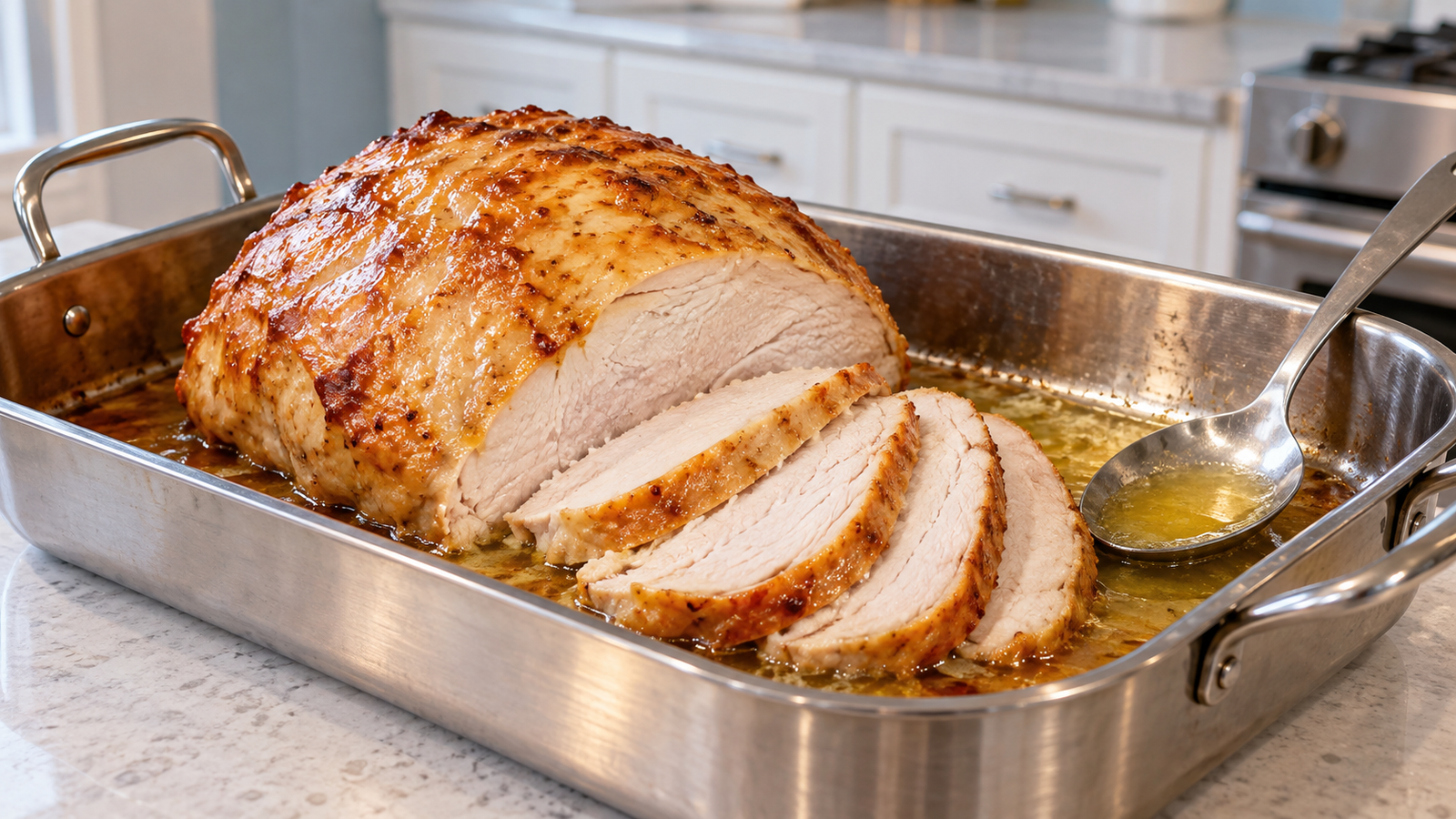
The turkey breast comes out of the oven looking perfect — golden, tight-skinned, exactly the color every photo promises. You slice into it anyway expecting dry meat, because that is what a turkey breast has always been for you. This time the knife goes through clean and the slice holds a bead of juice at the edge. The difference is not the oven. It is what you did to the outside of that bird every fifteen minutes while it cooked.
Butter-basting is not a trick for flavor alone, though it does that too. A whole turkey breast is almost entirely lean muscle with a thin skin and very little subcutaneous fat underneath to protect it, which is exactly why it dries out faster than a thigh or a whole bird with its legs still attached. Repeated butter does two things a dry roast cannot: it keeps the skin supple enough to crisp instead of crack, and it lays a thin barrier of fat over muscle that otherwise has none of its own. If you have already read our piece on why a turkey breast alone beats cooking a whole bird, this is the method that makes good on that argument.
What You Need
This is a short list on purpose. A turkey breast roast does not need anything beyond the bird, fat, and salt to be worth making.
- 1 bone-in, skin-on turkey breast, 5–7 lbs
- 6 tablespoons unsalted butter, divided
- Coarse salt
- A light crack of black pepper, if you like it
- 1 cup turkey or chicken bone broth (for the pan, optional but recommended)
Skip anything that tells you to rub the skin with a paste of herbs and citrus zest. None of that changes how the meat cooks, and on this site we are not reaching for a spice rack or a vegetable bin to make meat taste like meat. Butter, salt, and heat are doing all the real work here.
Salt It the Night Before If You Can
Pat the breast dry, salt it generously on the skin and underneath where the bone meets the meat, and leave it uncovered on a rack in the refrigerator overnight. This is the same logic laid out in our guide to salting meat early: the salt draws moisture to the surface, dissolves back into it, and gives the muscle time to reabsorb a brine it made for itself. Twelve hours is enough to notice the difference in both seasoning and how the skin crisps. If you only have an hour, salt it anyway and move on — it still helps, just less dramatically.
The Method, Start to Finish
- Pull the turkey breast out of the refrigerator an hour before cooking so it is not stone cold going into the oven. Pat the skin dry again — a dry surface is what actually crisps.
- Preheat the oven to 325°F (163°C). Set the breast skin-side up in a roasting pan or a heavy skillet with the bone side down. Pour the bone broth into the bottom of the pan, not over the meat.
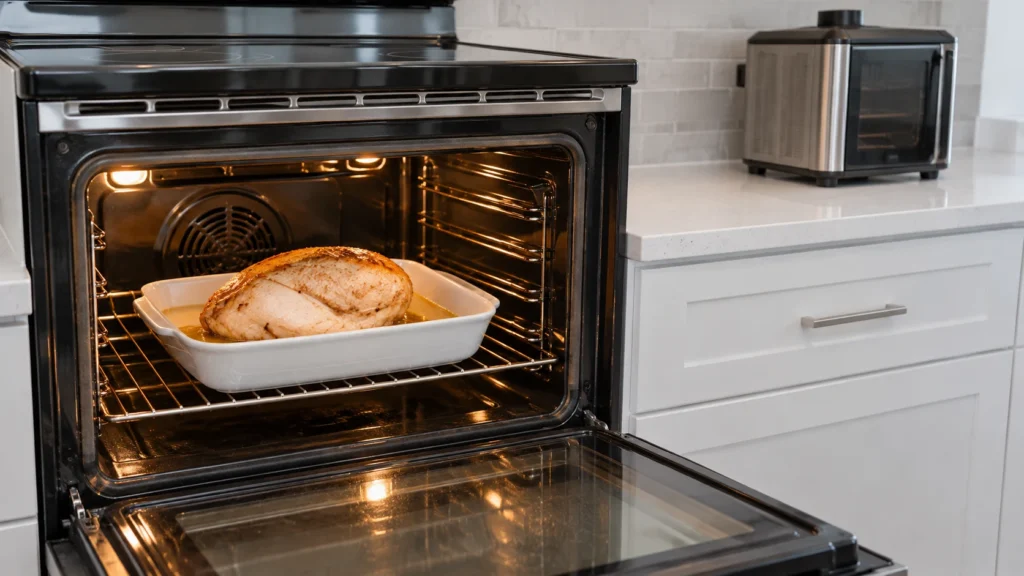
- Melt 2 tablespoons of butter and brush it over the entire skin before the pan goes in. This first coat is what starts the browning.
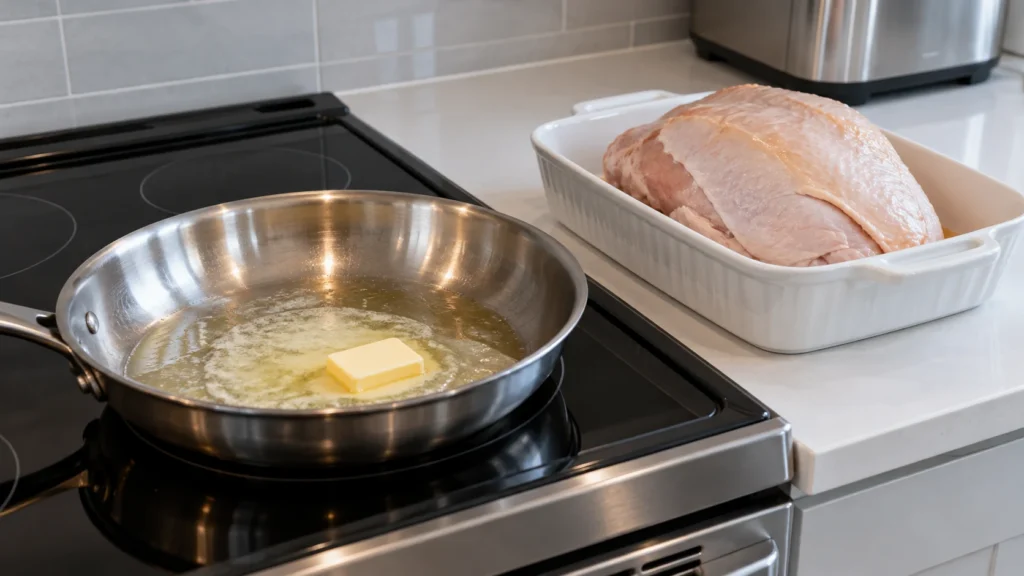
- Roast for 20 minutes, then begin basting. Melt the remaining butter and, every 15 minutes, spoon or brush it over the skin, working in the pan drippings as they collect. Baste four to five times over the course of the roast.
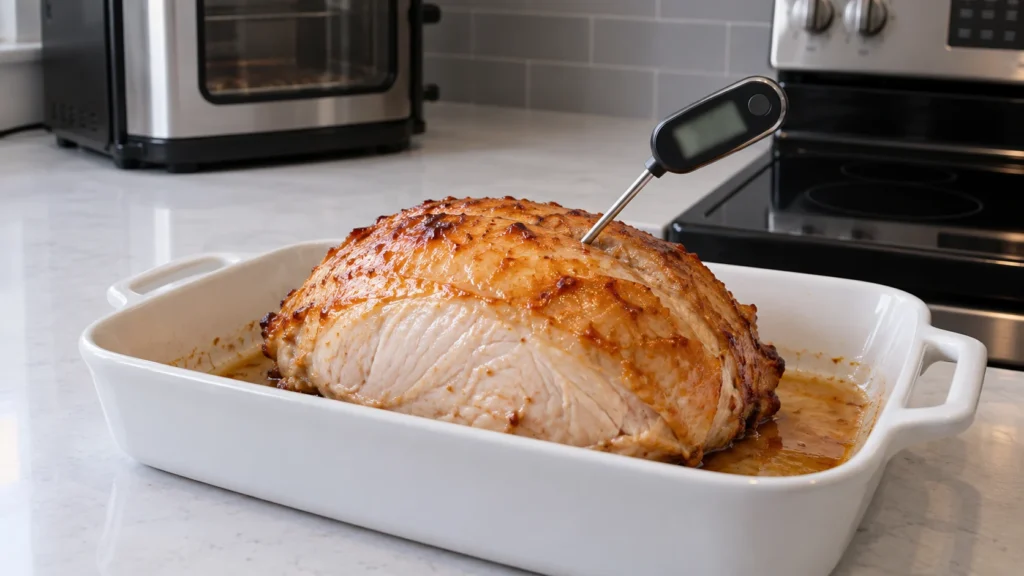
- At the 60-minute mark, start checking internal temperature at the thickest part of the breast, away from the bone, which reads hotter and will give you a false number.
- Pull the turkey at 160°F (71°C). It will carry over to a safe 165°F (74°C) while it rests, and pulling it a few degrees early is what keeps the final texture from crossing into dry.
- Tent loosely with foil and rest for 20 minutes before carving. Do not skip this — a turkey breast this size is still equalizing its internal temperature and redistributing juice for a full twenty minutes after it leaves the oven.
A 6-pound bone-in breast at 325°F generally takes 1 hour 20 minutes to 1 hour 45 minutes total. Go by the thermometer, not the clock — oven calibration and the exact shape of the breast will shift that window by 20 minutes in either direction.
Why the Low Oven Matters
A hotter oven browns the skin faster, which feels like progress, but it also drives moisture out of the lean breast meat faster than the inside can finish cooking evenly. See our explainer on matching cooking method to the cut for the longer version of this argument: lean, low-fat muscle rewards a gentler approach because there is no buffer of fat to absorb a mistake. At 325°F, the butter basting does the browning work that a 425°F oven would otherwise force the meat itself to do, and the turkey has time to cook through gently instead of racing the clock.
Reading the Temperature Right
| Internal temp at pull | What happens on the rest | Result |
|---|---|---|
| 150°F | Carries over to roughly 155°F — under the safe floor | Not done; return to the oven |
| 160°F | Carries over to 165–167°F | Safe, and the sweet spot for moist breast meat |
| 168°F | Carries over to roughly 172°F | Safe but noticeably drier — the margin for lean breast meat is narrow |
The USDA’s Food Safety and Inspection Service sets 165°F as the minimum safe internal temperature for all poultry, measured in the thickest part of the meat. Unlike a thigh, which keeps improving in texture well past that number, a lean breast is at its best right around the safety floor and gets worse the further past it you go. That narrow window is the entire reason basting and the low oven matter as much as they do here — they buy you margin on a cut that does not have much of its own.
Equipment That Actually Helps
You do not need much here, but three things make the difference between a basted roast and a frustrating one. An instant-read digital thermometer is not optional — the pop-up timer that comes stapled to some store-bought breasts is calibrated for a worst-case guess, not for pulling meat at exactly 160°F, and it will cost you the narrow margin this whole method depends on. A roasting pan with a V-rack or at least a flat rack keeps the skin out of the pooling drippings, which matters because skin sitting in liquid steams instead of crisping, undoing everything the basting was supposed to accomplish. A silicone pastry brush works better than a spoon for basting — it moves melted butter over the full curve of the breast in one pass instead of dumping it in one spot and letting gravity do an uneven job.
If you are working with a rimless or shallow pan, raise the temperature risk of flare-ups by keeping the bone broth topped up rather than letting the pan run dry — butter and rendered fat alone can scorch against a hot metal surface once the liquid under them disappears, and a scorched pan bottom will taste bitter in the drippings you are planning to pour over the finished meat.
Common Mistakes That Undo the Basting
- Basting too often. Opening the oven every five minutes drops the internal temperature repeatedly and can add 20 minutes or more to total cook time without improving the result. Four to five bastes over the full roast is the right frequency — more is just heat loss.
- Basting with cold butter straight from the fridge. A cold pour shocks the skin and takes longer to spread evenly. Melt it first, every time, even if that means a small saucepan staying warm on the stovetop for the full hour.
- Trusting the clock over the thermometer. Breast size, bone structure, and oven calibration all shift timing by 15 to 25 minutes in either direction. A breast that looks done at 70 minutes might still read 145°F in the center.
- Skipping the rest because the table is waiting. Carving immediately releases most of the juice you worked for onto the cutting board instead of back into the meat. Twenty minutes under foil is not a suggestion here — it is the last and easiest step in the whole method, and skipping it undoes real work from the hour before it.
- Measuring temperature against the bone. Bone reads hotter than the surrounding muscle and will tell you the meat is further along than it actually is. Always pull the probe tip toward the thickest part of the flesh itself.
Frequently Asked Questions
Can I use a boneless turkey breast instead? Yes, and it will cook noticeably faster — start checking temperature at the 40-minute mark instead of 60. The bone in a bone-in breast slows heat penetration near the center, which is part of why it holds moisture slightly better than a boneless roast of the same weight.
Why does my skin tear when I try to baste it? This usually means the skin was still wet when it went into the oven, or the first baste happened before any crust had formed. Pat the skin fully dry before the first butter brush and let the first 20 minutes in the oven pass undisturbed so a light crust sets before you touch it again.
Is it safe to use the pan drippings if some turkey juice dripped into them raw? Yes, as long as the finished drippings are at or above the pan’s cooking temperature for the remainder of the roast — which they will be, since they sit in a 325°F oven alongside the meat for the full hour-plus. The same heat that cooks the turkey pasteurizes anything that drips into the pan beneath it.

Can this method work on a whole turkey, not just the breast? The basting logic still applies, but a whole bird’s legs and thighs want a higher internal pull temperature than the breast does, which is exactly the mismatch that makes a separate breast roast easier to get right in the first place.
Carving and Serving
Let the breast finish resting on a cutting board with a slight well cut around the edge to catch juice, or set it on a rimmed board. Slice against the grain, working from one side of the breastbone outward, in pieces about a third of an inch thick. Save every drop of what collects in the pan — that liquid is rendered turkey fat, butter, and bone broth that has been concentrating in the bottom of the pan for over an hour, and it is better poured over the sliced meat than anything you could make from scratch in the time you have left.
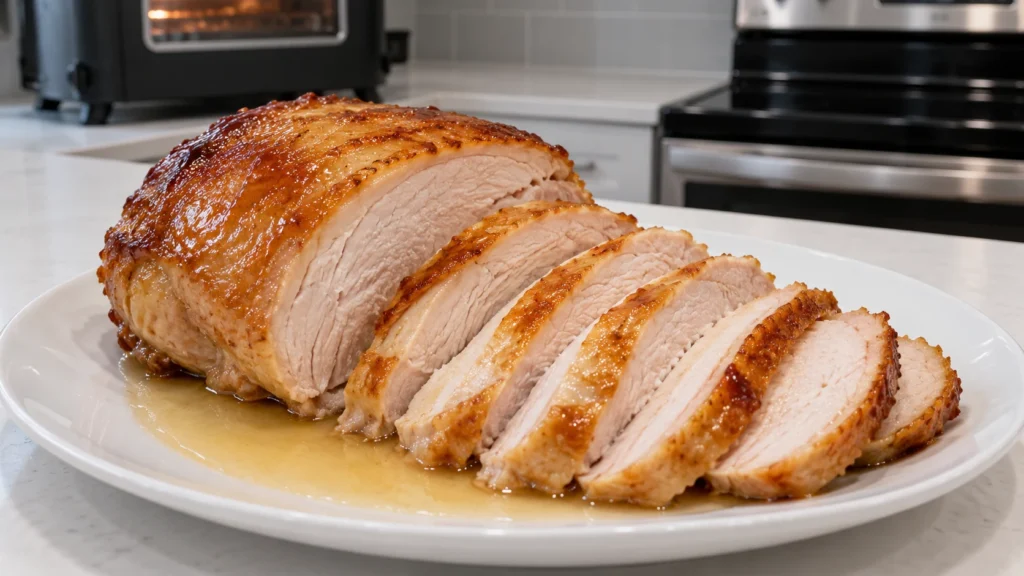
If the skin has gone slightly soft from basting liquid pooling under it anywhere, run the whole pan under a broiler for 60 to 90 seconds right before serving, watching it the entire time. This recovers crispness fast without touching the temperature of the meat underneath, since broilers work almost entirely on the surface.
Storing and Reheating
Carve what you plan to eat within three or four days and refrigerate it in the reserved pan drippings, which keeps the slices from drying out in storage the way plain refrigerated turkey breast reliably does. Reheat gently, covered, in a 300°F oven with a spoonful of the drippings poured back over the top, just until the center reaches 165°F again — the same floor that applied the first time. Avoid the microwave if you can; it heats unevenly and finishes the job the first roast started of drying out lean turkey breast.
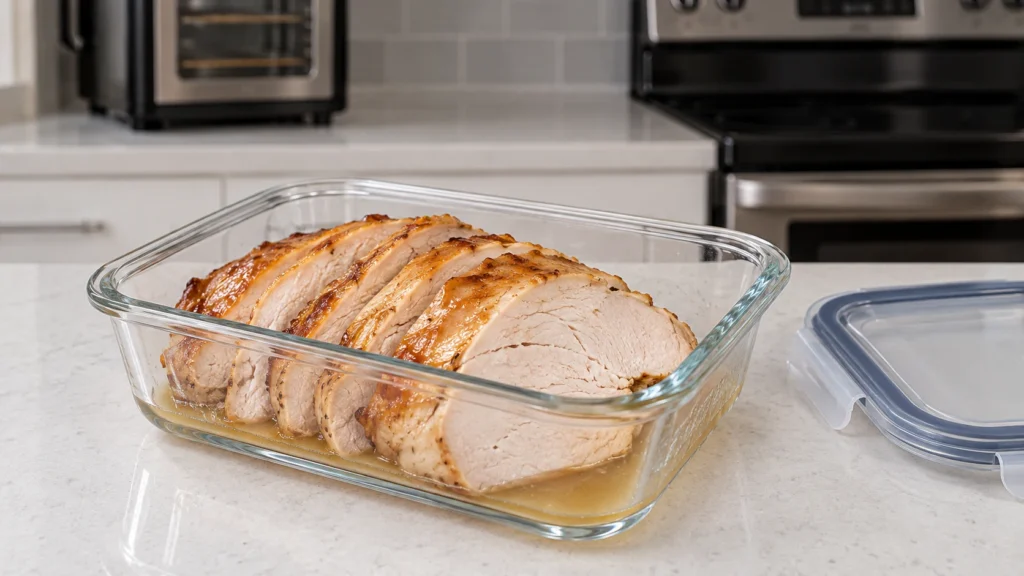
For longer storage, freeze sliced meat submerged in its own drippings in a sealed container for up to two months. Thaw it in the refrigerator overnight before the same gentle reheat. Our guide on how much turkey to buy and how long it takes to thaw covers the thawing math if you are working from a larger cut or planning ahead for a crowd.
A Few Ways to Vary It
- Swap the fat. Rendered turkey fat or duck fat basted on in place of butter gives a slightly more savory, less dairy-forward result — useful if you are avoiding dairy but still want the same moisture-retention effect.
- Spatchcock it first. A boneless or butterflied breast cooks faster and more evenly under the same basting schedule, though you will lose some of the structure that makes carving clean slices easy.
- Finish under higher heat. Pull the basted breast at 155°F internal and move it to a 450°F oven for the last five minutes for a deeper crust, watching closely so the extra heat does not push it past the safe carryover window.
- Double the batch. Two smaller breasts roast in the same pan in roughly the same time as one large one, which is a more efficient way to feed a crowd than scaling up to a whole bird if all anyone actually eats is the breast meat anyway.
What this recipe comes down to is removing the excuse that turkey breast has to be the dry, obligatory cut on the table. The meat itself was never the problem. It was always the method, and butter, patience, and a thermometer fix almost all of it.
Visual steps