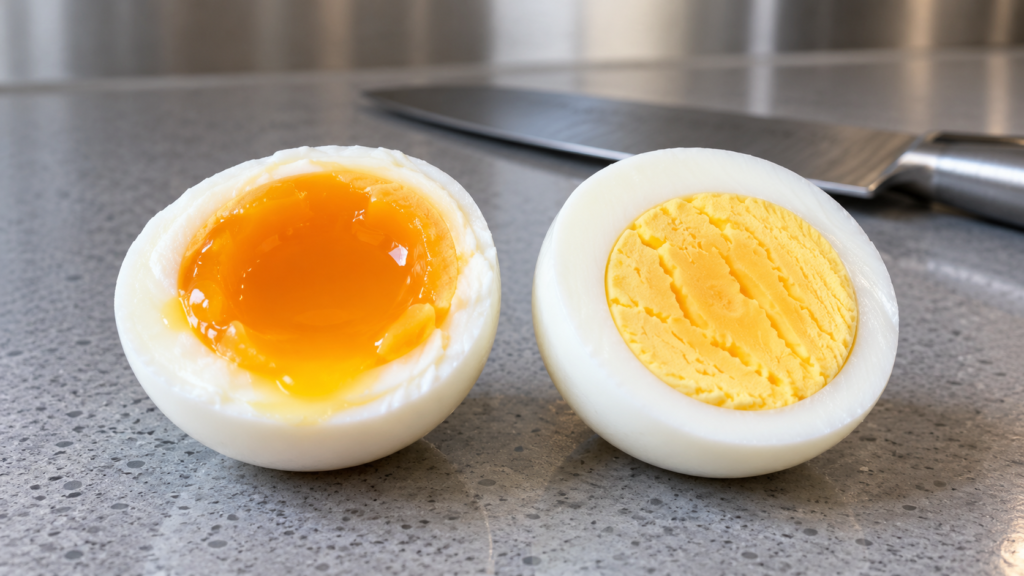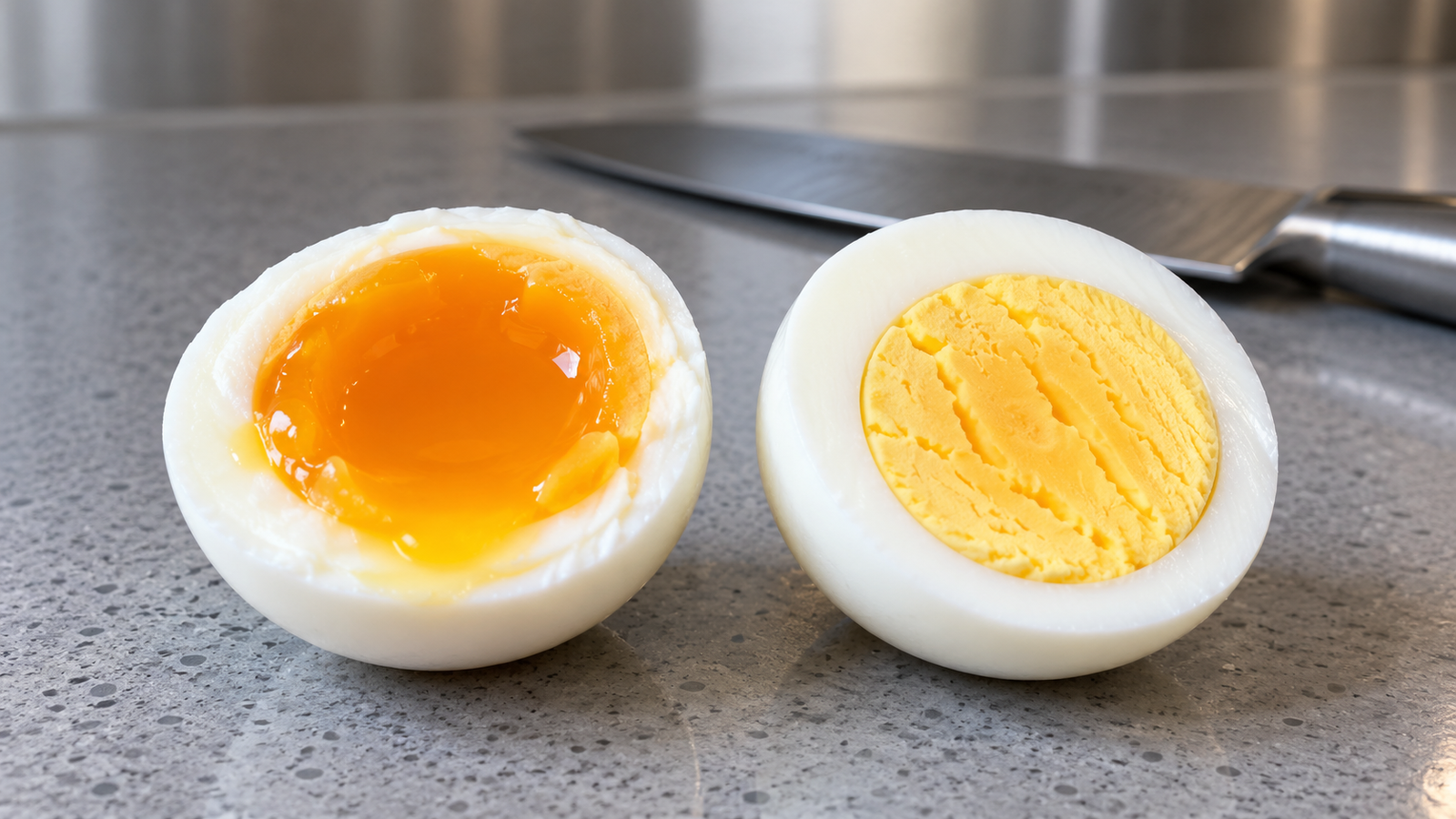
Six minutes and twelve minutes produce two completely different eggs from the same pot of water. The gap between a soft-boiled egg with a jammy, spoonable yolk and a hard-boiled egg with a chalky, fully set center comes down to how egg proteins respond to heat over time, and most of the confusion around boiling eggs traces back to not understanding that timing.
This article covers what’s actually happening inside the shell at each stage, the two main boiling methods and why they produce different results, how to adjust for egg size and altitude, why some eggs peel clean and others shred apart, and how long cooked eggs actually last once they’re off the stove.
What’s actually different between soft and hard boiled
An egg white and an egg yolk are both built from proteins, but different proteins, and they firm up at different temperatures. Egg white starts setting around 144 to 149°F and is fully opaque and firm by roughly 180°F. Yolk proteins begin to thicken around 149°F and don’t fully set until closer to 170°F. That’s a narrow window, but it’s wide enough to produce a runny yolk, a jammy yolk, and a fully firm yolk, all while the white around it is completely cooked.
Boiling water sits at 212°F at sea level, which is well above both of those set points. The egg itself doesn’t jump to 212°F the moment it hits the water. Heat has to move through the shell, through the white, and into the yolk, and that transfer takes minutes, not seconds. Soft-boiled and hard-boiled eggs aren’t cooked at different temperatures. They’re pulled out of the same hot water at different points along that heat curve, before or after the yolk crosses its own set point.
That’s why a kitchen timer matters more than almost any other variable in this process. Thirty seconds either way can be the difference between a yolk that still runs and one that’s started to firm at the edges.
Boiling-start timing, by result
These times assume large eggs, starting cold from the refrigerator, lowered into water that’s already at a full boil, with the pot uncovered or loosely covered at a steady boil the entire time.
| Time in boiling water | Yolk result | White result |
|---|---|---|
| 5 minutes | Fully liquid, barely warmed | Set but very soft |
| 6 minutes | Thick and runny, pours slowly | Fully set, tender |
| 7 minutes | Jammy, holds its shape when cut | Fully set, tender |
| 9 minutes | Firm at the edges, soft center | Fully set |
| 11 minutes | Fully set, pale yellow, no gray ring | Fully set |
| 13+ minutes | Fully set, risk of gray-green ring forming | Fully set, can turn slightly rubbery |
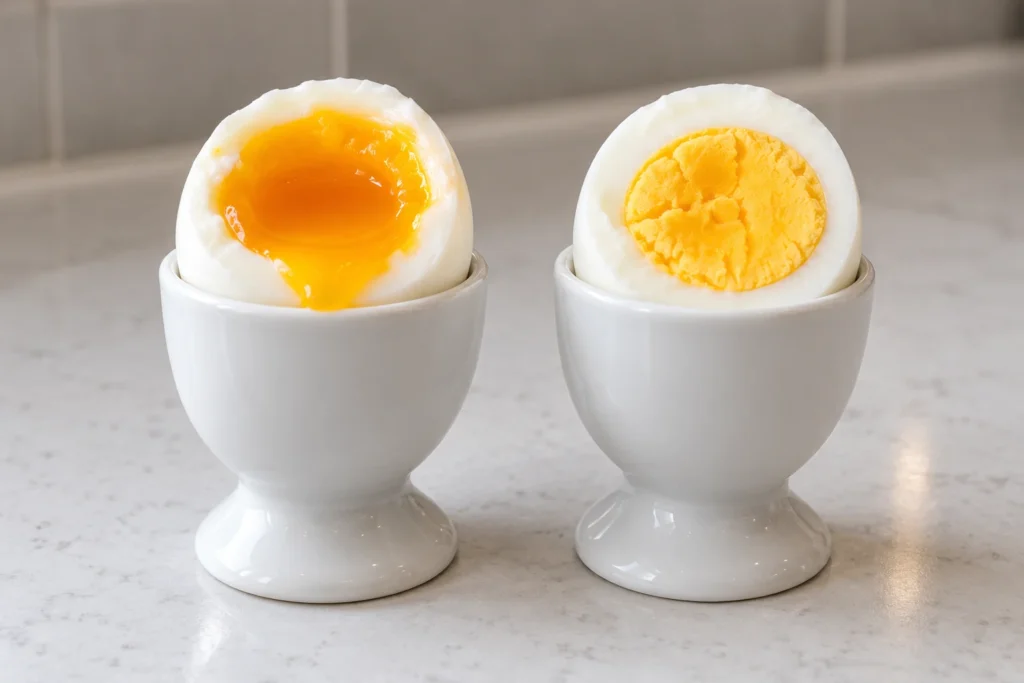
Medium eggs run about 30 to 45 seconds faster than large at every stage. Extra-large or jumbo eggs run 30 to 60 seconds slower. If you’re working through a dozen mixed sizes from your own hens rather than a uniform carton, sort by size first and boil in batches rather than averaging a single time across all of them.
Boiling start vs. cold start: two different methods, not two names for the same thing
There’s a second method that produces more consistent hard-boiled results: starting the eggs in cold water, bringing the whole pot up to a boil together, then cutting the heat and letting the eggs sit in the hot water off the burner for a set rest period.
For large eggs, that typically means bringing the pot to a full boil, removing it from the heat, covering it, and letting the eggs rest for 10 to 12 minutes for a fully hard yolk, or 6 to 7 minutes for a softer, jammier one. Because the water temperature is dropping slightly during the rest instead of staying pegged at a full boil, this method cooks more gently and is less likely to overshoot into a rubbery white, which is the main complaint people have about dropping eggs directly into a hard boil.
Neither method is objectively better. The boiling-start method gives tighter, more repeatable timing because the water temperature is constant and known. The cold-start method is more forgiving of small timing errors and tends to produce a slightly more tender white, but the exact doneness depends on your pot’s size and how much water is in it, since a bigger volume of water holds heat longer during the rest. If you’re cooking the same pot and the same egg quantity every time, cold start is easy to dial in. If you’re cooking variable batches, boiling start is more predictable.
Why eggs crack in the pot
Cracking during boiling almost always comes from thermal shock, not from bumping against the pot. A cold egg dropped straight into violently boiling water expands rapidly at the shell while the interior is still cold, and the shell can’t absorb that stress evenly. Three things reduce it: bringing eggs closer to room temperature before cooking rather than using them ice-cold from the back of the fridge, lowering them into the water gently with a spoon instead of dropping them, and keeping the boil at a steady rolling boil rather than a violent one, which also reduces the physical jostling that cracks shells against each other or the pot.
A small pinhole crack doesn’t ruin the egg. It can let a thin thread of white leak into the water, which is cosmetic, not a food safety issue, as long as the egg finishes cooking normally.
The gray-green ring, and why the ice bath actually matters
Overcooked hard-boiled eggs sometimes develop a dull gray-green ring around the yolk. That color comes from hydrogen sulfide released by the heated egg white reacting with iron in the yolk, and it shows up more with longer cooking times and with eggs that cool slowly after cooking rather than being cooled quickly.
An ice bath, or at minimum a few minutes under cold running water immediately after the eggs come out of the pot, does two things: it stops the cooking instantly so a 9-minute egg doesn’t keep creeping toward 11 minutes of effective doneness from residual heat, and it cools the egg fast enough to limit how much of that sulfur-iron reaction has time to happen. The ring is harmless to eat. It just looks unappetizing and signals the egg was either cooked too long or cooled too slowly.
Why fresh eggs are harder to peel
This is the single biggest source of boiled-egg frustration, and it has nothing to do with technique. It’s about the age of the egg before it ever hits the water.
A fresh egg has a lower internal pH, and the white sits in close, tight contact with the inner shell membrane. As an egg ages, even just a week or two in the refrigerator, carbon dioxide slowly escapes through the pores in the shell, the internal pH rises, and the white loosens its grip on the membrane. That’s why eggs bought a week or two before boiling peel in clean, whole pieces, while eggs boiled the same day they were laid or purchased tend to stick to the membrane and tear the white apart as you peel.
If you keep hens or buy very fresh eggs regularly, set aside the dozen you plan to hard-boil and let them sit in the refrigerator for 7 to 10 days before cooking rather than boiling them straight from collection. There’s no fix that works as reliably on a truly fresh egg, no amount of ice bathing or shell-cracking tricks will fully substitute for that aging window.
Soft-boiled eggs are peeled differently and don’t benefit from aging the same way, since the white is more delicate at 6 to 7 minutes of cooking and the goal is usually to peel it carefully under cool running water rather than to pop the shell off in large pieces.
Altitude changes the math
Water boils at a lower temperature as elevation increases, roughly 2°F lower for every 1,000 feet above sea level. At 5,000 feet, water boils around 203°F instead of 212°F. That lower temperature means heat moves into the egg more slowly, so the boiling-start times in the table above run short at altitude, a 7-minute jammy yolk at sea level might need closer to 8 to 9 minutes at 5,000 feet to hit the same result. The cold-start, rest-off-heat method is affected too, since the water is cooling from a lower starting point, so plan on adding a minute or two to the rest time and checking one egg before committing a full batch.
Steaming as an alternative to boiling
Steaming eggs instead of boiling them solves two of the most common complaints at once: cracked shells and stubborn peeling. Set a steamer basket or a simple colander over an inch of boiling water in a covered pot, add the eggs straight from the refrigerator, and steam rather than submerge them. The eggs never collide with a rolling boil or with each other inside turbulent water, which removes most of the thermal-shock cracking described above.
Steaming also tends to produce shells that separate more easily from the white, even on eggs that haven’t had the full week or two of aging recommended earlier. The working theory among people who test this repeatedly is that the gentler, more even heat of steam reduces how tightly the white bonds to the membrane compared with the more aggressive heat transfer of a hard boil. It’s not a complete substitute for using an aged egg, but it narrows the gap.
Timing runs close to the boiling-start chart above, generally 30 to 60 seconds longer for the same doneness, since steam at a full rolling boil sits right around 212°F at sea level but the egg isn’t in direct contact with moving water, so heat transfer is marginally slower. Six to seven minutes steamed gives a jammy yolk; eleven to twelve minutes gives a fully firm one. The same ice bath step afterward still applies.
Peeling a hard-boiled egg without destroying it
Once the egg has had its ice bath and cooled fully, crack the shell first by rolling the egg gently on the counter under light pressure, turning it so the entire surface develops a fine network of cracks rather than one large break. Start peeling at the wider end of the egg, where the air cell sits, since that’s where the membrane is loosest and easiest to get a finger or a spoon under.
Peeling under a thin stream of cool running water, or in a bowl of water, helps separate shell fragments from the white as you go instead of tearing the surface trying to pick off small pieces by hand. This matters more on eggs that are still on the fresher side, since the membrane is more likely to pull white away with it rather than lift cleanly. A spoon slid between the membrane and the white, following the curve of the shell, works better than fingernails for the same reason, less direct pressure on the white itself.
How long cooked eggs actually keep
Soft-boiled eggs with a liquid or jammy yolk don’t hold well. Once the yolk is runny, it’s in the same category as any dish with an undercooked egg center and should be eaten shortly after cooking rather than stored, both for texture and because the lightly cooked yolk doesn’t have the same shelf stability as a fully set one.
Hard-boiled eggs are a different story. Left in their shells and refrigerated, they keep well for about a week. Once peeled, that window shortens, since the protective shell and membrane are gone and the egg is more exposed to moisture loss and odor absorption from the refrigerator; plan on using peeled hard-boiled eggs within two to three days and storing them in a sealed container, ideally with a slightly damp paper towel to slow drying out. Eggs that will be eaten by anyone with a compromised immune system, who is pregnant, very young, or elderly should be cooked until the yolk is fully firm rather than jammy or runny, which is standard food safety guidance for egg dishes generally, not specific to this recipe.
Common mistakes worth fixing
- Using the same cook time for every egg size instead of adjusting 30 to 60 seconds up or down
- Skipping the ice bath, which lets residual heat keep cooking the yolk past the intended doneness
- Boiling eggs the same day they’re collected or bought, then blaming the peeling method instead of the egg’s age
- Dropping ice-cold eggs into a violent boil, which is the most common cause of cracked shells
- Treating altitude as irrelevant when it shifts boiling point and effective cook time meaningfully above 3,000 feet
Once you’ve nailed down a method and a time that works for your altitude, your pot, and your preferred yolk, the process becomes close to automatic. The variables that actually move the result are temperature, time, and egg age; everything else is secondary.
For more on how egg proteins behave under heat in other contexts, see Egg Whites vs. Whole Eggs: What Actually Changes. For general buying, storage, and handling basics, see Eggs: Buying, Storing, and Cooking Them Without Guesswork.
Visual steps