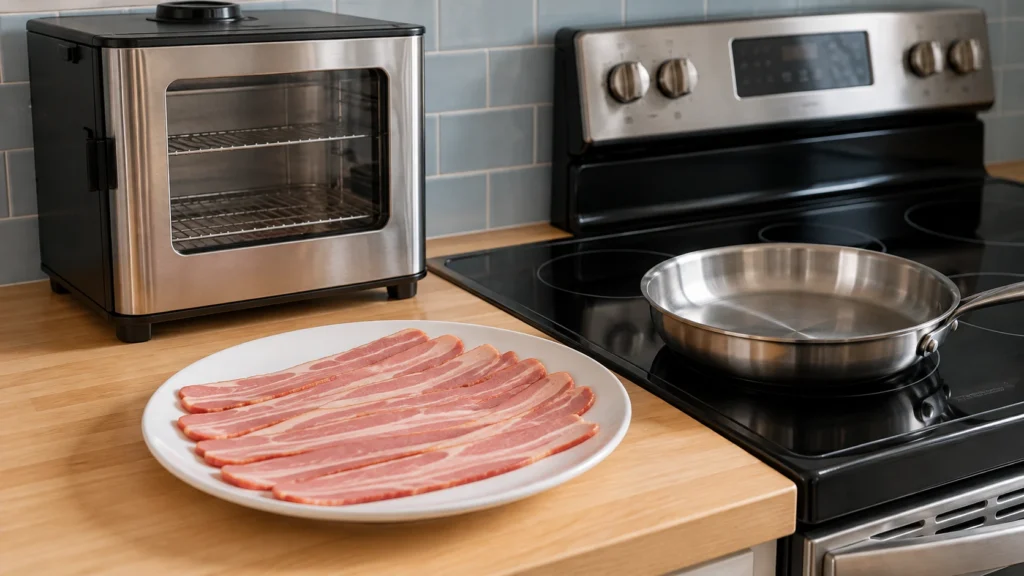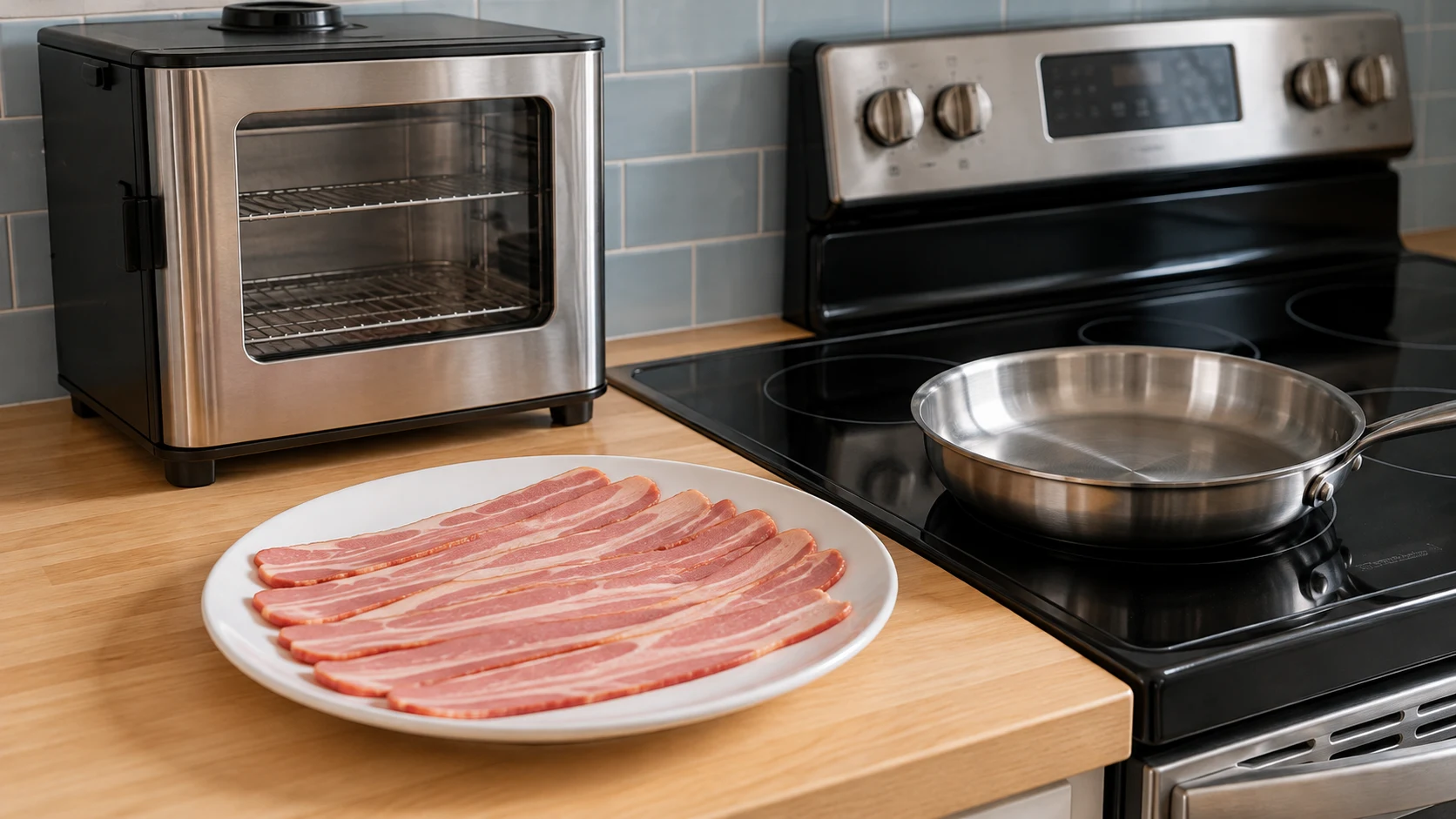
Why does turkey bacon from a package almost always disappoint, even when you follow the directions on the box? Because most of what is sold under that name is pre-cooked, reheated at the table, and built around the idea that turkey bacon should taste like an imitation of pork bacon rather than something good on its own terms. Cooked fresh from raw sliced turkey (thigh meat or breast with the skin left on, sliced thin) the result is a different thing entirely: real crisped edges, real rendered fat in the pan, and a flavor that is turkey all the way through instead of a liquid-smoke stand-in for pork.
Buying and Slicing the Right Cut
Skip the pre-packaged turkey bacon aisle entirely. What you want is a boneless turkey thigh with the skin still attached, or a turkey breast tenderloin if you want a leaner result with less fat to render. Ask a butcher counter to slice it into strips about ⅛ inch thick, or do it yourself with a sharp knife after chilling the meat in the freezer for 20 minutes first. Partially firm meat slices far more evenly than fully soft, room-temperature meat does, which matters here because uneven thickness is the main reason homemade turkey bacon cooks unevenly. Aim for strips that are reasonably consistent from one end to the other rather than tapering sharply, since a strip that is thick at one end and thin at the other will finish those two ends at noticeably different times in the same pan, forcing you to either pull it early and leave the thick end underdone or let it ride and burn the thin end.
What You Need
- 1 lb boneless turkey thigh, skin-on, sliced into thin strips
- Coarse salt
- A light crack of black pepper, optional
- 1 tablespoon rendered turkey fat, lard, or tallow, for the pan
No sugar cure, no liquid smoke, no nitrate blend from a spice aisle. Real bacon’s deep flavor comes from a long cure and often a smoke step that this quick version is not attempting to replicate. This is turkey, crisped in its own fat, salted well, and nothing more. It will not taste identical to pork bacon, and it is not trying to.
The Method
- Salt the sliced strips lightly on both sides and let them sit at room temperature for 15 minutes while the pan heats. This is a short cure, not an overnight one, since the strips are thin and will season through quickly.
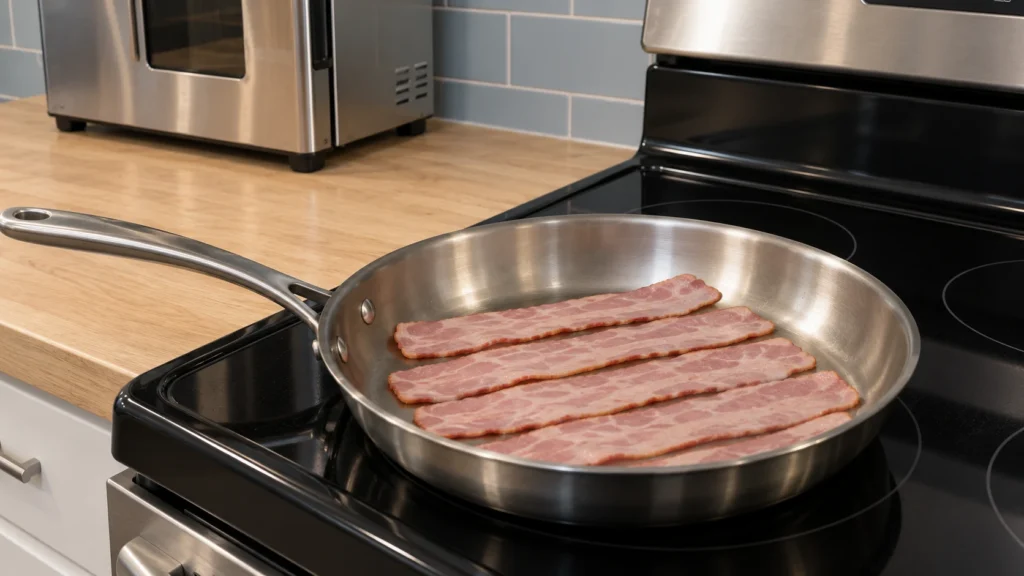
- Heat a cast-iron or heavy stainless skillet over medium-low heat and add the fat, letting it melt and spread across the surface.
- Lay the strips in the pan in a single layer without crowding. Crowded strips release steam that has nowhere to go, which softens the surface you are trying to crisp.
- Cook for 3 to 4 minutes on the first side without moving the strips, until the underside is deeply browned and some fat has visibly rendered into the pan.
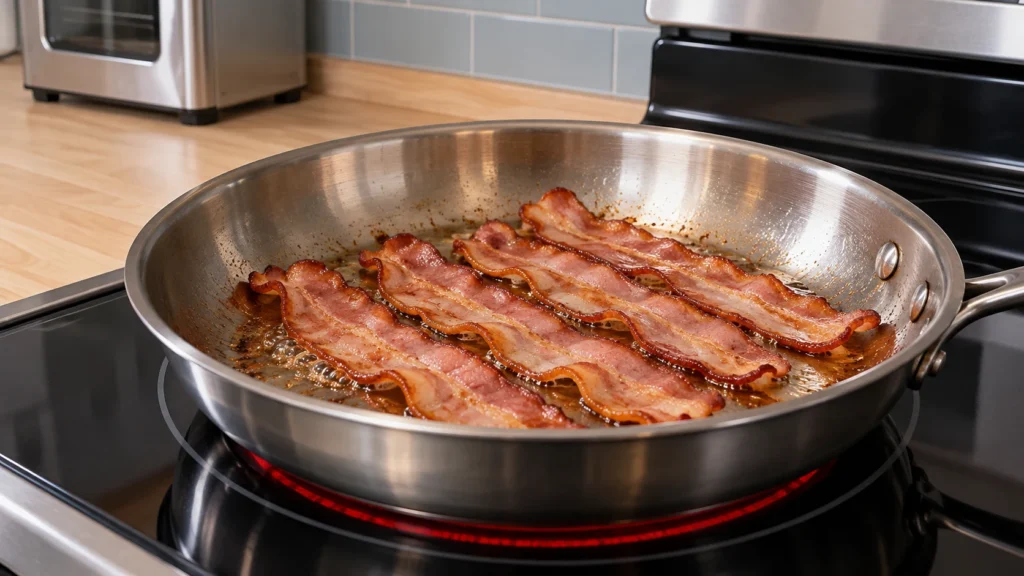
- Flip once and cook the second side for another 2 to 3 minutes, watching closely. Turkey bacon this thin goes from perfectly crisp to burnt in under a minute once the pan and the rendered fat are both hot.
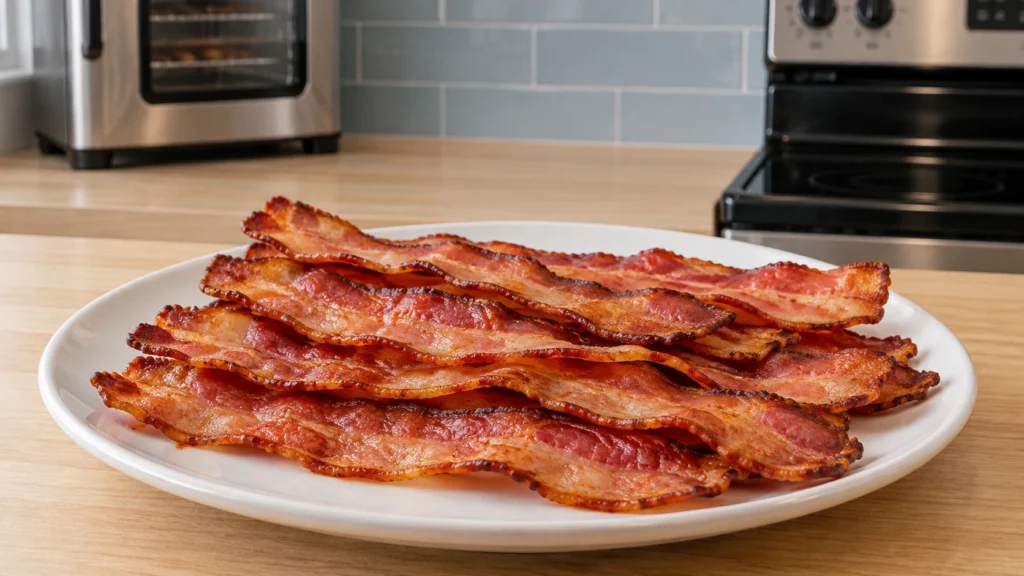
- Transfer to a paper-towel-lined plate to drain briefly, then serve right away while the edges are still at their crispest.
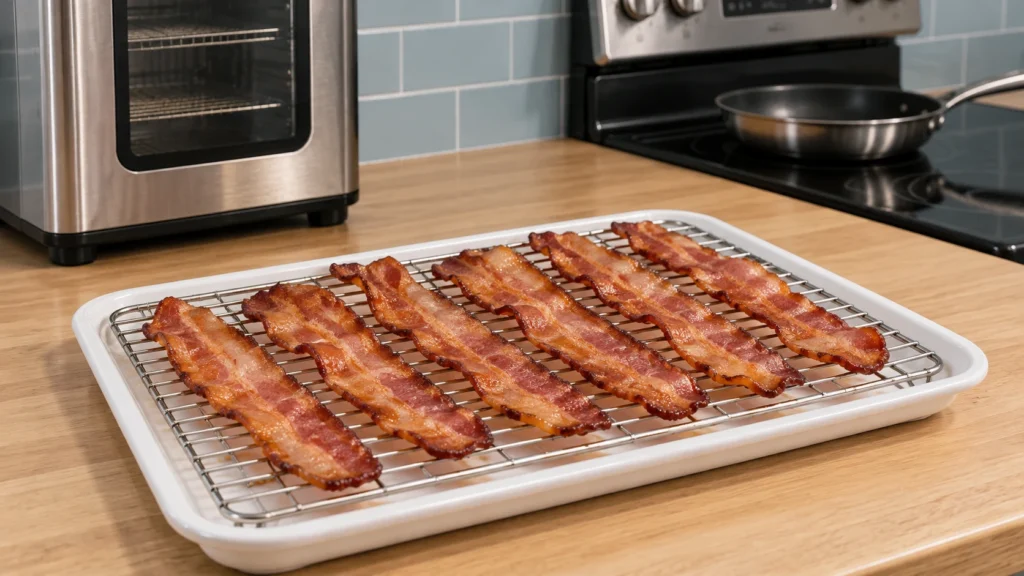
Total time runs 6 to 8 minutes once the pan is hot, faster than most people expect from scratch-made bacon. Keep the heat at medium-low rather than medium or high. Turkey’s leaner composition compared to pork means it has less fat to protect it from scorching, and a too-hot pan will burn the surface before the strip has rendered and crisped properly.
Why Thin Matters More Here Than With Pork Bacon
Pork belly bacon has a thick, even fat cap running through almost every slice, which bastes the meat from inside as it cooks and buys real forgiveness on timing. Turkey thigh or breast meat has none of that built-in protection. What fat exists is mostly in and just under the skin, not marbled evenly through the muscle. Slicing thin compensates for this by shortening the distance heat has to travel to crisp the surface, so the strip finishes before the leaner interior has a chance to dry out completely. A thick-cut turkey “bacon” strip, by contrast, either stays underdone in the middle or overcooks at the edges trying to catch up. There is very little good middle ground at a thickness much past ⅛ inch.
Doneness and Safety
| Sign | What it tells you |
|---|---|
| Pale, still translucent at edges | Not done; keep cooking |
| Deep golden-brown, visibly rendered fat in pan | Safe and at peak texture |
| Dark brown-black, smoking in the pan | Past done; bitter, burnt flavor developing |
Thin-sliced poultry like this is hard to probe accurately with a thermometer because there is so little mass to register a stable reading, so color and rendering are the more practical doneness signals here. By the time a strip this thin looks fully browned and crisp at the edges, it has passed well beyond the USDA’s 165°F poultry safety floor. If you are ever uncertain, the thickest strip in the batch is the one to spot-check with an instant-read thermometer before calling the whole pan done.
Common Mistakes
- Slicing too thick. Anything heavier than ⅛ inch struggles to crisp all the way through without burning the exterior first.
- Cooking at too high a heat. Turkey’s lower fat content compared to pork punishes high heat quickly; medium-low with patience outperforms medium-high every time here.
- Crowding the pan. Trapped steam softens what you are trying to crisp. Cook in batches if your skillet is not large enough to hold everything in one uncrowded layer.
- Flipping repeatedly. One flip, timed right, develops better color than four quick turns ever will.
- Walking away. Because the strips are thin, the window between perfectly crisp and burnt is short. Stay at the stove for the full cook.
The Pan You Use Changes the Result
Cast iron and carbon steel hold and release heat differently than a thin nonstick pan does, and that difference shows up clearly on something this thin and quick-cooking. A heavy pan that has been preheated properly stays at a steady temperature even once the cold turkey strips go in and briefly cool the surface, which means the first strips you lay down cook at close to the same rate as the last ones. A thin pan, especially one still carrying some residual coolness from the stovetop burner cycling on and off, dips in temperature the moment meat touches it and takes longer to recover. You end up with the first batch undercooked and pale while you wait for the pan to catch back up, then an overcorrected, nearly burnt second batch once it does. Give whatever pan you use a full two to three minutes to preheat before the fat goes in, and resist adding the turkey strips until the fat itself is visibly shimmering.
Scaling It Up for a Crowd
A single pound of sliced turkey thigh yields a modest 10 to 12 thin strips, which disappears fast at a breakfast table. Scaling up is straightforward (buy more turkey thigh and slice more strips) but resist the temptation to also scale up how many strips go in the pan at once. The crowding problem described above gets worse, not better, as total volume increases, since more strips means more released steam with the same amount of pan surface to escape from. Work in sequential batches instead, keeping finished strips warm on a rack over a sheet pan in a low oven (around 200°F) rather than stacking them on a paper-towel-lined plate, where trapped steam from the strips underneath will soften the crispness you just spent several minutes building.
Pairing It With the Rest of the Plate
Turkey bacon this way works best as a textural counterpoint to something softer on the same plate. A few slices alongside pan-seared chicken thighs, crumbled over shredded chicken thigh meal prep, or simply served next to a soft-cooked organ meat like liver, where the crisp edges and the tender interior of the other dish contrast rather than compete. Because there is no bread, egg, or vegetable side built into this recipe, think of it as a component rather than a stand-alone plate. A crisp, salty, fatty element you add to something else that is already carrying most of the meal’s substance.
Storing and Reheating
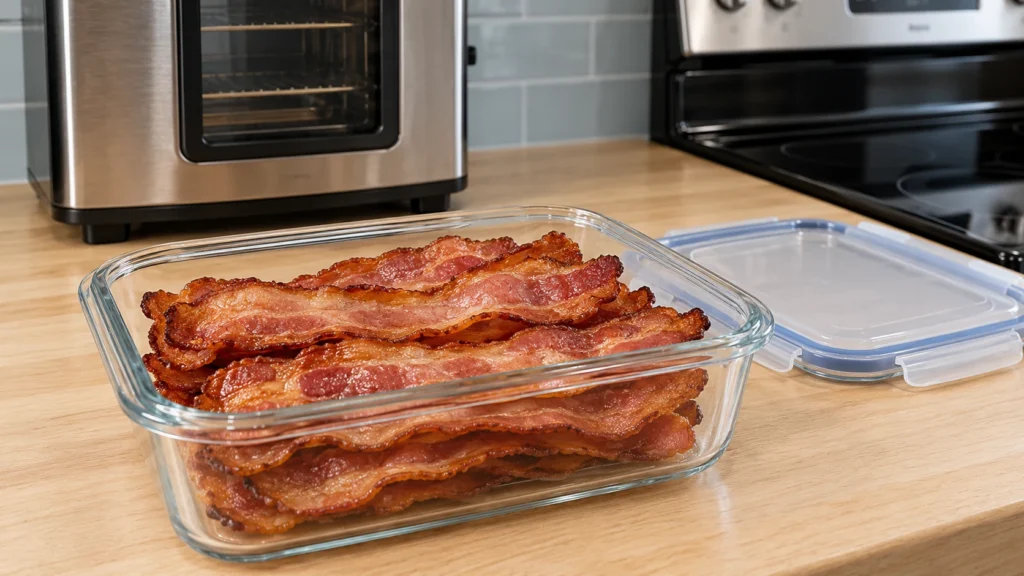
Cooked turkey bacon keeps refrigerated in a sealed container for three to four days. Reheat in a dry skillet over medium heat for 60 to 90 seconds per side to bring back some crispness. The microwave works in a pinch but leaves the strips limp rather than crisp, since it has no browning effect on the surface. Raw sliced strips can also be frozen, laid flat between sheets of parchment so they do not freeze into one solid block, for up to two months; thaw in the refrigerator before cooking.
What to Do With the Rendered Fat
A batch of turkey bacon leaves behind a small but genuinely useful amount of rendered turkey fat in the pan. Strain it while still warm and save it. It carries a smoky, savory flavor from the browning and works well for searing a chicken thigh or basting the next turkey roast you make. Our broader guide to rendered animal fat covers how long it keeps and other uses for it.
Frequently Asked Questions
Can I use ground turkey formed into thin strips instead of sliced thigh meat? It is possible but more fragile. Ground meat strips fall apart more easily when flipped and lack the structural integrity whole-muscle slices have. If you try it, chill the formed strips thoroughly before cooking and handle them minimally.
Why does mine come out chewy instead of crisp? This usually means the slices were cut too thick, the pan was not hot enough at the start, or the strips were crowded and steamed rather than seared. Re-check thickness first. It is the most common culprit.
Is skin-on turkey thigh meat necessary, or can I use skinless? Skin-on gives noticeably better results because the skin itself renders fat as it crisps, which is most of what makes this taste like bacon rather than plain pan-seared turkey. Skinless works but produces a drier, less satisfying strip.
Can I cure the strips longer for a more bacon-like flavor? A longer dry salt cure, 4 to 6 hours in the refrigerator rather than 15 minutes at room temperature, does deepen the seasoning and firm the texture slightly, closer to how real bacon develops flavor over days. Pat the strips fully dry before they hit the pan if you go this route (any surface moisture left from the longer cure will cause spattering and uneven browning.
My strips curled up badly in the pan) is that a problem? Mild curling is normal, especially with skin-on strips, since the skin side contracts faster than the meat side as it heats. If curling is severe enough that parts of the strip lift off the pan surface entirely, press gently with a spatula for the first 30 seconds after the strips go in to encourage even contact while the first sear sets.
Can I make this with ground turkey instead of sliced thigh, pressed thin and cut into strips after cooking? You can cook a thin sheet of seasoned ground turkey in the same pan and cut it into strips once crisped on both sides, though the texture will read more like a crisped patty than a true sliced-bacon bite. If bacon-like structure matters to you, sliced whole-muscle thigh or breast is worth the extra few minutes of knife work.
Homemade turkey bacon will never be a perfect stand-in for the pork version, and trying to force that comparison is the fastest way to be disappointed by it. Judged on its own (crisp edges, real rendered fat, turkey flavor concentrated by a hot pan) it earns a place in the regular rotation rather than existing only as someone else’s substitute. Once you have made a batch or two and gotten a feel for how fast it moves from pale to perfectly crisp in your particular pan, it becomes one of the faster things in this whole site’s repertoire. Closer to a six-minute side than a project, which is exactly what bacon, in any form, was always supposed to be.
Visual steps