Curing salt is not a flavor ingredient that happens to also help preserve meat on the side. It’s a genuine safety ingredient that happens to also shape flavor and color as a secondary effect. Getting that order backward in your own head is exactly how people end up treating a serious food-safety step as optional, something to skip or improvise on a first attempt, and it genuinely isn’t optional.

What curing salt is actually stopping
Clostridium botulinum is a specific bacterium whose spores exist almost everywhere, including in and around raw meat, and under the right conditions it produces one of the most potent toxins known. Those specific conditions are: low oxygen, low acidity, and a moderate temperature range that a lot of ordinary curing and smoking naturally sits well inside of. A piece of meat sitting in a low-oxygen environment for an extended cure, exactly the environment bacon, ham, and dry-cured sausage are made in, is a genuinely plausible place for that bacterium to grow if nothing stops it.
Sodium nitrite is what stops it. It inhibits the growth and toxin production of Clostridium botulinum specifically, which is the core safety reason curing salt exists at all. The fact that it also contributes the pink color associated with cured meat and a distinct tangy, cured flavor is a secondary effect, not the main point, even though those secondary effects are often what gets marketed and talked about.
Why it’s dyed pink, and why that matters more than it sounds
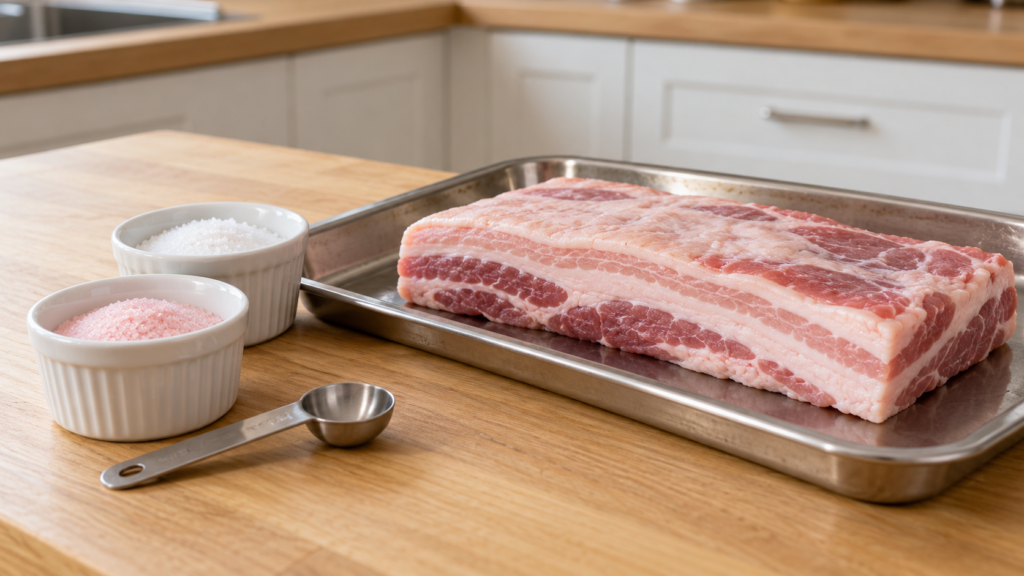
Curing salt is dyed a distinct pink specifically so it can never be mistaken for table salt, either by sight in a pantry or by a cook reaching for the wrong container mid-recipe. This isn’t a cosmetic choice. Nitrite is effective at the small concentrations curing requires, but it’s genuinely toxic at higher doses, and a mix-up where curing salt gets used in table-salt quantities, or vice versa in a cure recipe, is a real and documented source of kitchen accidents. Keep curing salt stored well separately from table salt, clearly and permanently labeled, and never move it into an unlabeled or generic-looking container, even just temporarily while a batch is being measured out.
Cure #1 and Cure #2 are not interchangeable
| Cure #1 (Prague Powder #1) | Cure #2 (Prague Powder #2) | |
|---|---|---|
| Contains | Sodium nitrite and salt | Sodium nitrite, sodium nitrate, and salt |
| Used for | Short cures: bacon, ham, corned beef, most sausage that will be cooked or smoked before eating | Long, slow dry cures lasting weeks to months: dry salami, prosciutto-style products, items not cooked before eating |
| Why the difference matters | Nitrite alone does its job over the shorter timeframe of these cures | Nitrate acts as a slow-release reservoir, gradually converting to nitrite over the much longer cure time, so protection doesn’t run out partway through |
Using Cure #2 for a short cure like bacon isn’t dangerous in the sense of adding too little protection, but it introduces nitrate the process doesn’t need and isn’t designed around. Using Cure #1 for a long dry cure is the more serious mismatch, since the nitrite alone may not provide the sustained protection a multi-week or multi-month cure actually requires. The two products exist for genuinely different processes, not as interchangeable brands of the same thing.
On exact ratios: follow the package, not a half-remembered number
Curing salt usage is measured in small, carefully precise amounts relative to the total weight of meat being cured, and the correct ratio depends entirely on which specific product is actually being used, since formulations and exact concentrations can and do vary slightly between different brands, and obviously between Cure #1 and Cure #2 themselves. More is not safer here. Nitrite becomes genuinely toxic well before it becomes meaningfully more protective, so overshooting a recipe’s amount is a real risk in its own right, not just wasted product.
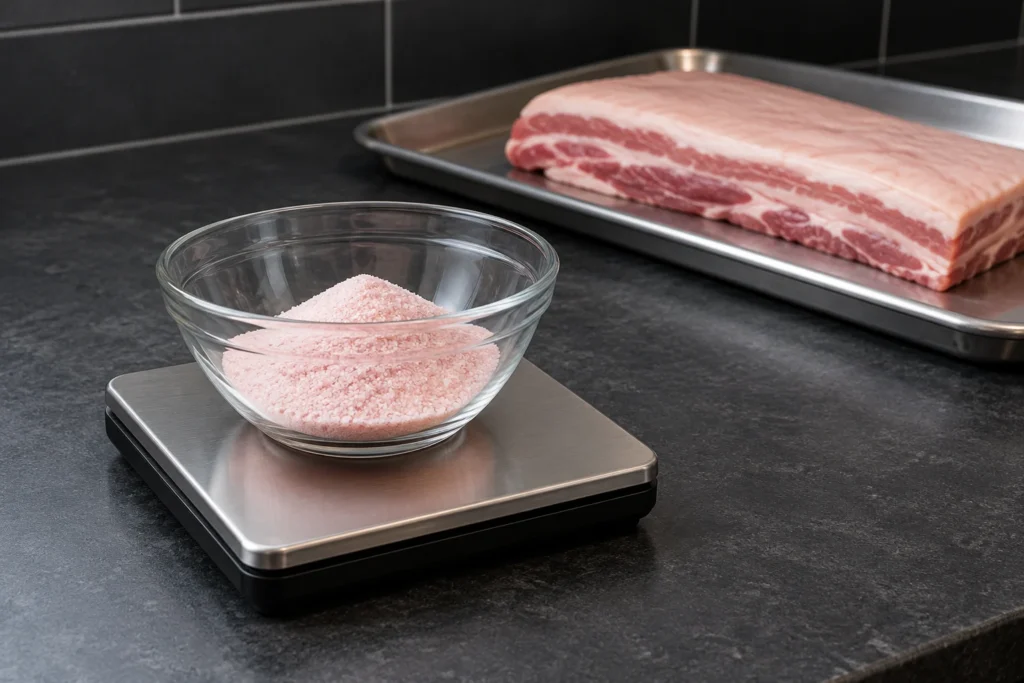
The only genuinely responsible approach is to use the exact ratio printed directly on the specific curing salt product actually being used, measured carefully with an accurate kitchen scale rather than estimated loosely with spoons, and to cross-check that printed ratio against a trusted, current curing resource before ever attempting a first batch. The USDA’s Food Safety and Inspection Service and the National Center for Home Food Preservation both publish detailed, current guidance on curing ratios and safe practices, and either is a better source for an exact number than a forum post, a video, or a half-remembered figure from a different recipe entirely. A kitchen scale accurate to at least a gram, not a tablespoon measure, is genuinely necessary equipment for this, not an optional upgrade.
A word on nitrosamines, since the question comes up
Nitrite can, under certain conditions, particularly high-heat cooking of nitrite-cured bacon specifically, react with naturally occurring compounds in meat to form nitrosamines, a separate chemical byproduct that regulatory agencies have studied and factored into how curing is regulated. This is a real, acknowledged consideration, which is part of why commercial curing practices and permitted usage levels have been refined over time by food-safety regulators specifically with bacon in mind, and why following current official guidance rather than an old or informal recipe matters. It’s a separate issue from the Clostridium botulinum risk curing salt exists to prevent, not a reason to skip curing salt, since the alternative, curing without adequate nitrite, trades a well-studied, regulated, and manageable consideration for a much more acute and dangerous one.
For a home curer, the practical takeaway is simple: use the correct, current ratio from an authoritative source, avoid cooking cured bacon at extremely high, prolonged heat where avoidable, and don’t attempt to compensate by adding extra curing salt beyond the recipe’s specified amount, which would increase nitrosamine-forming potential without adding meaningful extra protection against botulism.
What curing salt does not replace
Curing salt reduces one specific, serious risk and does that one job well. It doesn’t replace basic food-safety discipline around every other part of the process: keeping meat properly, consistently refrigerated before and during curing except in the specific cases where a recipe calls for controlled room-temperature fermentation, using genuinely clean equipment and work surfaces throughout, and following a tested recipe’s full process closely rather than improvising timing or temperature based on a guess. A cure done with the correct salt but careless handling elsewhere still carries real risk. The curing salt is one layer of a safe process, not the entire process by itself.
“Uncured” and “no nitrates added” labels are doing a word game
Packaged bacon and deli meat labeled “uncured” or “no nitrates or nitrites added” has almost always still been cured with nitrite, just sourced from celery powder or celery juice concentrate instead of a synthetic curing salt. Celery is naturally high in nitrates, which convert to nitrite during processing the same way synthetic sodium nitrite does, and the finished product goes through the same underlying chemistry and carries the same real food-safety protection as a product cured directly with Cure #1.
The regulatory distinction exists because the nitrite source is natural rather than synthetic, which is meaningful for labeling rules and for anyone specifically trying to avoid synthetic additives as a personal preference, but it isn’t meaningful for food safety. A home curer substituting celery powder for Cure #1 or Cure #2 without knowing the actual nitrate or nitrite concentration of that specific celery powder product has no reliable way to calculate a safe amount, which makes this substitution considerably riskier at home than it sounds, precisely because the concentration isn’t standardized or printed clearly the way it is on commercial curing salt.
Temperature and time still matter alongside the right curing salt
Curing salt does its job within a specific set of conditions, not as a guarantee that overrides poor technique elsewhere. A short cure like bacon is typically done under refrigeration the entire time, at a steady temperature well below the range where bacteria multiply quickly. A long, dry-cured product sometimes involves a controlled fermentation stage at a specific, carefully monitored temperature and humidity, closer to what a commercial dry-aging room provides for beef, except tuned for the different goal of safe fermentation rather than tenderizing. Attempting a long dry cure in an uncontrolled environment, a garage or a basement with swinging temperatures, introduces real risk that the right curing salt alone can’t fully offset.


Mistakes that turn a safety step into a false sense of security
- Eyeballing the amount instead of weighing it. Curing salt ratios are precise for a reason; a kitchen scale is required equipment here, not a nice-to-have.
- Assuming any pink salt is curing salt. Himalayan pink salt and decorative pink finishing salts contain no nitrite at all and provide zero curing protection despite looking similar.
- Using Cure #1 for a long dry cure because it’s what’s on hand. The nitrite alone may not sustain protection over a cure lasting weeks or months the way Cure #2’s nitrate reservoir is designed to.
- Substituting celery powder without knowing its actual nitrate concentration. Without a standardized, labeled concentration, there’s no reliable way to calculate a safe amount.
- Skipping proper refrigeration or temperature control because the curing salt is already in the mix. Curing salt is one layer of safety, not a substitute for correct handling throughout the entire process.
Where to actually buy it, and what to avoid
Curing salt sold under names like Prague Powder, Instacure, or simply labeled Cure #1 or Cure #2 from a reputable curing-supply source is the right product to use. Products vaguely labeled “pink salt” without clarifying whether that means Himalayan pink salt, a decorative pink finishing salt with no nitrite at all, or genuine curing salt, are a real source of confusion worth being careful about. Always read the actual ingredient label specifically looking for sodium nitrite or sodium nitrate before simply assuming any pink-colored salt product is the real curing salt a given recipe is actually calling for.
Curing is old; regulated curing salt is comparatively recent
Salt curing itself is ancient, used for thousands of years as one of the only reliable ways to preserve meat before refrigeration existed in any form. Nitrate-rich salt deposits were sometimes present in that early curing salt without anyone understanding the specific chemistry involved, which is part of why some cured meats developed their characteristic pink color and flavor long before sodium nitrite was isolated and understood as the active ingredient responsible. What’s changed since then isn’t the basic idea of using nitrite or nitrate to cure meat safely; it’s the precision. Modern curing salt provides a known, standardized, measurable concentration, and modern food-safety regulation sets clear permitted usage levels based on real research, which is a meaningfully different and safer situation than relying on inconsistent natural salt deposits or folk-recipe guesswork the way curers did for most of human history.
That history is worth knowing mainly because it explains why “people have always cured meat without measuring precisely” isn’t a reassuring argument for skipping precision today. Historical curing also carried a real, measurable rate of illness and death from exactly the risks modern curing salt and modern guidance are specifically designed to eliminate.
Putting this into practice
This article is the companion piece to curing bacon at home, which covers the hands-on process a short cure like bacon actually involves, step by step. The chemistry above is what makes that process genuinely safe to do at home in the first place; the technique article covers how it’s actually carried out from raw pork belly to finished, sliceable bacon. Reading both before a first attempt is worth the extra few minutes it takes.

This is food-safety and technique information, not a substitute for a tested curing recipe or professional guidance. Improperly cured meat carries real risk, including botulism. Always use a curing salt product’s specific label instructions, verify ratios against authoritative sources before a first attempt, and when in doubt, don’t proceed. References: USDA Food Safety and Inspection Service and the National Center for Home Food Preservation.
Visual steps