
Flank steak has a reputation problem. Cooked wrong, it’s genuinely one of the toughest, chewiest cuts on the animal; stringy, hard to cut through, the kind of steak that makes people swear off a whole category of beef. Cooked right, it’s fast, flavorful, and inexpensive relative to almost anything else in the steak case. The entire difference between those two outcomes comes down to two things most people skip: not overcooking it, and slicing it correctly afterward. Get those right and flank steak stops being the disappointing cut and starts being the one you reach for on a weeknight.
Why this cut needs a different approach than a ribeye
Flank comes from the abdominal muscles, which work constantly and build long, coarse muscle fibers running in one obvious direction the entire length of the steak. There’s very little intramuscular fat here, almost none of the marbling that protects a ribeye from drying out, so flank has almost no margin for overcooking. A ribeye pushed a few degrees past target is still a reasonably good steak. A flank steak pushed the same few degrees past target turns noticeably tougher, fast, because there’s no fat buffering the muscle fibers as they tighten under heat.
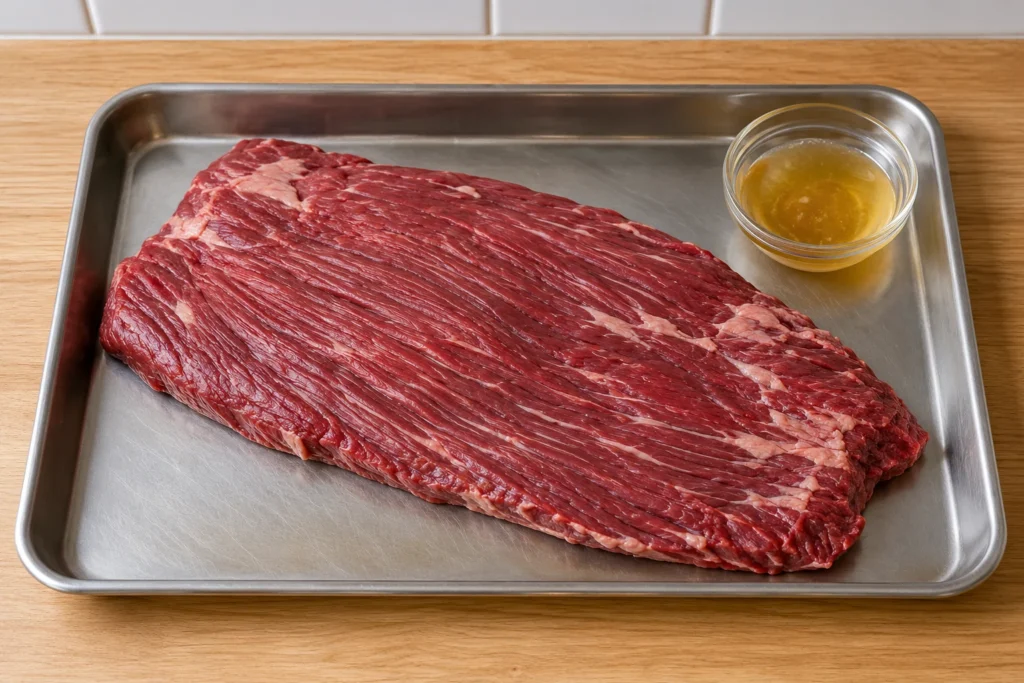
What you need
- 1 flank steak, 1.5–2 lbs
- 2 tablespoons beef tallow
- 1–2 teaspoons coarse salt
- A light crack of black pepper, optional
Step by step
- Salt the steak on both sides and let it sit at room temperature for 30 minutes. Flank’s thin, even shape means it doesn’t need the longer rest a thicker roast does.
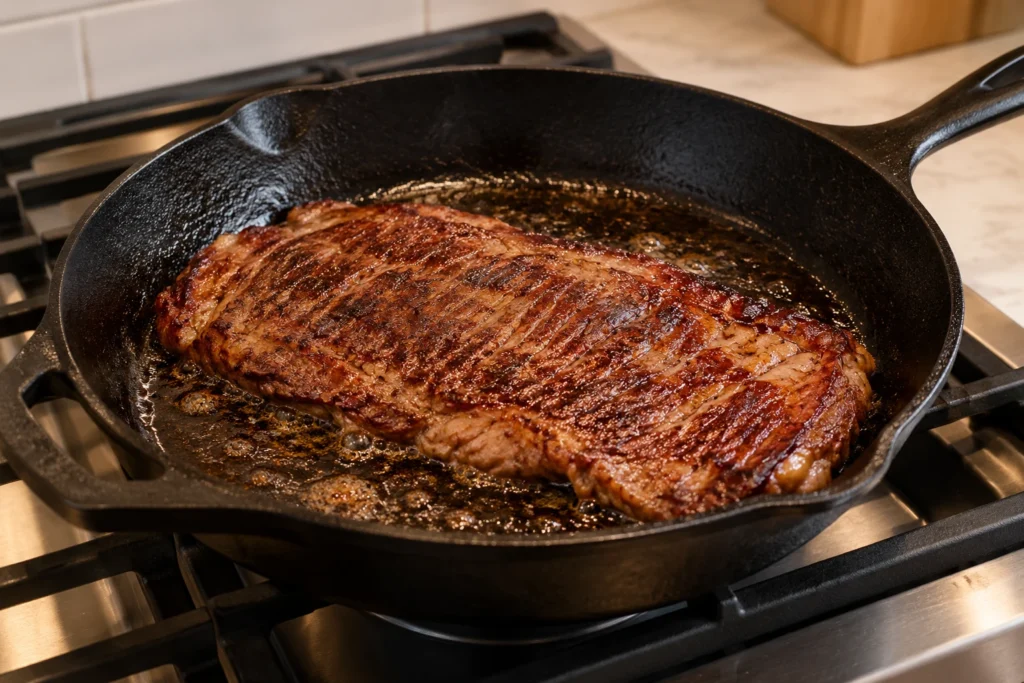
- Heat a cast-iron skillet over high heat until it just starts to smoke lightly. Add the tallow; it should shimmer immediately.
- Lay the steak in the pan. Because flank is thin and cooks fast, don’t walk away; 3–4 minutes per side is typical for medium-rare, depending on exact thickness.
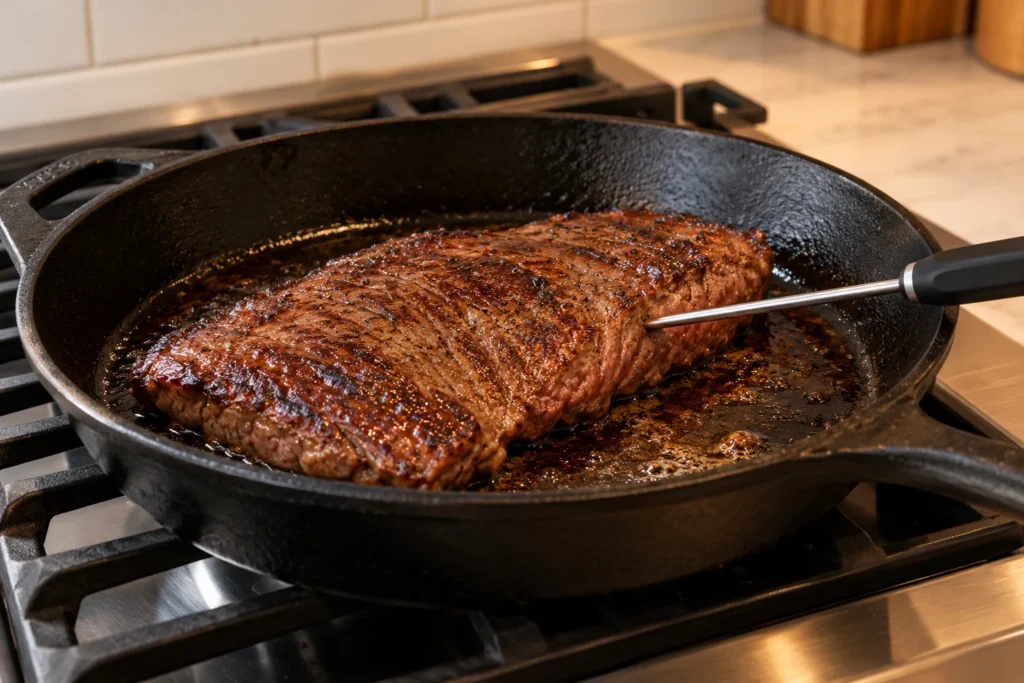
- Flip once, cook the second side the same length of time, and start checking internal temperature around the 6-minute mark total.
- Pull at 125–130°F for medium-rare. Flank moves through its remaining degrees of carryover fast given its thinness, so pull slightly earlier than you would a thicker steak.
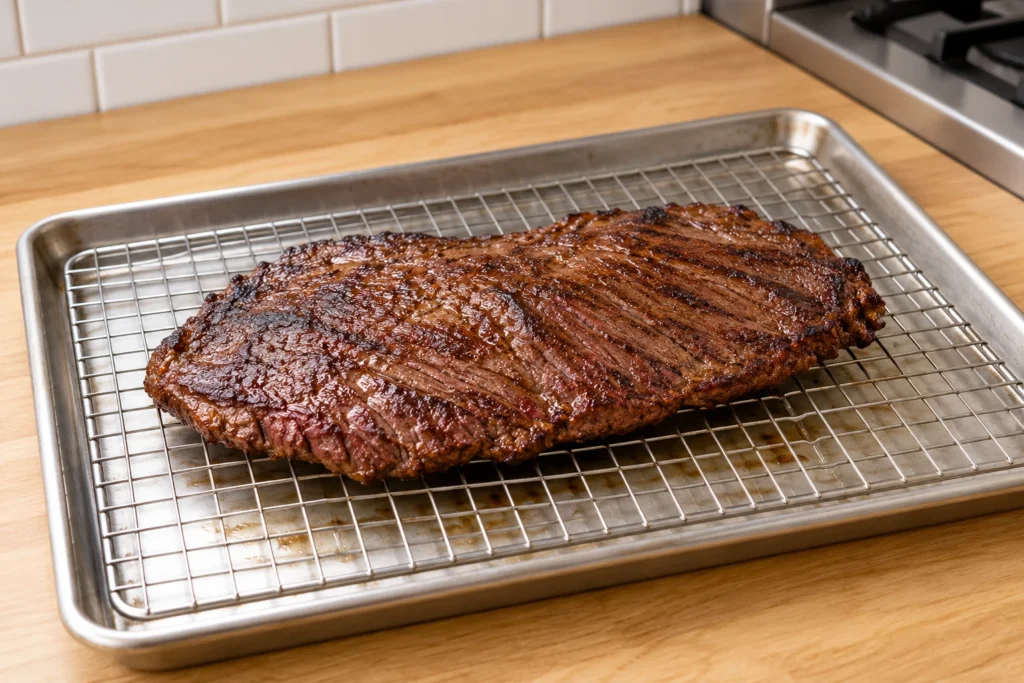
- Rest for 5 minutes, tented loosely, before slicing.
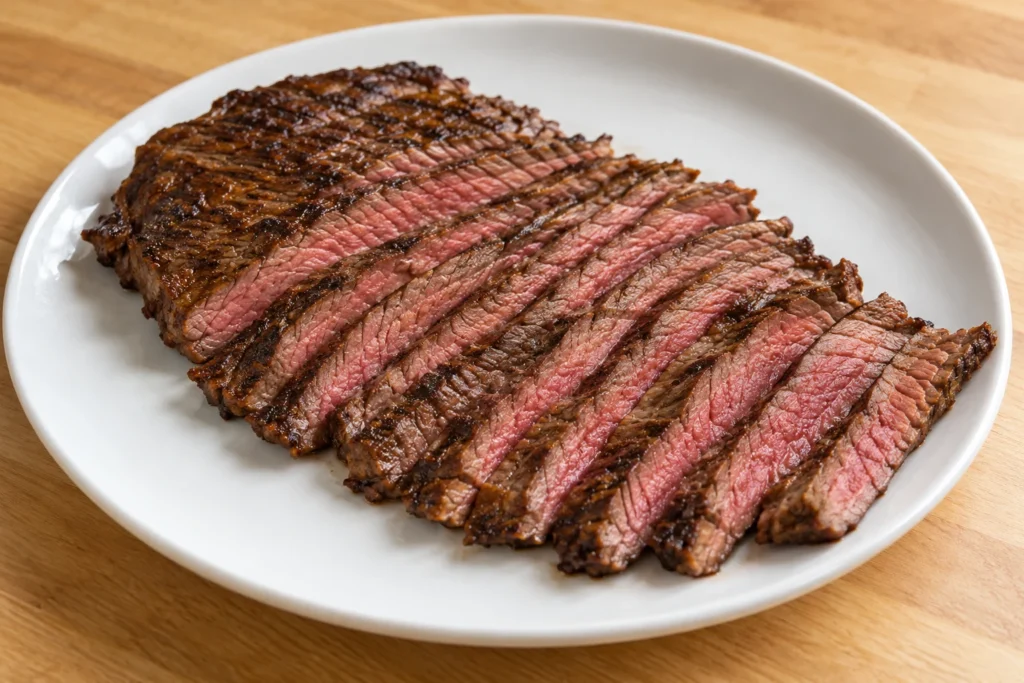
- This is the step people skip and shouldn’t: slice thin, against the grain, at a slight angle. Look at the visible direction of the muscle fibers running across the steak and cut perpendicular to them, not parallel.
Why slicing against the grain matters more here than on almost any other cut
Every steak benefits from being cut against the grain, but flank’s long, coarse fibers make the difference dramatic rather than subtle. Slice with the grain by mistake on a ribeye and you probably won’t notice much; slice with the grain on flank and you’ll be chewing through long, intact muscle strands that feel noticeably tougher, even if the steak was cooked exactly right. Hold your knife at roughly a 45-degree angle across the visible grain lines and keep slices thin, under a quarter-inch; thinner slices shorten the individual fibers in each bite even further, which matters a lot on a cut this lean.
The temperature question
USDA guidance sets 145°F with a 3-minute rest as the safe minimum for whole-muscle beef. Most people cooking flank steak pull it in the 125–130°F range for medium-rare, below that recommended floor, which is a personal doneness choice rather than a food-safety recommendation; worth weighing against how much you trust your meat source, same as with any other whole-muscle steak. Because flank has so little fat to protect it, going past medium (140°F-plus) tends to produce a noticeably tougher result here faster than it would on a fattier cut, so if you’re experimenting with doneness, err toward pulling earlier rather than later on this specific steak.
Mistakes that are specific to this cut
- Walking away because it’s “just a quick steak.” Flank’s thinness means the window between perfect and overcooked is narrower in actual minutes than on a thick ribeye.
- Slicing with the grain. Covered above, but worth repeating; this single step probably matters more to the final result than anything you do during cooking.
- Not getting the pan hot enough first. A lean, thin steak in a pan that isn’t fully preheated steams instead of searing, and you lose most of the crust-building window before the steak is already approaching done.
- Cutting thick slices. Even cut correctly against the grain, thick slices leave longer individual fiber segments in each bite than thin ones do.
Why flank is one of the better value cuts for this diet
Flank consistently prices lower per pound than ribeye, strip, or tenderloin, despite being a genuinely good steak once you know how to handle it; the lower price mostly reflects that it demands a bit more technique, not that the meat itself is inferior. For a deeper look at where cuts like this fit into getting more protein for less money, see where the value actually is when you buy meat. A 1.5-pound flank steak, sliced thin, comfortably feeds 3–4 people, which makes it one of the more efficient steak options for a household rather than a single-serving splurge cut.
Reverse sear versus a hot pan for flank: why hot pan wins here
Reverse searing solves a problem specific to thick cuts: getting the center up to temperature slowly while the outside gets a separate, fast blast of heat for browning. Flank steak doesn’t have that problem to begin with; it’s thin enough that a hot pan cooks it through and browns the surface in roughly the same window of time, with no meaningful gap between the two jobs the way there is on a 1.5-inch ribeye. Reverse searing a flank steak would mean putting a thin, delicate cut through an extended low-oven stage it doesn’t need, with real risk of drying it out given how little fat it has to protect it during that extra time. This is one of the clearest cases where the simpler, single-stage method is also the technically correct one, not just the more convenient one.
Reading the steak by feel, not just the clock
Because flank is thin and cooks quickly, a few seconds of difference in pan temperature or starting thickness can shift your actual cook time meaningfully away from any generic time estimate. Press the center of the steak gently with a pair of tongs partway through the second side: a soft, yielding give suggests it’s still rare in the middle; a little more resistance with some spring-back suggests medium-rare is close; a firm, springy feel that pushes back quickly against the tongs usually means it’s already past medium. This isn’t a replacement for a thermometer, but it’s a useful real-time check while the steak is still in the pan, before you’ve committed to pulling it.
Buying flank steak
Look for a flank steak with a fairly uniform thickness end to end; some flank steaks taper noticeably at one end, which cooks faster and risks being overdone by the time the thicker end catches up, similar in spirit to the tapering problem on a whole tenderloin, except here you can’t fix it with twine. A deep red color without obvious dryness or browning at the edges (a sign of age or poor storage at the counter) is a good sign. Because flank is a hardworking, lean muscle, a bit of visible surface sheen from natural moisture is normal and not a quality concern the way it might be on a different cut.
What to do with leftover ends and trim
If you trim the thinner, tapered end off before cooking to even out the steak’s thickness, don’t throw it away. That trim cooks even faster than the rest of the steak and works well diced small and seared hard for 60–90 seconds total, eaten on its own as a quick bite while the main steak rests, or saved and added cold to a bowl of warmed bone broth the next day the way described below for leftovers generally.
Storage and reheating
Leftover sliced flank keeps 3–4 days refrigerated. Reheat briefly and gently; a hot pan for 20–30 seconds per side with a small spoon of tallow, just enough to warm it through without pushing already-thin slices toward overdone. Cold leftover flank, sliced thin, also works well straight from the fridge over a bowl of warmed bone broth, which softens and warms the meat without any direct heat risk of overcooking it further.
Quick answers
Can I marinate flank steak the usual way carnivore rules allow, or does marinating require off-limits ingredients? Traditional flank marinades lean heavily on acid (citrus, vinegar) and aromatics, both off the table here. Skip the marinade entirely. A well-salted flank steak, cooked correctly and sliced against the grain, doesn’t need a marinade to be tender; the marinade was mostly compensating for technique mistakes in the first place.
My flank steak came out tough even though I cut against the grain, what else could be wrong? Overcooking is the other major cause. Double-check your internal temperature at pull time; flank steak taken past 140–145°F internal firms up fast given how little fat it has, and that toughness can look identical to a grain-cutting mistake even when the slicing was done correctly.
Is flank steak the same thing as skirt steak? No, though they’re often confused and cooked similarly. Skirt comes from the diaphragm area, is thinner and more heavily grained, and cooks even faster than flank. The method above works for either, but watch skirt steak more closely; it can go from perfect to overdone in under a minute given its thinness.
Can I cook flank steak on a grill instead of a cast-iron pan? Yes, and it’s a genuinely good option; direct, high heat over a hot grill works on the same principle as a hot skillet. Follow the same timing and temperature targets, and consider the two-zone setup covered in two-zone grilling if you want a slightly larger margin for catching the right pull temperature without the heat being quite as unforgiving as a single-temperature cast-iron sear.
How much does resting actually matter on a steak this thin? Less than on a thick roast, but it’s still worth doing; even 5 minutes lets some of the moisture pushed toward the surface during cooking redistribute back through the meat before you cut into it. Skipping the rest entirely on flank tends to show up as more liquid pooling on the cutting board than you’d get from the same steak rested properly.
A note on portioning for a household
Because flank slices thin and spreads across a platter more than a single thick steak does, it’s easy to under-buy for a group without realizing it until the steak is already sliced and on the table. A rough rule that holds up well in practice: plan for 6–8 ounces of raw flank per adult eating it as a main course, a bit more if it’s the only protein on the table and there’s nothing else carnivore-friendly to round out the meal. For a household of four, that puts you at 1.5 to 2 pounds, right in the range most grocery store flank steaks are already cut to; one steak, no need to buy two unless you’re feeding a larger group or want deliberate leftovers for the next day.
Fanning the sliced steak out across a wide platter rather than stacking it in a neat pile also makes a modest amount of meat look more generous at the table, and it has a practical benefit too; slices spread flat lose heat and stop cooking from residual warmth faster than a stacked pile does, which matters less for a steak you’re serving immediately but is worth knowing if the platter sits out for a few minutes while the rest of the meal comes together.
One last practical note: flank steak shrinks a bit more visibly than a thick steak does as it cooks, simply because it’s thin enough that moisture loss across its whole surface is proportionally larger relative to its total mass. Don’t mistake that shrinkage for a sign something went wrong; a well-salted, correctly timed flank steak losing a modest amount of volume during a hot sear is entirely normal and expected, not a symptom of overcooking on its own.
If you are scaling this recipe for a larger gathering, cooking two flank steaks in separate batches in the same hot pan, resting the first under loose foil while the second cooks, holds up far better than trying to crowd both into the pan at once; crowding drops the pan’s surface temperature and turns a fast sear into a slow steam for both steaks.
Visual steps
