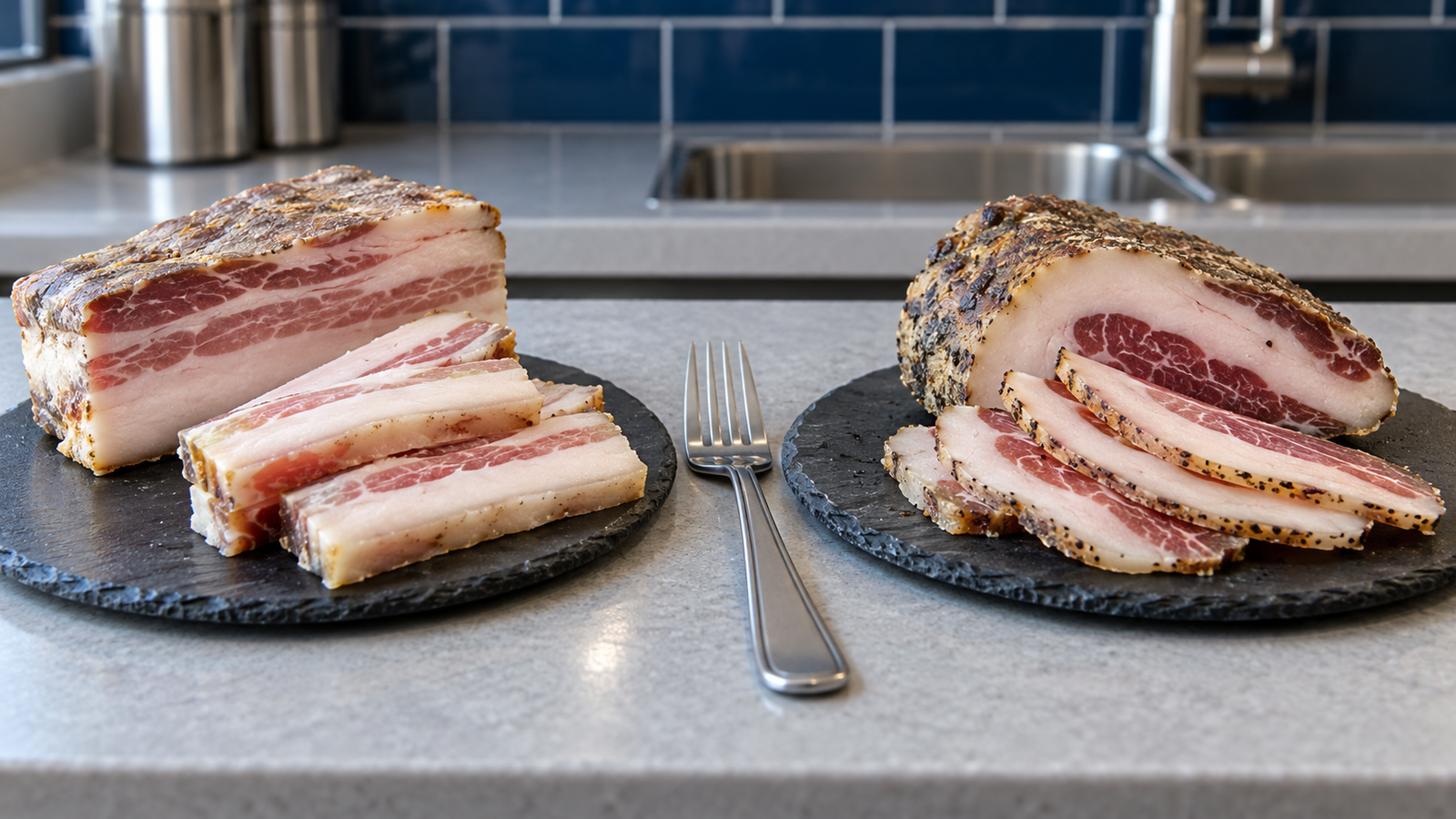
Most curing advice is written for lean muscle: bacon from pork belly, ham from the leg, jerky from a round roast. Salt pork and guanciale sit outside that pattern. Both start from cuts that are mostly fat, and the fat is the actual target of the cure, not a side effect of curing a leaner muscle attached to it. That difference changes how long the cure takes, what the finished product tastes like, and how it gets used in the kitchen.

Why fat takes a cure differently than lean meat
Salt cures lean meat largely through osmosis. Muscle tissue holds a lot of water, so salt applied to the surface draws that water out while salt moves in, and the process runs fairly fast and evenly because water carries the salt through the tissue. Fat holds very little water. There is much less moisture to move, so salt has to work its way through mostly by direct contact and time rather than by riding along with water leaving the tissue. A cure that fully penetrates a pork belly’s lean section in a few days can take noticeably longer to reach the same salt level through the fat layer on that same cut.
Fat also fails differently than lean meat does. Lean meat’s main spoilage risk during curing is microbial growth, which salt controls by lowering water activity. Fat’s main risk is oxidation: exposure to air and light turns fat rancid, producing a sharp, waxy, “off” smell and flavor that has nothing to do with bacteria. A cured fat product can be perfectly safe from a pathogen standpoint and still taste ruined because it picked up oxidation during an improperly wrapped cure or a too-long, too-warm storage period. That is one reason both salt pork and guanciale are traditionally kept away from light and air, wrapped tightly in cloth or paper rather than left exposed on a shelf.
Salt pork: what it actually is
Salt pork is pork belly or fatback, dry-cured in salt (often with a small amount of sugar to balance the flavor), without the smoking step that turns a similar cut into bacon. Salt pork starts from the same cut used for bacon, covered in our guide to curing bacon at home, but skips the smoke and relies on a heavier salt cure to do the preserving work instead. Historically it was cured heavily enough to keep without refrigeration, which made it a practical preservation food on ships, in logging camps, and in home kitchens before reliable cold storage existed. Modern commercial salt pork is usually cured more lightly than its historical version and does need refrigeration, so treat the “shelf-stable” reputation as a fact about the old heavy cure, not a guarantee about what is sold in a store today.
In the kitchen, salt pork works as a flavoring fat more than a cut eaten on its own. A small diced piece rendered in the bottom of a pot is the traditional base for New England baked beans and many versions of clam and corn chowder. In the American South, a piece of salt pork simmered with collard greens or black-eyed peas does the same job: it renders fat and salt into the cooking liquid and seasons the whole dish from the inside, the way a ham bone would in other recipes. Because the cure is salt-forward, taste the dish before adding more salt at the table. A pot that already has a piece of salt pork rendering in it is easy to oversalt.
Guanciale: a different fat-curing tradition
Guanciale is cured pork jowl, the cut from the cheek and lower jaw, and the name comes directly from “guancia,” the Italian word for cheek. Unlike salt pork, which is primarily a cooking fat, guanciale is a dry-cured product meant to be sliced and used as a central ingredient, most famously in carbonara, amatriciana, and gricia. The cure typically includes salt and black pepper, and depending on the region, additions like garlic, bay leaf, nutmeg, or juniper, rubbed onto the jowl and left to cure for one to two weeks before an extended air-drying period that can run anywhere from three weeks to several months depending on size, humidity, and the maker’s preference.
That air-drying period is the real difference between guanciale and a quick home-cured pork product. During drying, the jowl loses a meaningful amount of its original weight as moisture leaves, concentrating flavor and firming the texture enough to slice thin. Thin slicing matters here specifically because guanciale is usually cooked, not eaten raw: rendering thin slices in a pan releases fat into the sauce, which is the entire point of using it in a pasta dish rather than pancetta or bacon. People sometimes substitute pancetta for guanciale because it is easier to find. The results are edible but noticeably different: pancetta has a higher proportion of lean meat and a milder cure, so it renders less fat and brings a less concentrated flavor to the dish.
Where lardo fits in the same family
Lardo is worth mentioning here because it sits at the far end of the same spectrum: cured back fat, usually from the dorsal fat along the pig’s spine, with almost no lean meat at all. It is cured with salt and often fresh herbs like rosemary and garlic, then aged, traditionally in marble or stone troughs, for months. Unlike salt pork and guanciale, lardo is typically eaten with minimal or no cooking, sliced paper-thin over warm bread so the fat starts to soften from the bread’s heat. It is the clearest example in this category of fat cured purely to be eaten as itself, with no lean muscle involved and no cooking step required.
How curing times and conditions differ for pure fat
Because fat has so little moisture to help move salt through it, dry-curing fat generally takes longer per inch of thickness than curing a similarly sized piece of lean meat, and the salt percentage used is often calculated against the fat’s weight rather than assuming the same ratio that works for lean cuts (see our breakdown of curing salts and why the type matters for how those ratios are figured in general). Temperature and humidity control matter just as much as with lean-meat curing: a space that is too warm speeds up both the cure and the risk of spoilage running ahead of it, and air that is too dry can crust the surface before the inside has finished curing, trapping uncured fat under a hardened shell.
Comparing salt pork, guanciale, and lardo
| Product | Cut used | Cure type | Typical drying time | How it’s eaten |
|---|---|---|---|---|
| Salt pork | Pork belly or fatback | Dry salt cure, no smoke | Days to about two weeks | Rendered as a cooking fat |
| Guanciale | Pork jowl / cheek | Dry cure with pepper and spices | 3 weeks to several months | Sliced thin, rendered in cooking |
| Lardo | Back fat (dorsal) | Dry cure with herbs | Several months | Sliced paper-thin, eaten raw or barely warmed |
Freezing to extend how long it keeps
Freezing is the simplest way to extend the usable life of either product once it is cured, and it works differently than it does for fresh meat because the salt content changes how the fat freezes and thaws. Wrap the piece tightly, cut into portions sized for how it is actually used (a few tablespoons’ worth of salt pork for a pot of beans, a handful of guanciale slices for one pasta dinner), and press out as much air as possible before sealing, since the fat is more exposed to freezer odors and oxidation than lean meat would be at the same temperature. Thaw in the refrigerator rather than at room temperature, and use thawed portions within a few days rather than refreezing, since repeated freeze-thaw cycles accelerate the same rancidity problem that improper storage causes in the first place. Pre-portioning before freezing also solves a practical problem: guanciale is much easier to slice thin while it is still cold and slightly firm, so cutting it into use-sized chunks before the freeze means less fighting with a softened, room-temperature piece later.
Curing fat safely
Whatever the product, curing fat at home still means paying attention to the same fundamentals that apply to curing any meat: accurate salt measurement by weight rather than volume, since salt crystals pack differently depending on the brand and grind, consistent refrigeration temperature during the cure unless you are following a tested traditional method built for specific climate conditions, and clean handling throughout. The National Center for Home Food Preservation and the USDA’s Food Safety and Inspection Service both publish guidance on curing and smoking meat at home, including the water-activity and temperature benchmarks that make a cure safe rather than just traditional. A tested ratio and process matters more for fat-heavy cuts than people expect, because a too-light cure on a fat-dominant cut leaves more surface area exposed to oxidation and spoilage than the same mistake would on a leaner cut.
Do you need curing salt (nitrite) for these?
Whether a home cure needs sodium nitrite depends less on whether the product is “fat” versus “lean” and more on how long it sits unrefrigerated and whether it gets fully cooked before eating. Salt pork is almost always cooked thoroughly before it is eaten, rendered into beans, greens, or chowder, and most home recipes keep it refrigerated and use it within a reasonable window, so many home cooks cure it with plain salt and sugar and skip nitrite entirely. That is a different situation from a long, room-temperature or cellar-temperature air-dry.
Guanciale and lardo are the products where curing salt becomes a real safety question rather than a style choice. Both spend weeks to months hanging in conditions well above refrigerator temperature, and that extended time in a low-oxygen, moist interior is exactly the environment Clostridium botulinum needs to grow and produce toxin, regardless of how much the outside of the piece has dried. Commercial guanciale and lardo almost always use a nitrite or nitrate cure for this reason, alongside controlled humidity and temperature during the hang. A home version that skips curing salt and relies on salt concentration and drying alone is taking on real risk if the hang runs long, humid, or warm, which is why most tested home-curing guides for whole-muscle, long-aged products recommend using the correct curing salt rather than treating it as optional.
Salt alone, without nitrite, is not interchangeable with curing salt, and the two should never be substituted for each other based on taste or color preference. The amount of curing salt used matters as much as whether it is used at all: too little does not protect against botulism risk, and too much introduces its own health risk, which is why tested recipes specify curing salt as a percentage of the piece’s weight rather than “a pinch” or “to taste.”
Buying salt pork and guanciale instead of curing your own
Not everyone wants to run a multi-week cure at home, and both products are available to buy. Salt pork shows up in most well-stocked grocery stores, usually packaged near bacon or in a section with other cured pork, often vacuum-sealed in a small block. Check the package for a “keep refrigerated” instruction and a use-by date rather than assuming it is shelf-stable; as covered above, most modern commercial salt pork is cured lightly enough that it needs the same cold storage as bacon.
Guanciale is harder to find in a standard grocery store and is more reliably available at Italian specialty markets, butcher shops that carry cured Italian products, or online from cured-meat producers who ship it vacuum-sealed. When buying, look at the fat-to-lean ratio on the piece: a good guanciale has a substantial, even fat cap with the lean muscle running through it in a visible, marbled pattern, not a thin lean cheek with a token layer of fat. If a recipe calls for guanciale and the only option on hand is pancetta, that substitution works in a pinch, but expect a milder, less fatty result rather than an identical dish.
Common mistakes
- Treating modern salt pork as shelf-stable the way historical versions were. Refrigerate it unless the package specifically says otherwise.
- Confusing guanciale with pancetta or bacon in a recipe. The fat content and cure strength are different enough to change the finished dish.
- Slicing guanciale thick out of habit from slicing bacon. Thin slices render and cook more evenly.
- Storing any of these fully exposed to air and light, which speeds up rancidity even when the cure itself was done correctly.
- Assuming one all-purpose salt percentage works for every cut. Fat and lean muscle hold salt differently, and the right ratio depends on which one makes up most of the piece.
Salt pork, guanciale, and lardo are three answers to the same basic question: what do you do with a cut of pork that is mostly fat? Each one cures that fat for a different job: as a cooking base that disappears into a pot of beans or greens, as a central cooked ingredient sliced thin and rendered into a sauce, or as something eaten almost raw and meant to be tasted on its own. The cure itself, how long it runs, how heavily salted it is, how long the piece dries, tracks directly with which of those three jobs the fat is meant to do.
Visual steps
