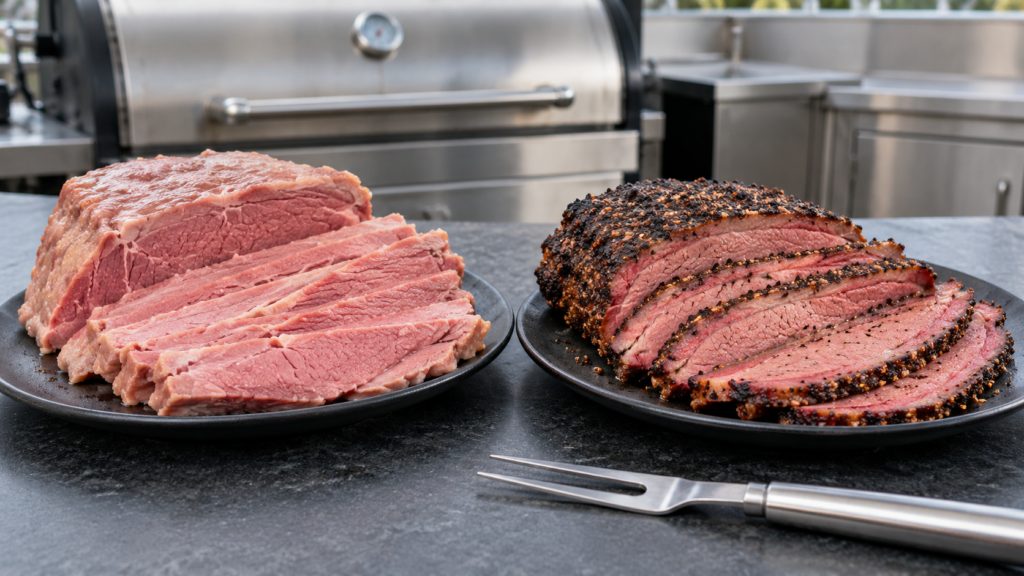
Corned beef and pastrami start from the exact same place: a brisket, cured in the exact same basic brine. Everything that makes them taste like two completely different foods happens after that shared starting point, not before it. Understanding where they actually diverge makes both far less mysterious, and makes it obvious why a corned beef brisket pulled straight from its brine will never taste like pastrami no matter how it’s cooked from there.
The shared starting point: a brine cure
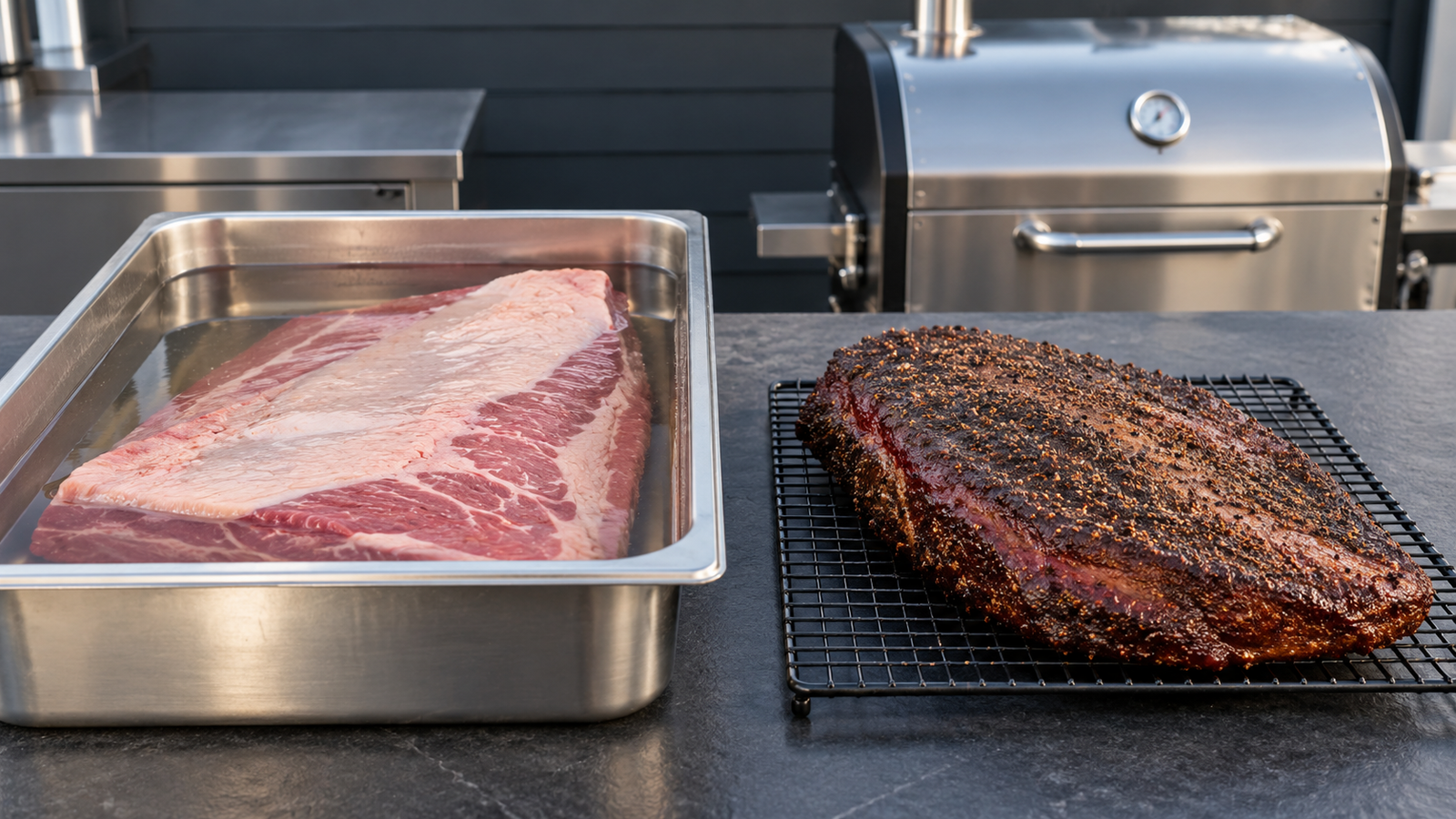
Both begin as a flat or whole beef brisket submerged in a wet brine built around Cure 1, the same sodium nitrite curing salt covered in full in this site’s curing-salts explainer, which does the actual safety work here: inhibiting the growth of Clostridium botulinum over the days the brisket spends curing. That article covers the full chemistry and the reason an exact ratio belongs on the product label rather than guessed at, so it won’t be repeated here. What matters for this comparison is simpler: both corned beef and pastrami need that same curing step to even exist as recognizable foods, since without it, “corned beef” and “pastrami” are just a plain brisket.

A basic brine runs roughly a gallon of water to a cup of kosher salt plus the correct ratio of Cure 1 for that volume (verified against the product’s own label, not estimated), along with sugar and pickling spices: mustard seed, coriander, bay leaf, black peppercorns, cloves, allspice. The brisket cures submerged and refrigerated for 5 to 10 days depending on thickness, turned occasionally so the brine reaches every surface evenly.
Where corned beef stops
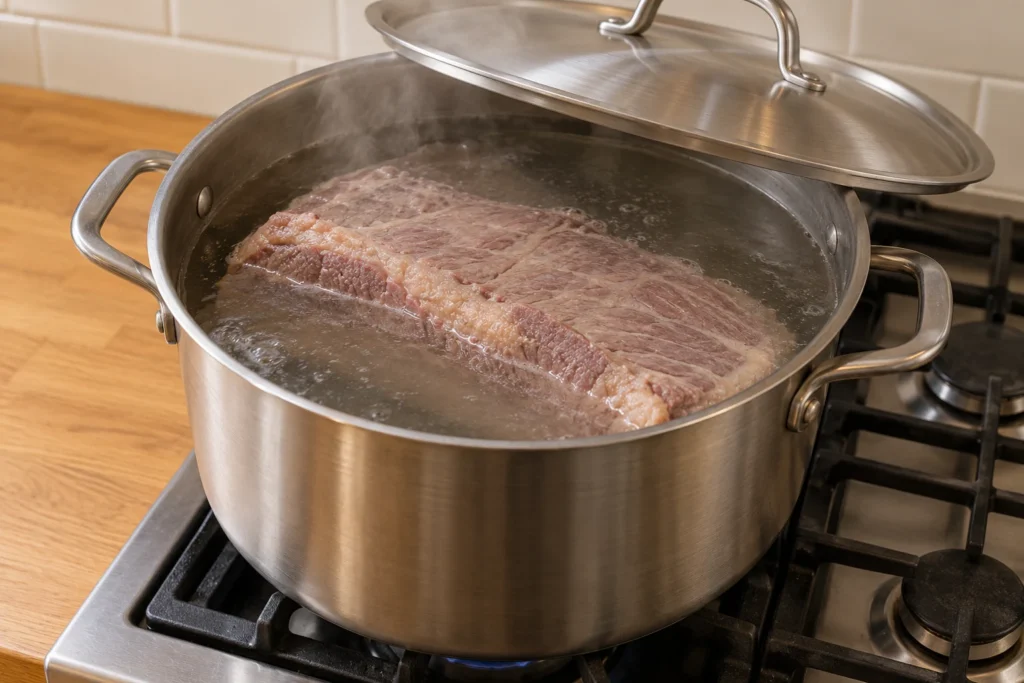
Corned beef is the simpler of the two once curing finishes. Rinse the cured brisket to remove surface salt, then simmer it gently in fresh water, often with the same pickling spices added back in, for roughly 3 hours per pound of brisket until it’s fork-tender. That’s the entire process: a long, gentle simmer, nothing else layered on top of the cure. The name itself comes from the large grains of salt historically used in curing, called “corns” of salt, not from any actual corn in the recipe.
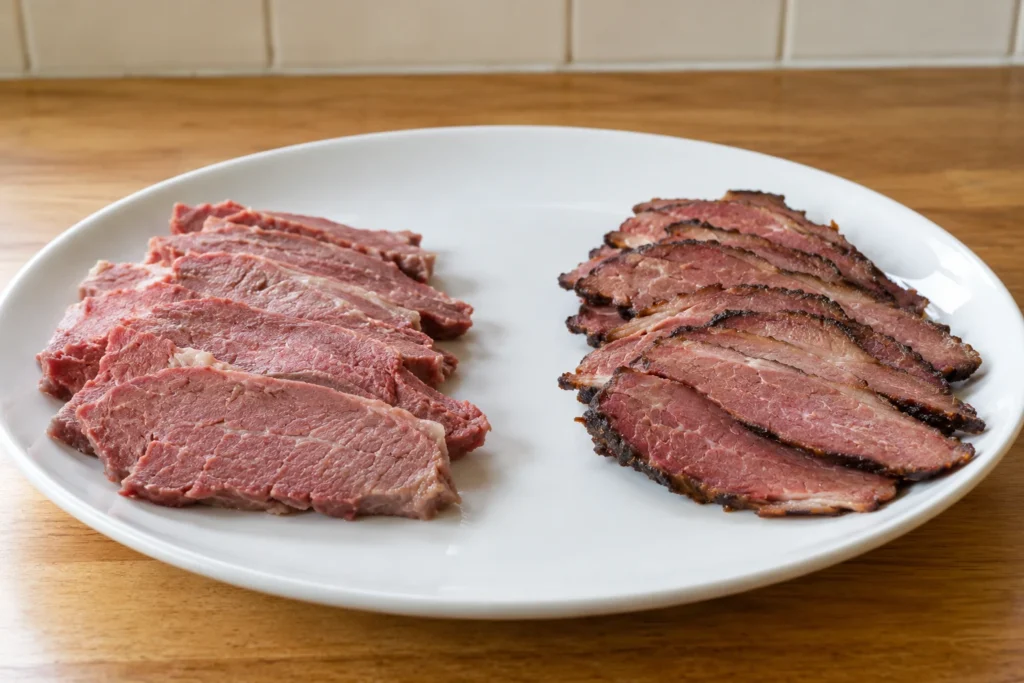
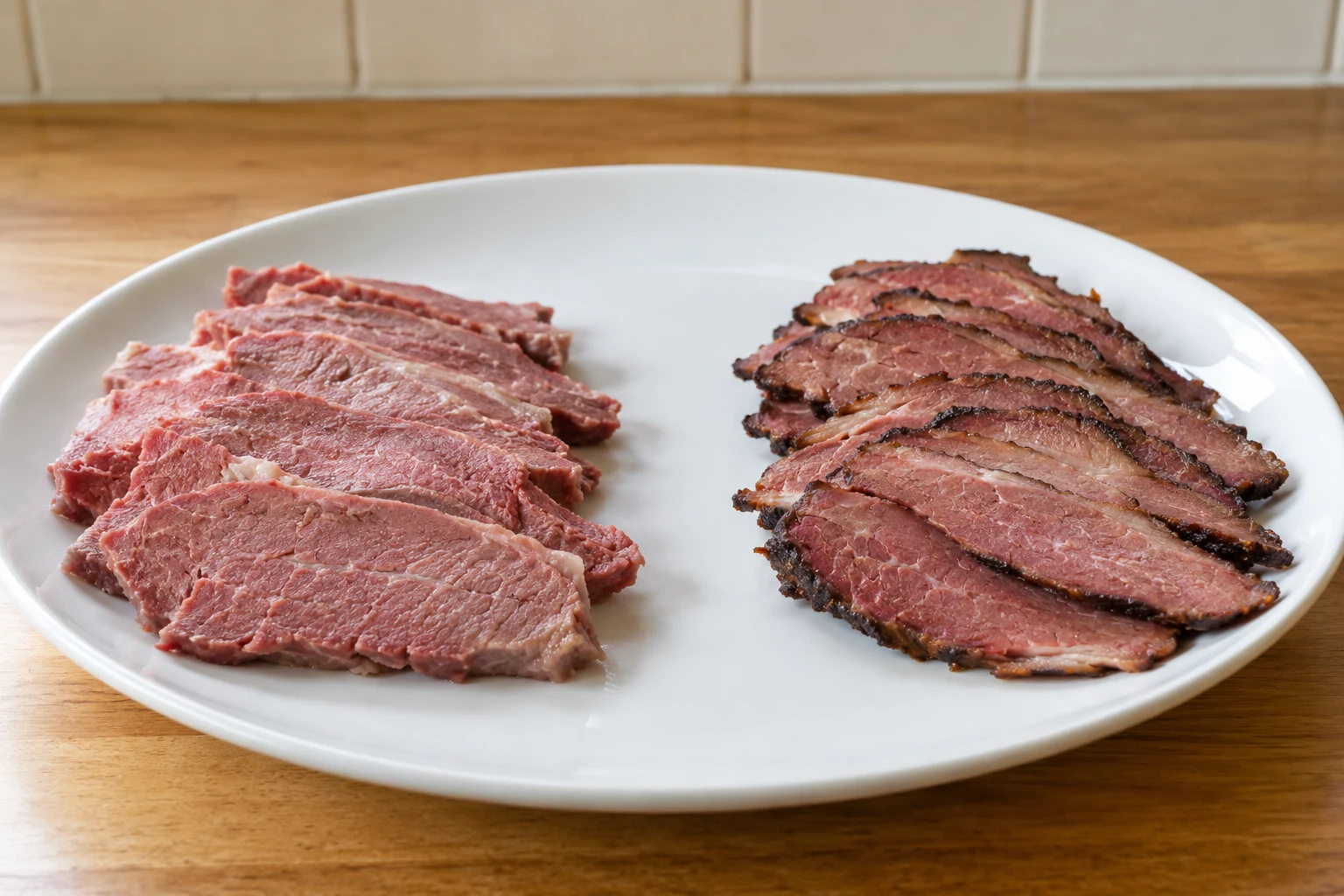
Done this way, corned beef stays pink throughout from the cure, tender from the long simmer, and carries a direct, unmasked brine flavor with nothing smoked or heavily spiced competing with it.
Where pastrami keeps going
Pastrami takes that same cured brisket and adds three more steps corned beef skips entirely. First, a heavy, coarse spice rub goes on, usually black pepper and coriander in roughly equal parts, crushed coarse rather than ground fine, which is what builds pastrami’s distinctive dark, peppery crust. Second, instead of a water simmer, the rubbed brisket goes into a smoker, typically in the 225 to 250°F range for several hours, closer to how this site’s other smoked brisket is handled than to a pot of simmering water. Third, after smoking, pastrami gets steamed, often for another hour or more, which finishes tenderizing it the way corned beef’s simmer does, just after the smoke has already done its work rather than instead of it.

That smoke-then-steam sequence is the real reason pastrami tastes nothing like corned beef despite sharing a cure. The spice crust, the smoke flavor, and the particular tenderness that comes from steaming after smoking rather than simmering in liquid are all additions corned beef never receives.

| Corned beef | Pastrami | |
|---|---|---|
| Cure | Wet brine with Cure 1 | Same wet brine with Cure 1 |
| Spice rub | None beyond what’s in the brine | Heavy, coarse black pepper and coriander crust |
| Heat method | Simmered in water | Smoked, then steamed |
| Flavor | Direct, brine-forward | Peppery, smoky, more complex |
| Typical use | Sliced for a boiled dinner or a sandwich | Sliced thin for a deli-style sandwich |
Where the two names actually come from
Both names describe process, not ingredient, which is part of why they’re easy to confuse at first. “Corned” refers to the large grains, or “corns,” of salt used in older curing methods, long before the word “corn” meant the vegetable in most English-speaking countries. “Pastrami” traces back to a Romanian word for pressed or preserved meat, carried into American delicatessen tradition largely through Jewish immigrant communities in the late nineteenth and early twentieth centuries, where it evolved into the smoked, steamed, heavily spiced version most people picture today. Neither name describes a cut of beef or a flavor on its own; both describe a specific sequence of steps applied to the same starting cut.
Picking the right brisket for this project
The flat, rather than the fattier point, is the more common choice for both corned beef and pastrami, mostly because it slices into neater, more uniform pieces once finished, and because a long cure and an even longer cook both work more predictably on a more consistent shape. A whole packer brisket, point and flat together, can absolutely be cured and used for either, and some traditional delis specifically favor a point-cut pastrami for its extra fat and richness, but a flat alone is the simpler, more forgiving starting point for a first attempt at either recipe.
Size matters more here than it does for a quick weeknight cut, since the curing time scales with thickness, not weight alone. A thinner flat cures faster and more evenly than a thick one, which is worth factoring in before committing to a specific piece, since an unevenly cured brisket can end up fully cured at the edges and under-cured at its thickest point if the timing was planned around the wrong dimension.
Making corned beef at home
- Cure a flat-cut brisket in a salt, sugar, and Cure 1 brine with pickling spices, submerged and refrigerated, for 5 to 10 days depending on thickness.
- Remove the brisket and rinse it thoroughly under cold water to clear excess surface salt.
- Place it in a pot, cover with fresh water, add pickling spices again if desired, and bring to a gentle simmer, never a hard boil, which toughens the meat instead of softening it.
- Simmer covered for roughly 3 hours per pound, checking for fork-tenderness rather than relying on time alone.
- Rest briefly, then slice against the grain.
Making pastrami at home
- Cure the brisket exactly as above, for the same 5 to 10 day window.
- Rinse thoroughly, then pat completely dry, since a wet surface won’t hold the spice rub properly.
- Coat generously with a coarse black pepper and coriander rub, pressed on firmly.
- Smoke at 225 to 250°F until internal temperature reaches roughly 165°F, building the bark and smoke flavor.
- Wrap and steam (a rack over simmering water in a covered pot works at home) for another hour or more, until it probes tender the same way a smoked brisket does.
- Rest, then slice thin against the grain, the standard deli-style cut.
A realistic home attempt versus a deli’s
Both are genuinely achievable at home with a smoker, a large pot, and patience, though a home attempt rarely matches a dedicated deli’s result on the first try, and that’s worth expecting rather than treating as a failure. Commercial pastrami specifically often goes through a longer, more controlled curing and smoking process than a home kitchen can easily replicate, and deli slicers cut thinner and more evenly than most home knives manage. A home version that’s a little thicker-sliced and slightly less uniform than a deli’s is still a real, legitimate version of the same food, not a lesser imitation of it.
Why the simmer and the smoke-then-steam both work on the same tough cut
Brisket is loaded with collagen, the same connective tissue that makes it a natural fit for a long smoked cook elsewhere on this site, and both corned beef and pastrami are really just two different delivery methods for the same underlying collagen-to-gelatin conversion. A gentle simmer and a smoke-then-steam sequence both hold the meat in roughly the same low, sustained heat range for roughly the same total time, long enough for that connective tissue to soften fully. The curing step changes flavor and color; the final tenderizing step, whichever form it takes, is doing the same structural work as any other long, slow brisket cook. That shared mechanism is also why rushing either process with higher heat produces the same disappointing result it would on an uncured brisket: a tough exterior with the collagen still intact at the center.
Serving it without needing anything elaborate
Corned beef sliced thick and served plain, alongside its own cooking liquid spooned back over the top, is a complete meal on its own with nothing else required. Pastrami sliced thin holds up well eaten the same simple way, or piled generously as the entire point of a plate rather than a component of something more elaborate. Neither needs bread, a specific side, or any particular presentation to be a legitimate, satisfying way to eat either one; the cure, the smoke, and the long cook are already doing all the real work.
Storage and reheating
Both keep 3 to 5 days refrigerated once cooked, and both freeze well, ideally sliced and portioned before freezing rather than as one large block. Reheat corned beef gently in a covered pan with a splash of its own cooking liquid or water, since it can dry out if blasted with direct heat. Pastrami reheats best steamed again briefly, the same method used to finish it originally, which restores moisture a dry reheat in a pan tends to strip away.
Mistakes specific to this process
- Boiling instead of simmering. A hard boil toughens the brisket; a gentle simmer tenderizes it.
- Skipping the rinse after curing. Excess surface salt left on makes the finished product oversalted no matter how careful the brine ratio was.
- Applying the pastrami rub to a wet surface. A damp brisket won’t hold a coarse spice crust properly; pat it fully dry first.
- Skipping the steam step on pastrami. Smoking alone leaves it tougher than true pastrami; the steam afterward is what actually finishes the tenderizing.
- Slicing with the grain. Both are considerably more tender sliced thin against the grain than cut the easy way.
Quick answers
Can I make pastrami without a smoker? Not genuinely. The smoke flavor is a defining part of what separates pastrami from corned beef, and liquid smoke or a stovetop smoking setup is a real but noticeably weaker substitute for actual time in a smoker. A pastrami-style spice rub on a simmered, unsmoked brisket is closer to a heavily seasoned corned beef than real pastrami.
Do I have to cure the brisket myself, or can I buy one pre-cured? A pre-cured, uncooked corned beef brisket is widely available, especially around certain holidays, and skipping the home curing step entirely is a completely reasonable shortcut for a first attempt at either recipe. Curing from scratch gives more control over salt level and spicing, but buying pre-cured brisket and picking up the process from the simmer or the spice-rub-and-smoke stage is a legitimate way to try pastrami specifically without committing to a multi-day cure first.
Why does my homemade pastrami come out tougher than a deli’s? This is almost always a smoking-and-steaming-time problem rather than a cure problem. A deli pastrami often spends considerably longer in both stages than a home attempt’s first try, and pulling it before the brisket actually probes tender, the same probe-feel test that applies to any other long brisket cook, produces a tougher result regardless of how well the cure and rub were handled.
Is the pink color in corned beef and pastrami from the cure, and is that normal? Yes. The same curing chemistry that protects against Clostridium botulinum also produces the characteristic pink color in both, the same mechanism covered in the curing-salts article. An uncured, plain-cooked brisket turns fully brown or gray; the pink color here is a direct, expected result of a properly cured brisket, not a sign it’s undercooked.
This is a technique guide, not a substitute for a tested curing recipe or professional food-safety guidance. Always verify curing salt ratios against the specific product’s label and a trusted, current source before a first attempt, and cook cured beef to a safe final temperature. References: USDA Food Safety and Inspection Service and the National Center for Home Food Preservation.
Visual steps