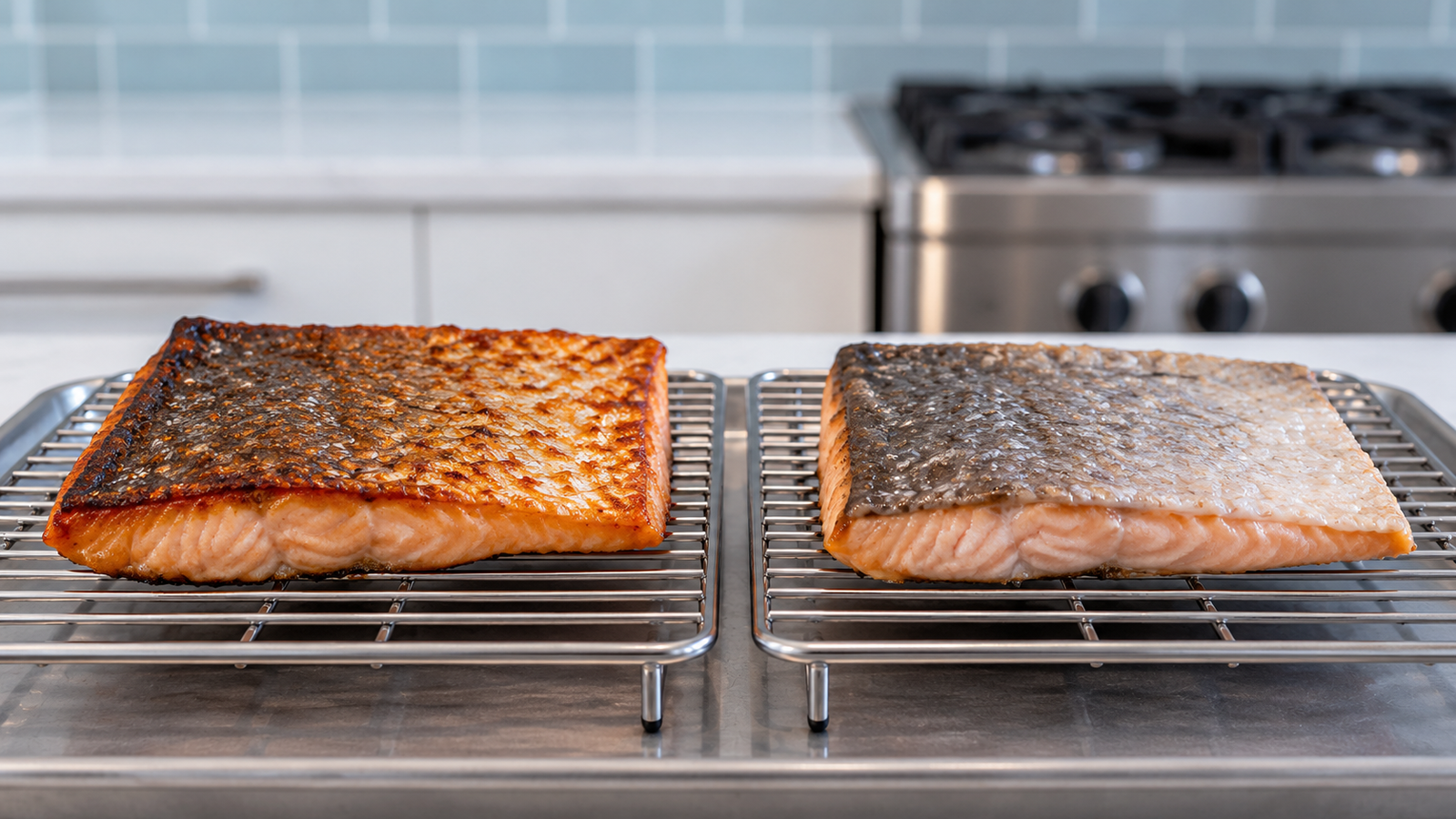
Salmon skin either shatters like a chip or sits there soft, pale, and rubbery, and there’s almost no middle ground once the fillet actually hits the plate. That gap is almost entirely about moisture and heat management, not luck, and not the fish itself. A salmon fillet that refuses to crisp is usually losing the fight before it even touches the pan.
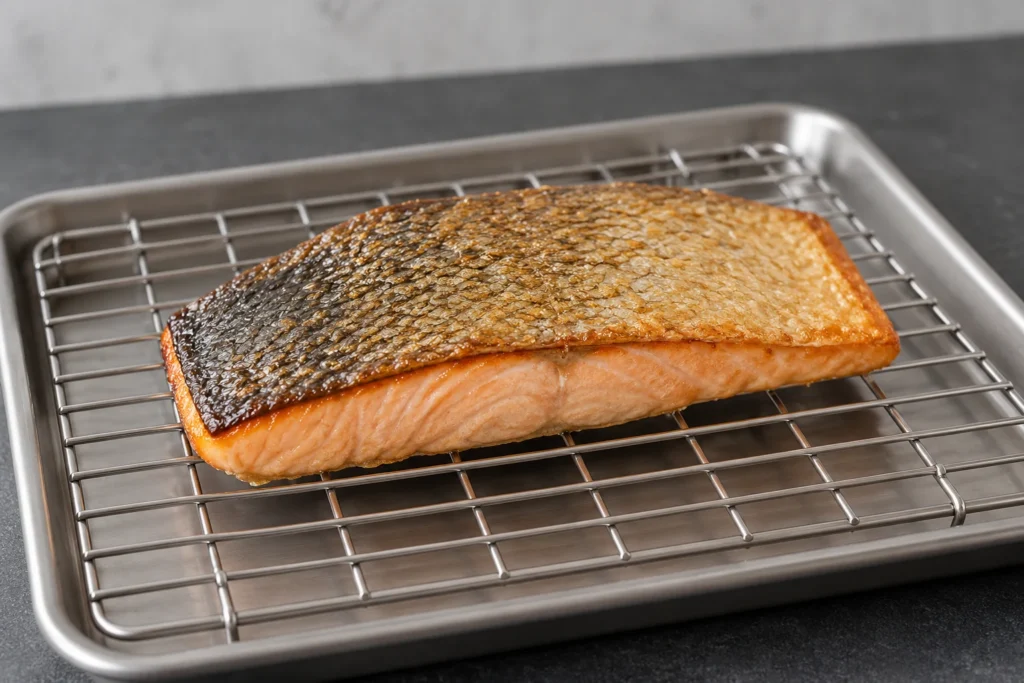
Why skin won’t crisp while it’s still wet
Skin is mostly collagen and fat sitting over a thin layer of connective tissue, and none of that renders into something crackling and crisp until the surface moisture is gone. Water has to boil off before the skin’s fat can actually start frying in its own right, and in a normal fillet straight out of the fridge, there’s enough surface moisture, from the fish itself and from any rinse before cooking, to absorb a meaningful chunk of the pan’s heat just evaporating it. Every second spent steaming off that moisture is a second the skin isn’t actually crisping, which is why a fillet that looks “almost there” for several minutes can suddenly go from pale to perfect once the water is finally gone.
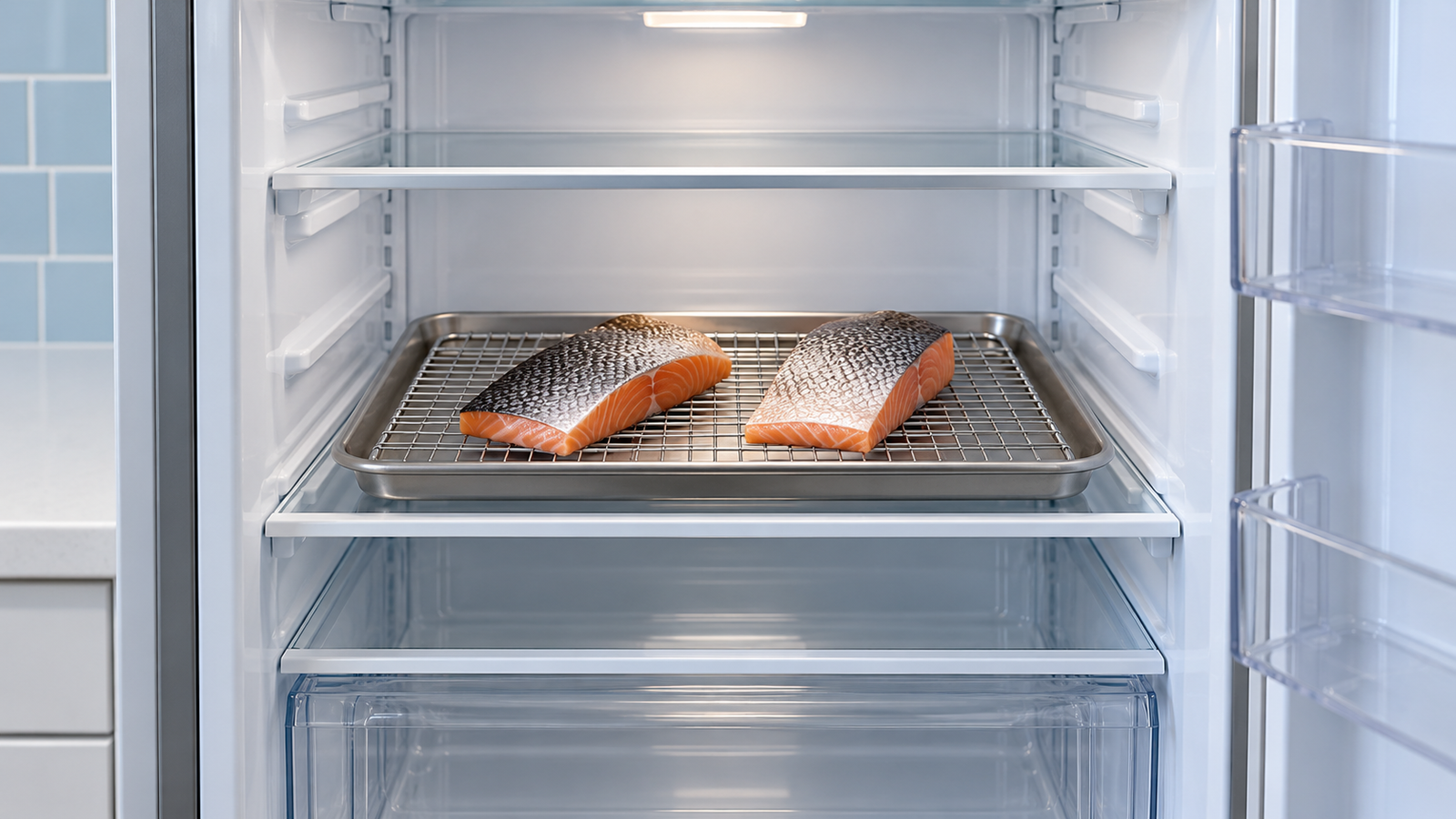
Patting the fillet dry with paper towel, pressing rather than wiping, removes the first layer of that problem before the pan is even involved. Letting it sit uncovered on a rack in the fridge for twenty to thirty minutes beforehand removes more of it, the same surface-drying principle that makes a dry-brined steak sear better than a wet one straight from the package.
Scoring the skin, and why it matters more than people think
Salmon skin shrinks and tightens as it hits heat, which pulls the whole fillet into a curl if nothing stops it. A curled fillet makes uneven contact with the pan, which means some of the skin is crisping while the rest is barely touching hot metal at all. Three or four shallow diagonal cuts through the skin, just deep enough to nick the fat layer without cutting into the flesh itself, relieve that tension and keep the fillet lying flat. It’s a small step that solves a problem most people blame on the pan or the fish instead of the skin’s own shrinkage.
The pan itself matters more here than for most cuts of meat
Non-stick is the most forgiving choice for anyone still learning this technique, since it genuinely reduces the chance of a stuck, torn fillet while the release-and-flip timing is still being learned by feel. Stainless steel, properly heated and oiled, crisps skin just as well once that timing is understood, and it tolerates higher heat for a harder final crust than most non-stick coatings are rated for. Cast iron sits in between: it holds and distributes heat evenly once fully preheated, which helps avoid the uneven hot spots that can scorch one section of skin while another stays underdone, but it needs a genuinely hot, well-seasoned surface and a patient preheat to perform at its best, more setup than either of the other two options typically asks for.
Whichever pan gets used, a properly heated and oiled surface matters more than the specific material. A cold or under-oiled pan sticks regardless of what it’s made from, and a fillet forced loose from a pan it was never going to release from cleanly tears its own crust away in the process, the exact outcome this whole technique is built to avoid.
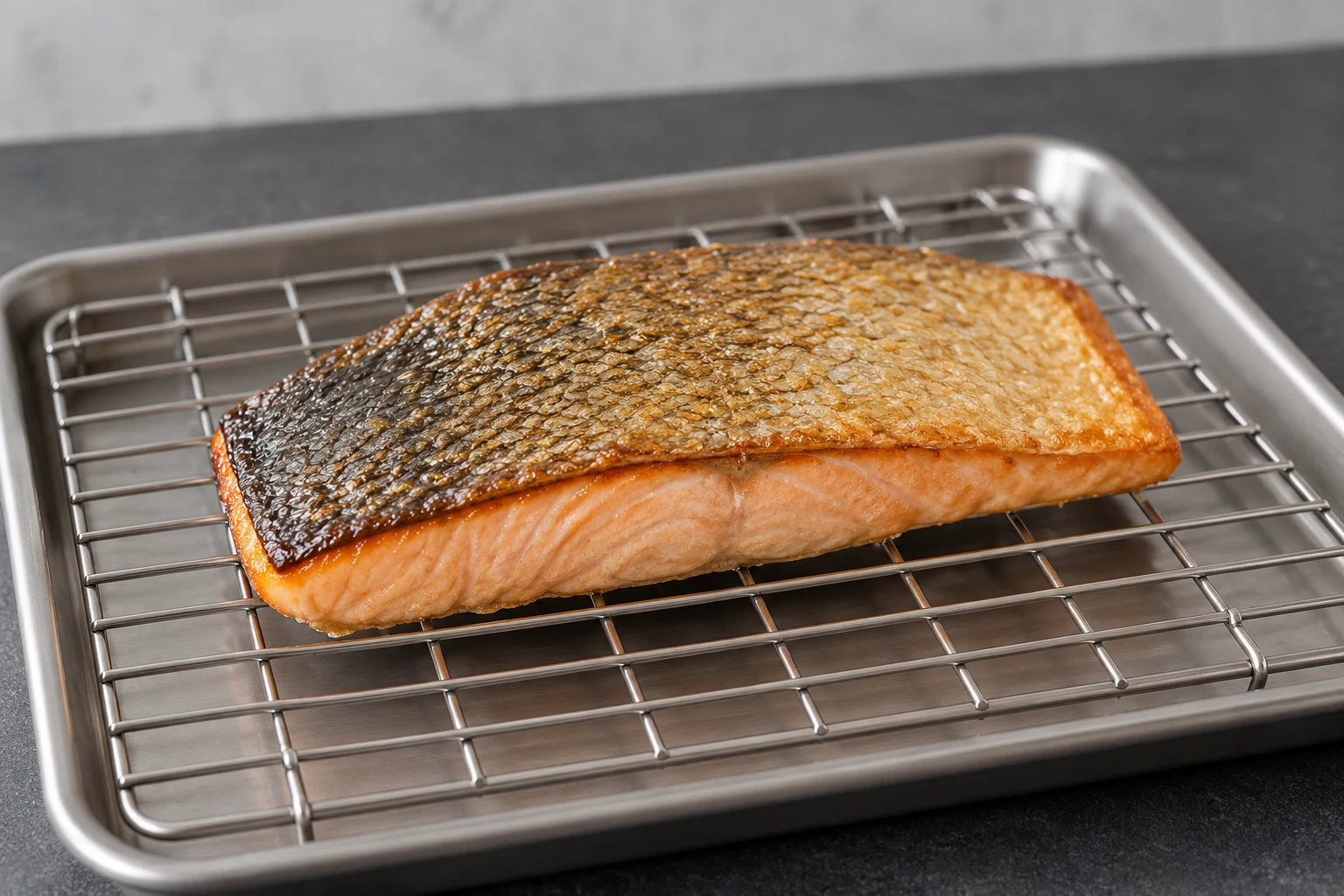
Cold pan or hot pan: the actual answer is neither extreme
Some techniques call for starting the fillet in a cold pan with the oil, letting both come up to temperature together. The idea is sound: a slower ramp gives the skin’s fat more time to render gradually before the surface outside it scorches. Other techniques insist on a screaming-hot pan from the start, chasing a fast, hard crisp. Both can work, but a hot-but-not-smoking pan, oil shimmering and just barely below the point it starts to smoke, is the more forgiving middle ground for anyone without a lot of salmon reps under their belt. Too cold and the fish sits releasing moisture into the pan for too long before anything actually crisps; too hot and the skin can burn on the surface before the fat underneath has fully rendered.
Pressing it down, and why the fillet needs to be told to stay flat
Even a properly scored fillet wants to curl slightly as the skin tightens in the first thirty seconds in the pan. Pressing it gently with a fish spatula, holding light, even pressure across the whole fillet rather than pushing hard in one spot, keeps full skin contact with the pan during exactly the window when that contact matters most. Letting go too early is a common reason one half of a fillet crisps evenly while the other half, the part that lifted away from the heat, stays pale and soft.
Knowing when it actually releases on its own
A salmon fillet that’s genuinely ready to flip releases from the pan with almost no resistance, sliding free under a spatula rather than tearing or sticking. That release happens because a proper crust has formed between the skin and the pan surface, the same underlying mechanism behind a seared steak releasing cleanly once its own crust is set. Trying to force a flip before that release happens tears the skin and leaves the crisped layer stuck to the pan instead of attached to the fish, which is the single most common way a nearly-perfect piece of salmon gets ruined in the last thirty seconds.
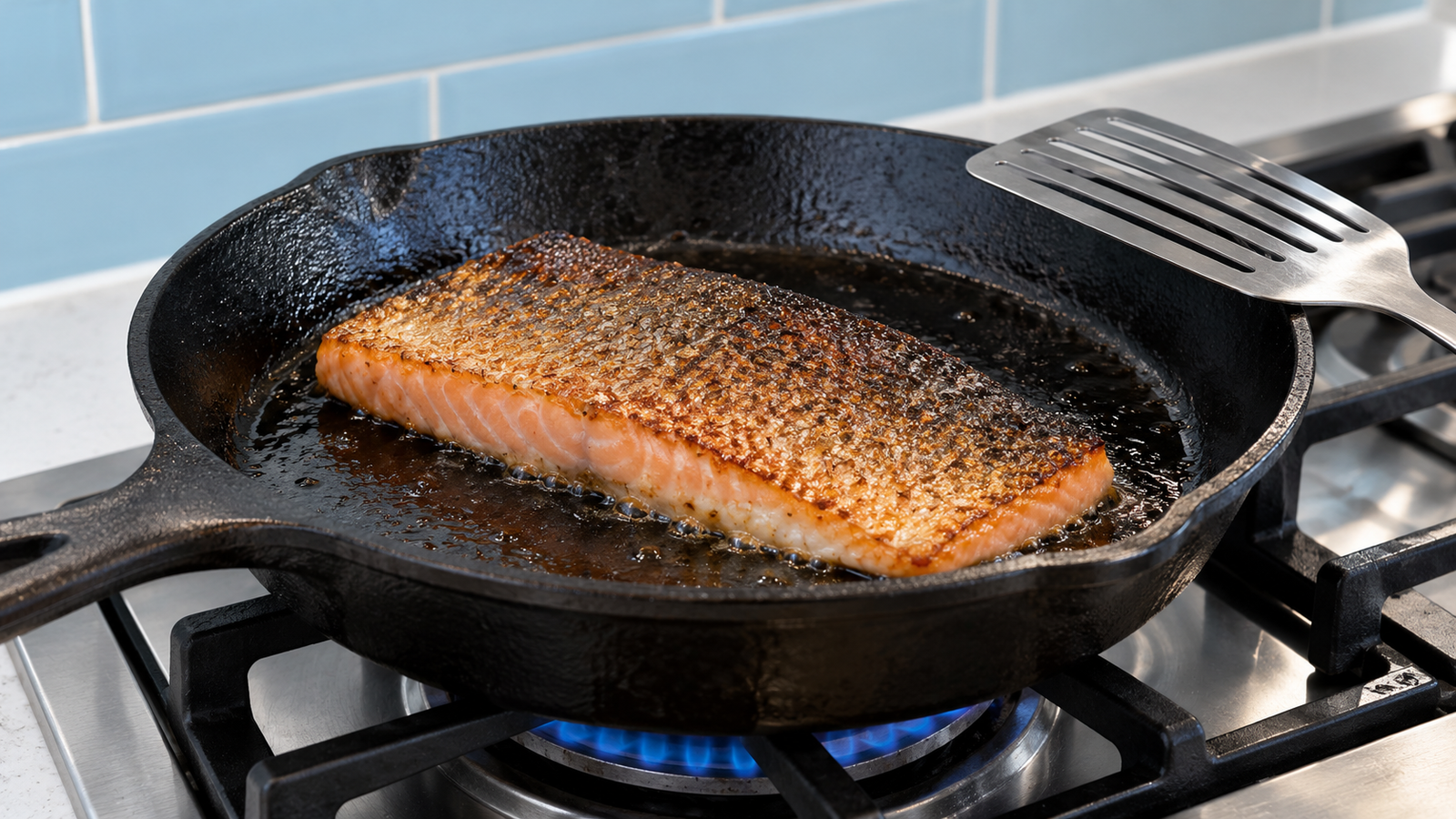
Buying salmon with the skin’s final texture already in mind
Not every piece of salmon at a counter is equally set up for crisping. Scale-on, skin-on fillets from a whole fish, not pre-portioned and vacuum-packed cuts, tend to have intact skin without the small tears and thin spots that make packaged portions harder to crisp evenly. Farmed salmon, more consistently fatty across the whole fillet, tends to crisp a little more reliably than leaner wild salmon, where fat content varies more by season and by the specific fish, and a leaner piece has less of its own rendering fat helping the skin along. Neither is the objectively correct buy; it’s a real tradeoff between consistency and the leaner, more pronounced flavor wild salmon tends to carry.
Checking that the skin itself is actually intact before buying is worth the extra few seconds. A torn or heavily scaled patch of skin on a fillet at the counter is going to be the weak point that never crisps evenly no matter how well everything else in this guide gets followed, and it’s far easier to simply pick a different, better piece than to compensate for damaged skin after the fact.
Beyond the stovetop: oven and grill both change the calculation
A hot oven, 425 to 450°F, with the fillet started skin-side down on a preheated sheet pan or in a preheated cast-iron skillet, gets closer to pan-sear results than a cold sheet pan ever will, since the preheated surface gives the skin the same early, hard contact it gets in a pan. An oven finish works well for anyone cooking several fillets at once, where a stovetop would mean crowding the pan and losing the dry-surface advantage this whole technique depends on.
A grill asks for a different kind of care: the skin genuinely helps here, acting as a barrier that keeps delicate flesh from sticking directly to hot grates and falling apart when it’s time to flip. A well-oiled grate and skin-side down for the majority of the cook, the same core principle as the pan, usually produces a result closer to deeply charred than classically crisp, which is a different, also legitimate texture rather than a failure of the technique.
Step by step, skin-side crisp
- Pat the fillet completely dry, then let it sit uncovered in the fridge for 20 to 30 minutes if there’s time.
- Score the skin with three or four shallow diagonal cuts, just through the skin and fat layer.
- Salt both sides, skin included, a few minutes before cooking.
- Heat a neutral, high-smoke-point fat in a stainless or cast-iron pan until it shimmers but isn’t smoking.
- Lay the fillet skin-side down and press gently with a fish spatula for the first 20 to 30 seconds.
- Leave it alone. Resist checking by lifting a corner early; it either releases cleanly or it isn’t ready yet.
- Once it releases on its own, cook skin-side down for most of the total time, flipping only briefly at the end to finish the flesh side.
Doneness, and why salmon gets treated a little differently
USDA guidance sets 145°F as the safe minimum internal temperature for fish generally, the same floor that applies to any other finfish. In practice, a meaningful number of people who cook salmon regularly pull it a bit earlier than that, often in the 120 to 130°F range, aiming for a center that’s still translucent and faintly rare rather than fully opaque all the way through. That’s a personal doneness preference, the same kind of choice this site already covers honestly for a medium-rare steak, not a food-safety override, and it carries more real weight the less certain the sourcing is. Cooking all the way to 145°F, where the flesh turns fully opaque and flakes easily, is the safer, more conservative target, and it’s the one worth defaulting to for anyone serving salmon to someone more vulnerable to foodborne illness.
What usually goes wrong, and the actual fix
- Skin left wet. Skipping the pat-dry step is the single most common reason skin never crisps at all, regardless of how hot the pan is.
- No scoring on a thick or naturally curved fillet. An unscored fillet curls away from the pan and crisps unevenly across its surface.
- Flipping too early. If it doesn’t release on its own with light pressure, it isn’t ready, and forcing it tears the crust away from the fish.
- Crowding the pan. Multiple fillets too close together trap steam between them, which undermines the same dry-surface requirement that crisping depends on in the first place.
- Cooking skin-side up for most of the time. Skin-side down for the majority of the cook is what actually builds the crisp; flipping too early and finishing flesh-side down wastes most of that opportunity.
What to do with a fillet that didn’t crisp
A fillet that comes out with soft, uncrisped skin isn’t ruined. Removing the skin before serving and treating it as a separate crispy garnish, rendered a little longer alone in a hot pan after the fillet comes out, salvages most of the texture that was lost the first time around. It’s not the ideal outcome, but it’s a genuinely useful fallback rather than starting over or serving a soft, chewy piece of skin nobody actually wants to eat.
Storing and reheating without losing the crisp a second time
Cooked salmon keeps for 2 to 3 days refrigerated, and once it’s cooled, that crisp skin is on borrowed time either way: any moisture trapped under a lid or in a sealed container softens it within a day, regardless of how well it crisped the first time. Storing it uncovered or loosely covered for the first hour or two while it’s still cooling, then sealing it once it’s fully cool, slows that softening slightly, though it won’t prevent it entirely.
Reheating salmon well is less about restoring the original crisp, which rarely comes back the same way twice, and more about not drying out the flesh in the attempt. A low oven, around 275°F, covered loosely with foil until just warmed through, keeps the center from overcooking the way a full-power microwave reliably does. For anyone who genuinely wants a second shot at crispy skin, a few minutes skin-side down in a hot, dry pan, with no added fat since the fillet already carries its own, re-crisps the surface while the center simply gets a gentle reheat alongside it.
What actually pairs with a crisp-skinned fillet
A properly crisped skin is worth keeping as the centerpiece rather than burying it under a heavy sauce, which softens exactly the texture the whole technique was built to achieve. A squeeze of something acidic, a simple pan sauce made from the fond left behind after the fillet comes out, or nothing at all beyond salt, lets the actual crisp stay the point of the dish rather than a detail lost under something wetter poured on top right before serving.
This is a technique guide, not a food-safety substitute. Always use a reliable thermometer, and anyone immunocompromised, pregnant, very young, or otherwise more vulnerable to foodborne illness should cook fish fully to the USDA safe minimum rather than to a rarer personal preference. Reference: USDA/FoodSafety.gov safe minimum cooking temperatures.
Visual steps
