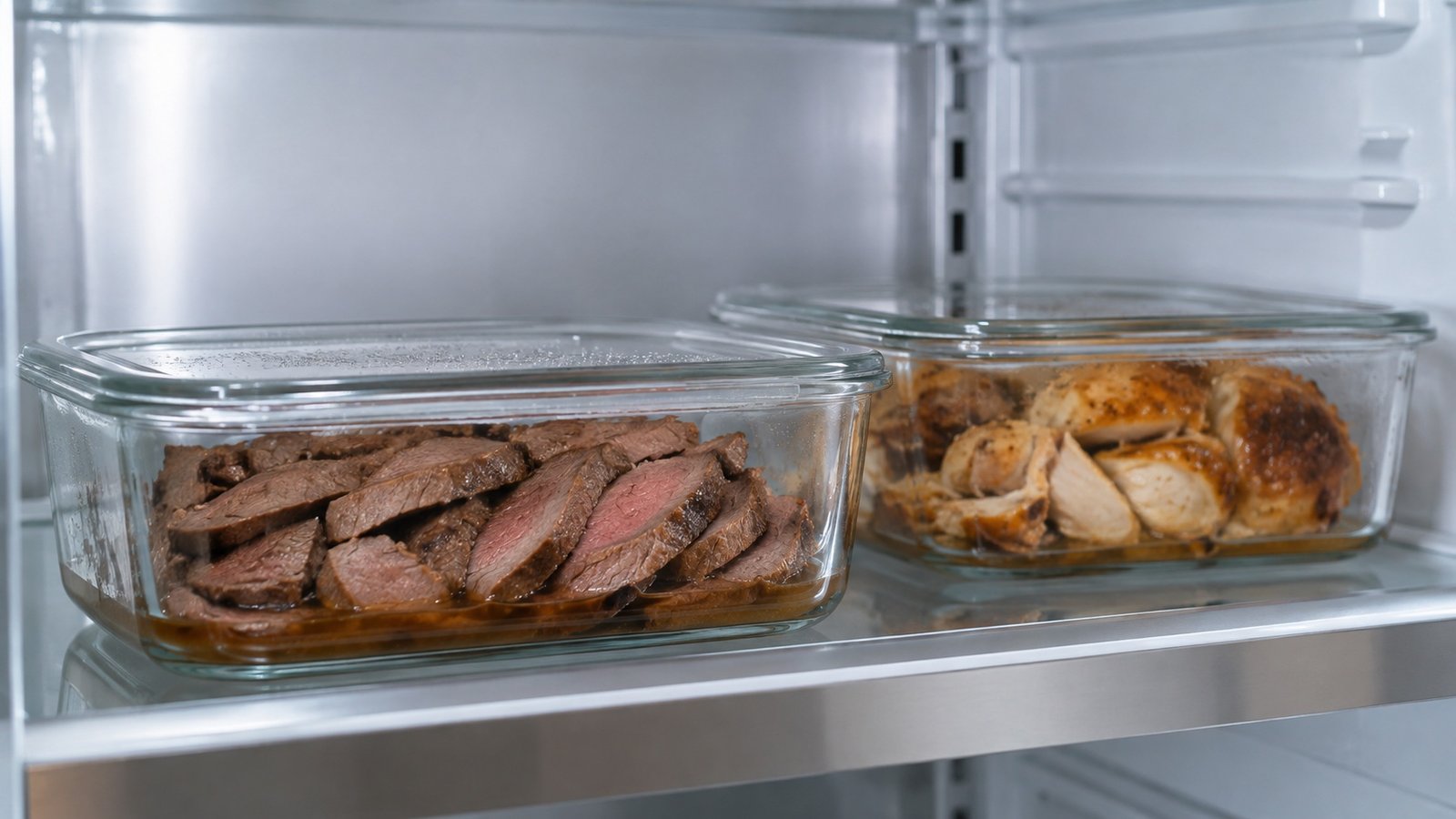
Cooked meat is easiest to waste in the hours after dinner, not on the fourth day. A large roast sits on the counter while the kitchen is cleaned. A pan of burgers cools in a deep stack. A whole chicken goes into the refrigerator intact because pulling it apart feels like tomorrow’s problem. By the time anyone wants lunch, the meat is dry at the edges, the storage date is a guess, and the useful window has become unclear.
A better system is small enough to use every time: portion cooked meat while it is still easy to handle, cool it promptly in shallow containers, label it with the cooking date, and make an honest decision on day four. That protects both the texture you worked for and the safety margin that leftovers need. It also turns a roast, grilled chicken, or pan of ground beef into several ready meals instead of one heroic dinner followed by a refrigerator mystery.
The short answer: three to four days cold
For cooked meat held in a refrigerator at 4°C / 40°F or colder, use a three-to-four-day window. The clock starts on the day it was cooked, not the day you remember finding it. If you cooked a steak on Sunday evening, it belongs in the freezer or on the plate by Thursday evening. If you are not confident the refrigerator stayed cold, the sensible answer is sooner, not later.
That range is a storage rule, not a sniff test. Cold slows bacterial growth; it does not stop it. A clean-looking, normal-smelling piece of meat is not a reliable safety signal. Write the date down when the container closes so you never have to bargain with a vague memory on day five.
| Cooked meat | Refrigerator window | Best freezer window for quality |
|---|---|---|
| Roasts, steaks, chops, ground meat, and meatballs | 3–4 days | 2–3 months |
| Cooked chicken or turkey | 3–4 days | 4–6 months |
| Meat stock, broth, gravy, or drippings | 3–4 days | 4–6 months |
Those storage windows assume proper cooling and a cold refrigerator. They are not a reason to stretch meat that sat out for an afternoon, rode around in a warm car, or spent hours in an oven turned off after cooking. When the handling history is uncertain, treat the uncertainty as information.
Cool the meat in portions, not in one giant mass
The move that matters most happens before the leftovers enter the refrigerator. Dense, deep piles hold heat in the middle long after the surface feels cool. Instead of putting a whole roast or a crowded pan into one large container, divide it. Slice a roast into meal-size portions. Pull cooked chicken from the bones. Spread ground meat or chopped beef in a shallow layer. Use several shallow containers when the batch is large.
- Set out clean, shallow containers before you begin carving or portioning.
- Separate the cooked meat into portions you would actually reheat at one time.
- Let obvious steam ease off briefly, then refrigerate the portions promptly rather than waiting for them to become fully cold on the counter.
- Keep the containers loosely covered while they cool if needed, then close them once cold.
- Label each container with the cooked date and the last safe refrigerator day.
Do not leave a large batch out while you wait for it to reach room temperature. The goal is rapid, even cooling, and shallow portions do that far better than one heavy vessel. Keep the refrigerator at or below 4°C / 40°F and leave room for cold air to move around the containers. An overfilled refrigerator is not merely inconvenient; it makes even cooling harder.
Portion by the next meal, not by the original cook
A whole cooked bird or a thick roast has already done its job. Leaving it intact for the sake of presentation makes storage slower and later reheating clumsier. Break it down while the meat is still warm enough to handle comfortably. Keep slices or pieces that will be reheated together in one container and avoid reopening a large box every time someone wants a small portion.
This is also the simplest way to keep texture under control. A steak reheats best as one thick piece, then gets sliced after warming. Thin slices of roast beef are better packed in a low, flat layer with the collected juices. Ground beef is easiest to use when pressed into a thin, loose layer that can warm quickly in a pan. Meatballs should cool in one layer first, then move to a container once they no longer steam heavily.
The pattern is consistent: smaller portions cool faster, are easier to date, and avoid the repeated heat-and-cool cycle created by taking from one large container all week. Cook for today, then pack for the exact meal you expect to eat next.
Use a date rule that does not depend on memory
Write two things on every container: what is inside and the final refrigerator day. “Roast beef — cooked Sunday — use by Thursday” is enough. Do not rely on an unlabeled container, a recollection of which evening you grilled, or a hopeful inspection after it has been sitting for several days.
If you cook often, keep a simple rotation: the newest containers go behind the older ones, and the oldest cooked meat becomes the next meal. This keeps the refrigerator from turning into an archive. It also gives you a clear freezing decision: if a portion will not be eaten by its use-by day, freeze it while it is still in good condition rather than freezing it after it has already become a reluctant choice.
| If you cooked it on… | Plan to finish or freeze it by… | Useful action |
|---|---|---|
| Sunday | Thursday | Pack Tuesday and Wednesday meals; freeze the rest on Wednesday if needed. |
| Wednesday | Sunday | Keep the closest meal in the refrigerator and freeze portions intended for next week. |
| Before travel or a busy stretch | Before the trip begins | Freeze immediately after cooling instead of asking someone else to guess the date. |
Freeze early enough to keep the meat worth eating
Freezing is not a last-minute rescue for tired leftovers. It is the right choice when you can already see that a portion will miss its refrigerator window. Freeze cooked meat in the portion size you will actually thaw. Press excess air from a freezer bag, or use a tight container with little empty headspace. Flat packages freeze and thaw more evenly than a thick block, and a flat package is easier to stack without losing track of it.
For quality, cooked roasts, steaks, chops, ground meat, and meatballs are best used within two to three months. Cooked poultry, stock, and gravy hold quality longer in the freezer. The freezer stops the clock on safety when it holds a steady 0°F / -18°C, but it cannot reverse dryness or freezer burn that began before the package went in.
For thawing, use the refrigerator when time allows. A microwave can be useful when the meat will go straight into reheating. Avoid thawing cooked meat on the counter. Once a portion is thawed, treat it like a meal you are about to eat, not a new long-term refrigerator project.
Reheat once, with just enough heat
Reheating is where good leftovers become dry leftovers. The fix is not to serve meat lukewarm; it is to add a little captured moisture and use controlled heat. Reheat only the portion you intend to eat. A large container that gets warmed, partially served, cooled, and reheated again loses quality fast and muddies the handling history.
- Steaks and chops: warm covered over low heat with a spoonful of their own juices or rendered fat, then uncover briefly if the surface needs reviving.
- Roast slices: lay them in a low pan with their juices, cover, and warm gently so the slices do not tighten before the center is hot.
- Ground meat and meatballs: use a wide pan, moderate heat, and a small amount of fat or juices; stir only as much as needed to warm evenly.
- Chicken or turkey: reheat covered in a shallow pan with collected juices, then uncover at the end only if the skin needs a short crisping pass.
For safety, reheat leftovers until the center reaches 74°C / 165°F. Use a thermometer in the thickest part rather than trusting steam around the edges. Then eat the reheated portion. Do not turn the same container into an endless loop of reheating and cooling.
Know when the right answer is to throw it out
There is no technique that repairs an uncertain storage history. Discard cooked meat that has been at room temperature for more than two hours, or more than one hour in very hot conditions. Discard a container with an unknown cooking date. And do not taste a questionable portion to decide whether it is safe. That is not thrift; it is gambling with information you do not have.
Visible mold, a leaking container, or a clearly off odour are immediate reasons to discard it, but the absence of those signs does not extend the calendar. The date, the refrigerator temperature, and the cooling history are the useful checks. When any of them fails, the batch has reached its end.
A 10-minute leftover routine that works every time
After a meat-heavy dinner, do this before the kitchen is finished: pull or slice the meat, portion it into shallow containers, add the juices you want to keep, write the date, and get the containers into a cold refrigerator. The next day, decide which portion will be eaten first. By day three, freeze anything that is not clearly assigned to a meal.
That routine is intentionally plain. It gives cooked meat a short, legible path: cook, cool, date, eat, or freeze. No unlabeled boxes, no dried-out leftovers, no repeated microwave cycles, and no guesswork at the back of the refrigerator. The result is meat that stays safer, reheats better, and actually gets used.
Food-safety references: USDA leftover-handling guidance; Health Canada safe food storage guidance; and Health Canada leftover guidance. This guide is practical storage guidance, not a substitute for local public-health advice.