Butter goes from perfectly done to genuinely burnt in roughly the time it takes to answer a short phone call, no longer than that. That’s the entire reason brown butter has a reputation as a tricky, advanced technique when it’s actually a simple one with almost no tolerance for distraction. Get the timing right and it takes about five minutes start to finish. Get it wrong and the whole pan is garbage, worth asking anyone who’s ever walked away from the stove “for just a second” at exactly the wrong moment.
Brown butter is not ghee, even though both involve browning
It’s genuinely worth being precise about this distinction, since the two get confused constantly even among people who cook regularly. Making ghee means cooking butter until its milk solids toast, then straining those solids out, leaving pure, clarified fat behind. Brown butter stops at the toasting step and never strains anything out. The browned milk solids stay suspended in the fat, which is the entire point: those solids are where the nutty, almost hazelnut flavor actually comes from, and leaving them in is what makes brown butter brown butter rather than a rough draft of ghee.
That difference changes what each one is good for. Ghee’s high smoke point and absence of milk solids make it suited to high heat searing. Brown butter, still carrying water and those browned solids, burns at a lower temperature and isn’t meant for that job at all. It’s a finishing fat and a flavor ingredient, used in smaller amounts, not a cooking medium for a hot pan.
What’s actually happening in the pan
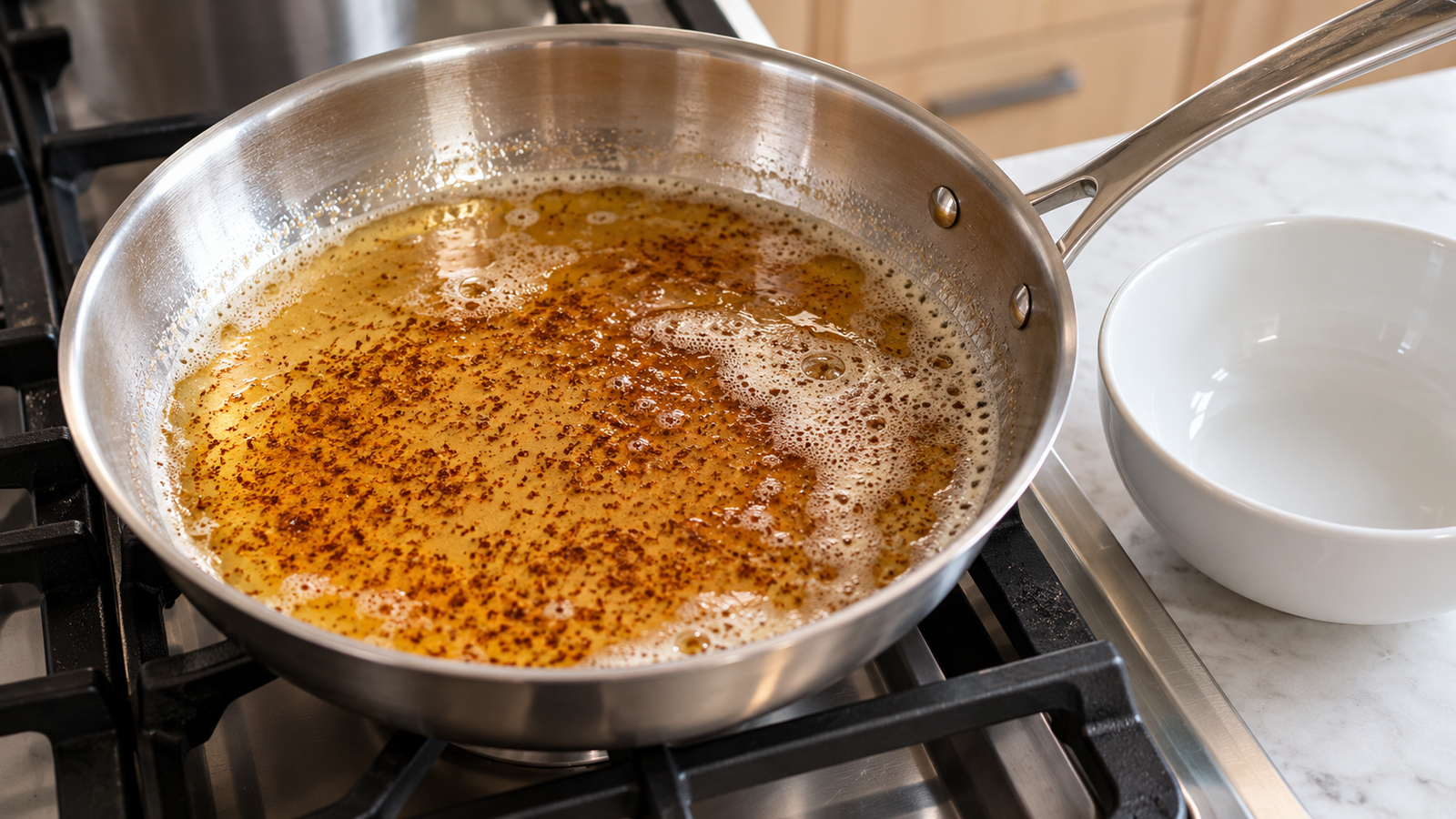
Butter is roughly 80 percent fat, with the rest made up of water and milk solids, mostly proteins and a small amount of milk sugar. Melt it in a pan over real heat and three distinct things happen in sequence, one after another. First, the water boils off, which is what causes the loud, rapid foaming in the first couple of minutes. Once most of that water is gone, the foam calms down and the milk solids, no longer protected by all that moisture, begin to sink to the bottom of the pan and toast directly against the hot metal. That toasting is a genuine Maillard reaction, the exact same browning chemistry responsible for building a proper crust on a seared steak, just happening here to milk proteins instead of meat proteins. The solids move through pale gold, to a deeper amber, to brown, releasing that nutty smell at each stage along the way.
The entire real window between “perfectly browned and ready to use” and “burnt, bitter, and worth throwing out” is often genuinely under a full minute once the solids start visibly coloring in the bottom of the pan. That’s the real reason this technique has a reputation at all: it isn’t genuinely difficult in any technical sense, it’s just unforgiving of inattention at exactly the point most people assume the hard part is already safely behind them.
Reading the pan instead of a clock
A clock is a rough guide here, not a reliable one, since pan material, butter quantity, and stove output all shift the actual timing. What doesn’t shift is the sequence of visual and smell cues, which are the same every time regardless of equipment.
| Stage | What to look for | What to do |
|---|---|---|
| Melting | Butter liquefies, loud rapid foam begins | Keep swirling the pan gently, don’t walk away |
| Foam subsiding | Foam quiets, butter looks clearer, a few flecks visible at the bottom | Watch closely now, this is where it speeds up |
| Browning | Flecks turn golden, a nutty smell starts | Swirl constantly, have the next step ready to go |
| Done | Flecks are a deep amber-brown, smell is distinctly nutty, not sharp or acrid | Pull off heat immediately, pour out of the hot pan |
| Burnt | Flecks are black, smell turns sharp and bitter | Start over; a burnt batch can’t be rescued |
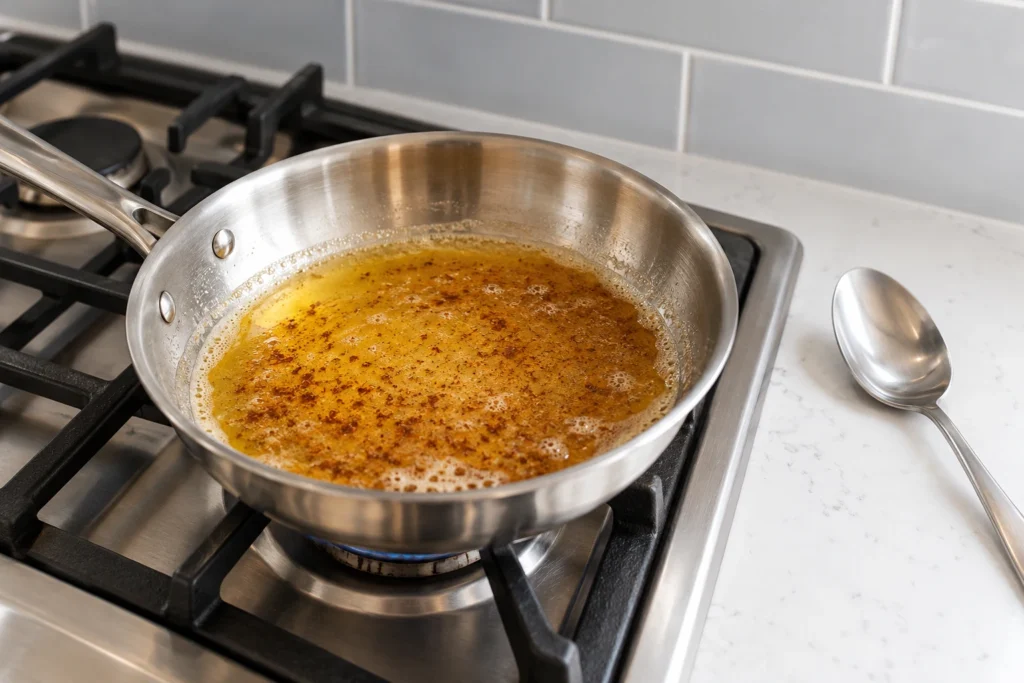
Smell is actually the more reliable signal of the two once the browning starts, since the visual difference between “perfectly done” and “one step too far” can be subtle in a dark pan, while the smell shift from nutty to acrid is unmistakable. Trusting the nose over the eyes in the last thirty seconds is the single habit that separates someone who burns their first few batches from someone who doesn’t.
Getting it out of the hot pan fast enough
The pan itself holds enough residual heat to keep cooking the butter for several more seconds after it’s pulled off the burner, which is long enough to turn a perfectly browned batch into a burnt one if it’s left sitting in the hot pan to “cool down” before being used. Pouring it out immediately into a cool bowl, or directly over whatever dish it’s actually finishing, stops that unwanted carryover cooking the exact moment it matters most. A light-colored pan, stainless steel or a light-bottomed skillet rather than dark cast iron, also makes the actual color of the butter and solids easier to judge accurately, which matters more here than on almost any other technique on this site.
Salted or unsalted, and why it actually matters more here
Unsalted butter is genuinely the better starting point for browning specifically, for a real reason that goes well beyond general seasoning control alone. As the water cooks off during browning, whatever salt is already in the butter concentrates along with everything else, which means a batch started with salted butter ends up noticeably saltier than the stick itself suggested. That’s rarely a problem in savory applications where a bit of extra salt is welcome, but it becomes a real issue the moment brown butter gets used in anything sweet or delicate, where that concentrated salt shows up as a harsh note rather than a balanced one. Starting unsalted and salting the finished batch to taste gives far more control over the final result than hoping a salted stick lands in the right place on its own.
Scaling the technique up without losing control of the timing
More butter in the pan means more total water to boil off before browning can start, which extends the slow, early part of the process without meaningfully extending the fast, dangerous part once browning actually begins. A pound of butter takes longer to reach the foaming-subsides stage than a single stick does, but once it gets there, the window to pull it before burning is roughly the same short stretch regardless of quantity. The practical result: scaling up a batch buys more total patience time, not more margin for error at the finish. Staying at the pan for the entire process, not just the final minute, matters just as much on a large batch as it does on a small one.
What it’s actually for
Brown butter works best as a finishing touch rather than a base cooking fat, spooned over a finished dish right before serving so its specific flavor stays forward instead of getting cooked away or muted by whatever else is happening in the pan. A spoonful poured over a pan-seared steak or chop right off the heat, finished with a bit of the browned solids themselves scraped up from the bottom of the pan, adds a depth that plain melted butter doesn’t come close to. It also holds its flavor well stirred into warm bone broth or drizzled over roasted bone marrow, anywhere a concentrated, nutty fat note is welcome without competing against a hard sear.
It pairs particularly well with anything already rich with its own fat, since the nutty note layers on top rather than fighting for attention. A thick ribeye finished with a spoonful, or a piece of fish spooned over right before serving, both pick up real depth from a technique that takes a few minutes and a single ingredient. It’s also a genuinely useful way to use the last few tablespoons of a stick that aren’t quite enough for anything else: a small batch browned and kept on hand turns leftover butter into a deliberate ingredient rather than something that just sits in the fridge going unused.
Where the name actually comes from
French cooking calls this beurre noisette, literally “hazelnut butter,” a name earned entirely by smell and color rather than any actual hazelnut involved. It’s one of the older, more established techniques in French cuisine specifically because it asks for nothing beyond butter, a pan, and attention, the kind of transformation that was valuable long before more complex sauce-making tools existed. That simplicity is a real part of why it’s stayed a standard, widely taught technique for so long across different cuisines: it doesn’t require anything a reasonably stocked kitchen wouldn’t already have on hand, just the discipline to actually stand at the stove and watch the pan the whole way through.
Turning it into a simple pan sauce
The fastest real use for brown butter is right in the same pan a cut of meat just finished cooking in. Once the meat is out resting, pour off excess fat if there’s a lot built up, add fresh butter, and brown it directly in the pan that still carries the browned bits left behind from the sear. Those bits add their own real depth on top of what the butter itself develops during the browning, landing closer to a proper, genuine pan sauce than plain melted butter would ever produce entirely on its own. A squeeze of something acidic stirred in right at the end, off the heat, balances the richness without needing anything more complicated than that: no roux, no reduction, just the fat itself doing the work.
This approach works because the pan is already hot and the fond (the browned residue stuck to the bottom) is already there waiting to be picked up. It turns what would otherwise be a separate step into something that adds almost no extra time to a meal that’s already being cooked.
Storing a batch worth saving
Brown butter keeps refrigerated for about a week in a sealed container, and it solidifies again once cold the same way regular butter does, just with the toasted solids suspended throughout rather than settled at the bottom (a quick stir before using redistributes them evenly if they do settle). It also freezes well for a couple of months, which makes batching a double or triple portion worthwhile, since the technique takes exactly as much attention for one stick of butter as it does for three, but the result stretches across several meals instead of just one.
Mistakes that turn a good batch into a wasted one
- Walking away during the loud foaming stage. That early foam looks like the slow part, but the transition to browning happens faster than it seems, and stepping away even briefly risks missing the window entirely.
- Using a dark pan and judging color by eye alone. Dark cast iron hides the actual color of the solids until they’re already overdone. A lighter pan or checking color against the edge of a spoon helps catch it in time.
- Leaving it in the hot pan after pulling it off the heat. Residual pan heat keeps cooking the butter for several more seconds, which is enough to burn an already-perfect batch.
- Confusing it with ghee and trying to use it for high-heat searing. Brown butter still contains water and solids that burn at a lower temperature than ghee’s clarified fat tolerates.
- Walking away because “it’s just butter.” Treating this like a casual, low-stakes step is exactly how a pan gets ruined; it deserves the same full attention as a hard sear.
- Not having the next step ready before starting. Since the finished window lasts only moments, scrambling to find a bowl or the next ingredient right as the butter hits peak color is a common way to lose it to carryover heat while distracted.
Visual steps
