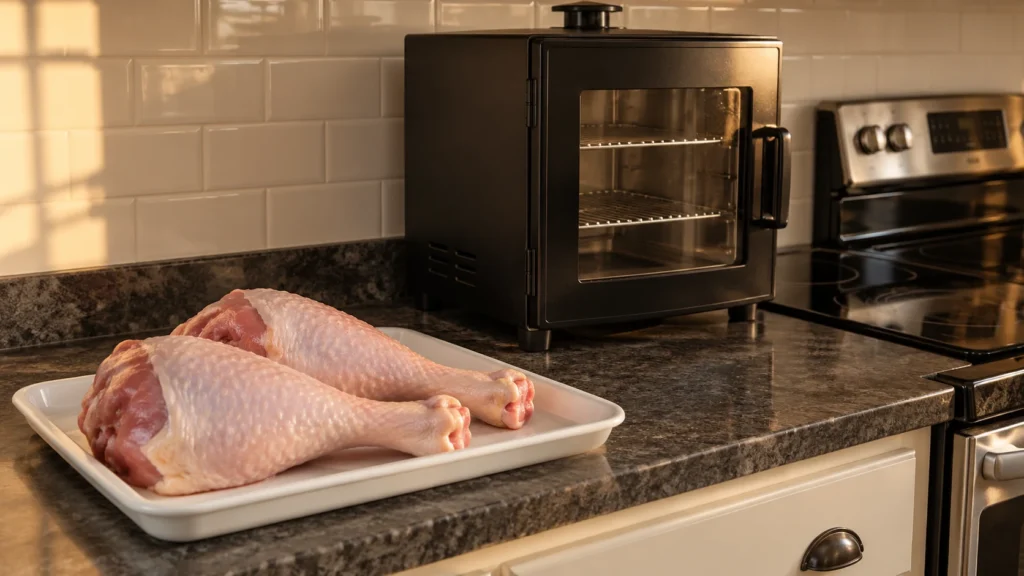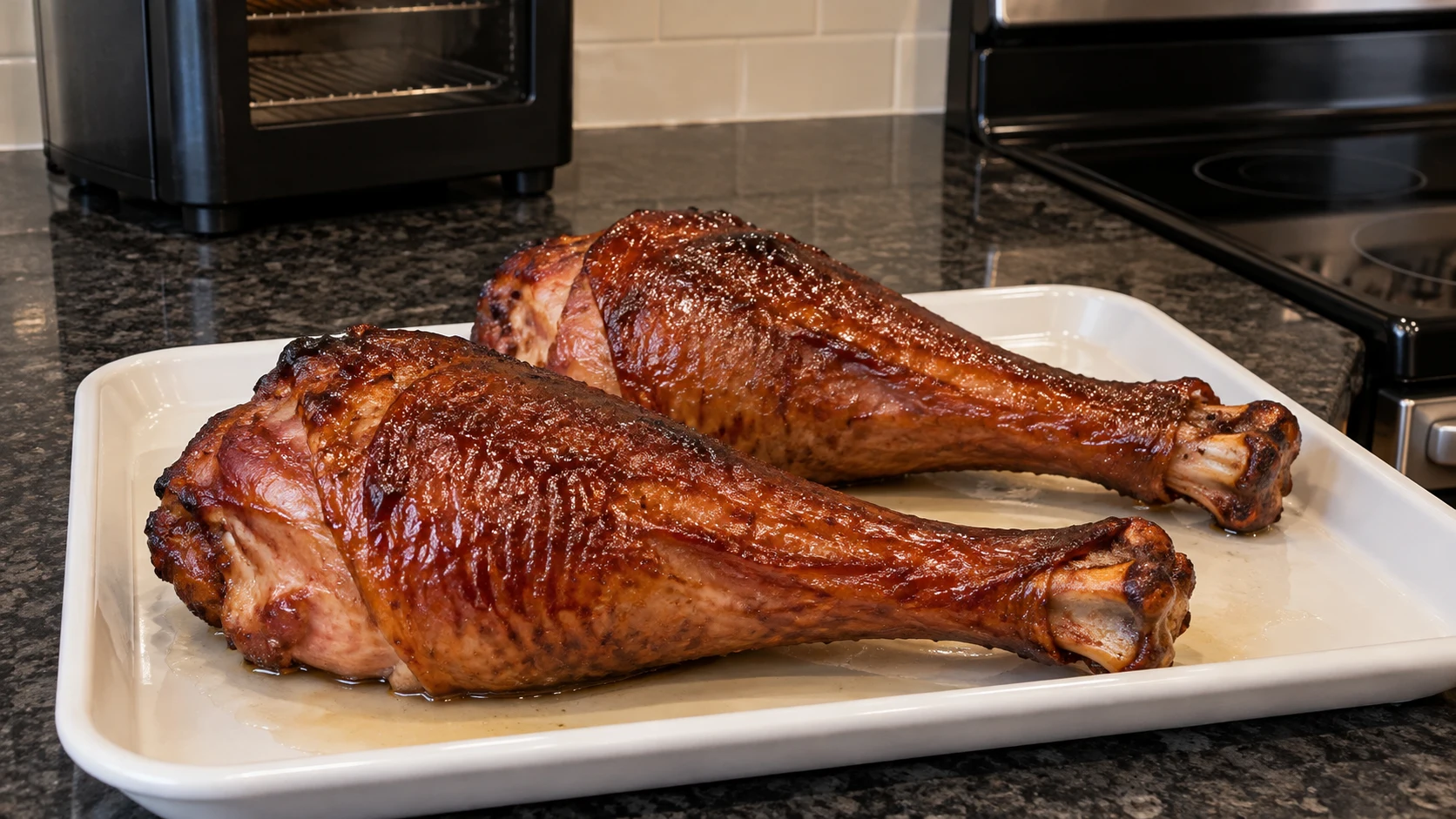
Fairground turkey legs have built a reputation that has almost nothing to do with the cut itself. The giant, dramatic leg sold at fairs and theme parks is usually injected, over-brined, and finished on a rotisserie built for speed and spectacle rather than flavor, and a lot of people’s only experience with smoked turkey leg is that salty, slightly mushy version. A turkey leg smoked slowly and properly at home is a completely different piece of meat: dark, well-worked muscle with enough connective tissue to reward hours of low heat, finishing with skin that crackles and meat that pulls cleanly off the bone.
What You Need
- 4 whole turkey legs (drumstick and thigh connected, skin-on)
- Coarse salt, about 1 tablespoon per leg
- A light crack of black pepper, optional
- 2 tablespoons rendered turkey fat or butter, melted, for basting
- Hardwood for smoking. Oak, hickory, or fruitwood all work well with poultry
No injection brine, no sugar-based rub, no sweet glaze brushed on near the end. This version lets salt, smoke, and time carry the whole dish, which is plenty for a cut this flavorful on its own.
Salting Ahead
Salt the legs generously on all sides, working some under any loose skin as well, and refrigerate uncovered for 12 to 24 hours before smoking. The same logic from our guide to salting meat early applies here: a leg this size needs real time for salt to penetrate past the surface, and a smoker’s long, dry cook will exaggerate under-seasoning more than a quick sear would.
Setting Up the Smoker
- Set up your smoker for indirect heat at 225–250°F (107–121°C), with the wood producing a thin, steady blue-white smoke rather than thick white billowing smoke, which signals an overly smoldering, dirty burn.
- Remove the legs from the refrigerator and let them sit at room temperature for 30 minutes while the smoker comes up to temperature.
- Place the legs on the grate skin-side up, away from direct heat, leaving space between each one for smoke and air to circulate fully around them.
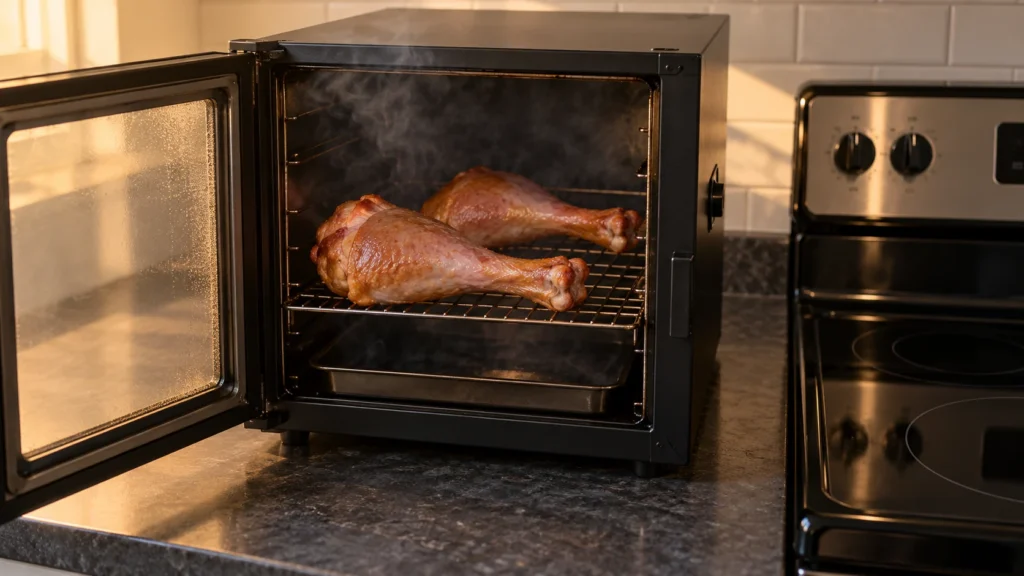
- Smoke undisturbed for the first 2 hours before opening the lid to check. Frequent lid-opening lets heat and smoke escape and meaningfully extends total cook time.
- After 2 hours, baste the skin lightly with melted turkey fat or butter, then continue smoking, basting again every 45 minutes to an hour.
- Begin checking internal temperature around the 3-hour mark, probing the thickest part of the thigh away from the bone.
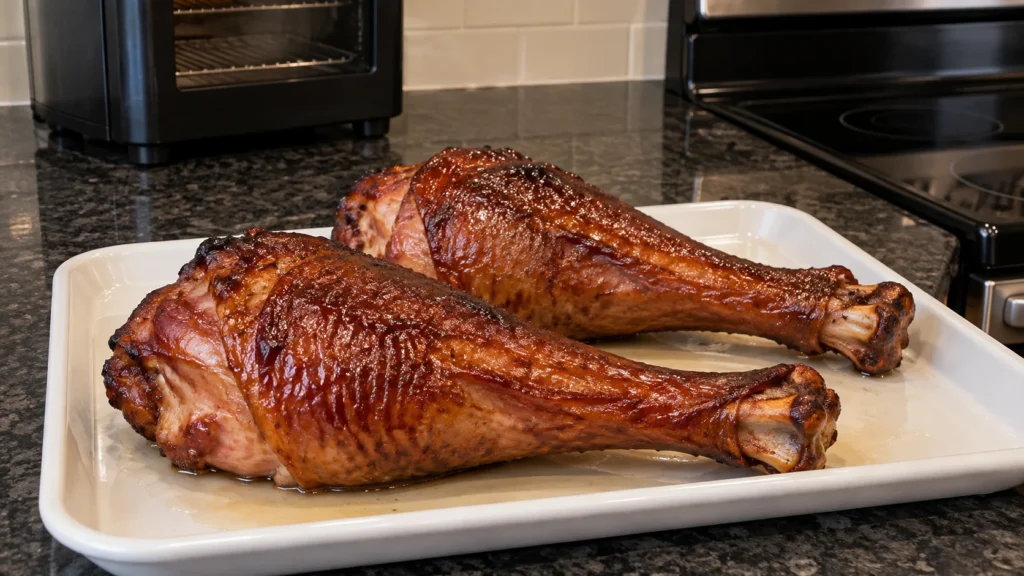
- Pull the legs once they read 175–180°F (79–82°C) internally. Well past the 165°F poultry safety floor, deep into the range where this cut’s connective tissue has actually had time to soften.
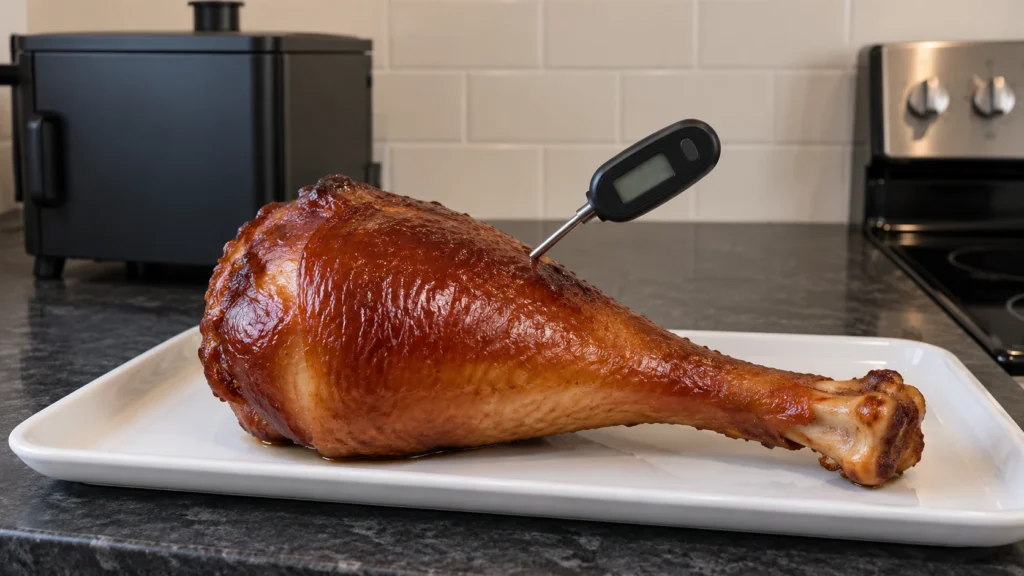
Total time runs 3½ to 4½ hours depending on the size of the legs and how consistently your smoker holds temperature. This is a weekend project, not a weeknight one, but almost none of that time is active work once the legs are on the grate.
Why This Cut Wants to Go Well Past 165°F
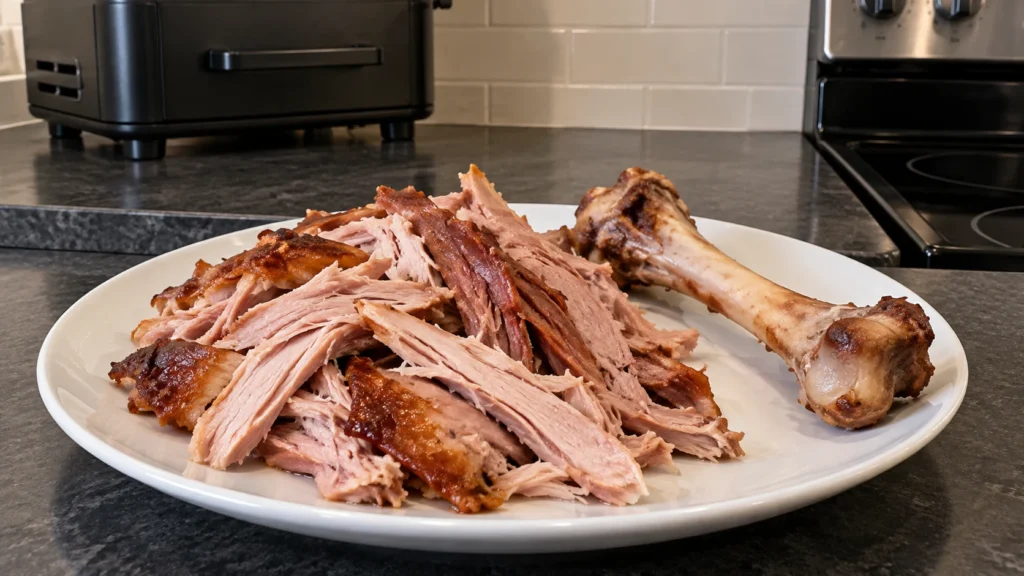
A turkey leg is almost entirely dark, working muscle wrapped in a dense network of connective tissue. More, proportionally, than a chicken thigh carries, simply because a turkey leg is doing more structural work for a much larger bird. The USDA’s safe minimum of 165°F deals with pathogen risk and says nothing about texture, and on a cut this fibrous, stopping at the minimum leaves you with meat that is safe but still tough and difficult to pull from the bone. Carrying the leg into the mid-to-high 170s gives the collagen in that connective tissue real time to convert into gelatin, the same transformation that makes a long-braised short rib tender. Smoke and low heat are simply a slower, drier-air version of what a braise accomplishes with liquid.
Reading Doneness Beyond the Thermometer
| Internal temp | What to expect |
|---|---|
| 165°F | Safe, but tendons still resist; meat clings tightly to bone |
| 170–175°F | Loosening; meat begins pulling away from bone ends |
| 178–182°F | Tender throughout; the drumstick bone twists with light resistance |
| 185°F+ | Very soft, approaching fall-off-the-bone; watch closely past this point for dryness |
A reliable secondary check alongside the thermometer: grip the end of the drumstick bone through a towel or glove and twist gently. A properly finished leg gives slightly at the joint, a sign the connective tissue there has softened. A leg that still feels rigid at 175°F+ may need another 20 to 30 minutes regardless of what the probe says, since smoker hot spots can occasionally give a misleadingly high reading in one specific spot.
Getting the Skin Right
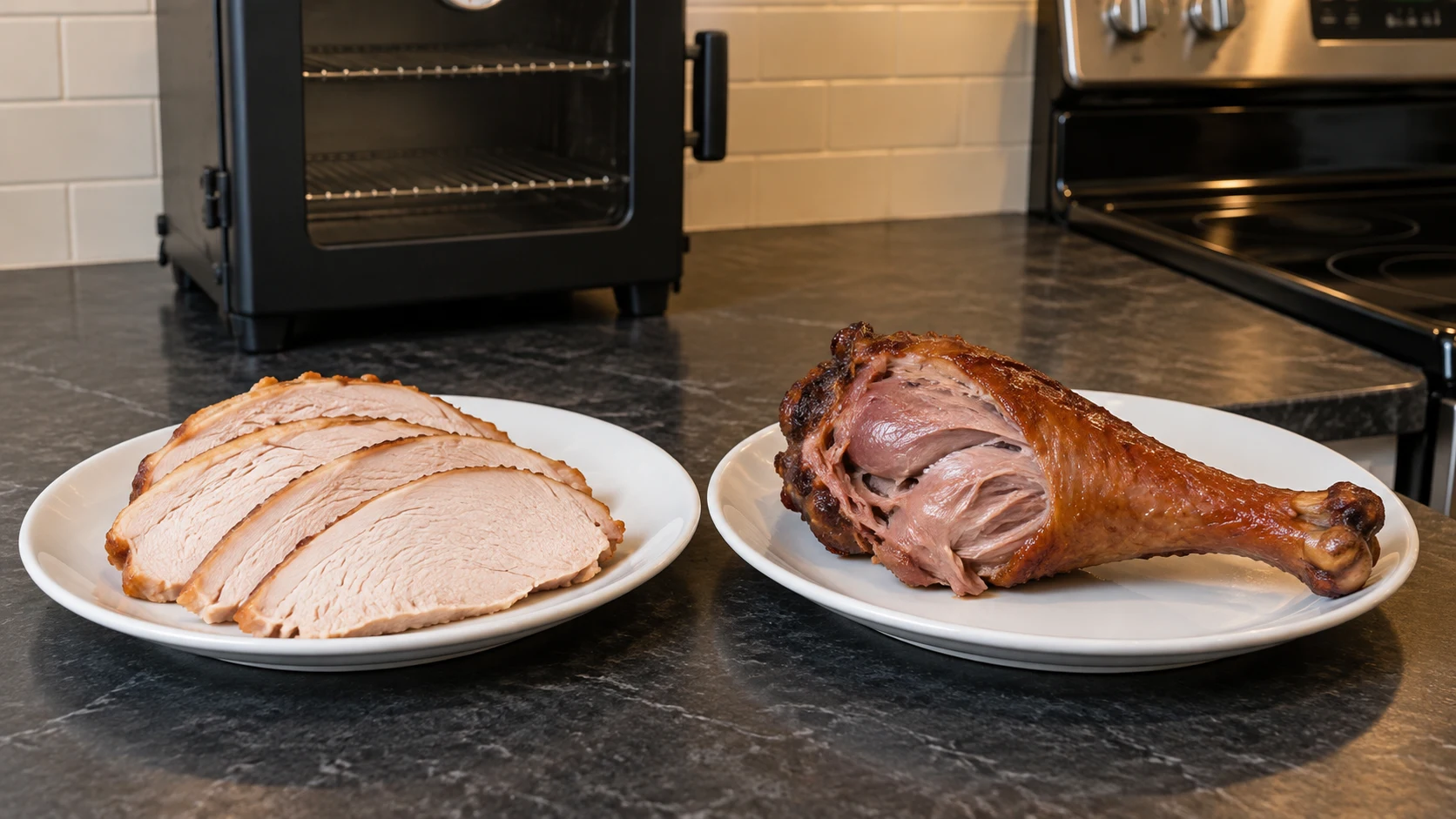
Low-and-slow smoking is excellent for the interior of the leg but can leave skin soft rather than genuinely crisp, since the smoker’s temperature rarely gets hot enough to drive off all the surface moisture the way a hard roast or sear would. If you want crisper skin than the smoke alone delivers, pull the legs at 170°F internal and finish them over direct, higher heat on the same grill or under a hot broiler for 3 to 5 minutes per side, watching closely, until the skin tightens and browns further. This also brings the internal temperature the rest of the way to the 178–182°F target without extending the low-heat smoke time.
Common Mistakes
- Pulling at exactly 165°F. Safe, but this cut specifically rewards going further. Treat 165°F as a waypoint, not the finish line, for a turkey leg.
- Running the smoker too hot. Above 275°F, the outside of the leg can dry out and the skin can toughen before the deep interior connective tissue has had time to break down properly.
- Skipping the rest period. Let smoked legs rest for 10 to 15 minutes under loose foil before serving. This gives juice time to redistribute through meat that has been cooking for several hours.
- Opening the lid constantly to check progress. Every lid-opening vents built-up heat and smoke, and repeated checking can add 30 minutes or more to total cook time across a long smoke.
- Confusing thick white smoke with proper smoke. Thin, blue-tinged smoke means a clean, efficient burn; thick white smoke usually means the fire is smoldering and will impart a harsher, more acrid flavor.
No Smoker? A Charcoal Grill Works
A kettle-style charcoal grill set up for indirect heat (coals banked to one side, legs on the opposite, cooler side, with a few wood chunks added to the coals for smoke) gets you most of the way to the same result with a bit more temperature management required. Keep the vents mostly closed to hold a steady 225–250°F, and add fresh coals or wood roughly every hour to maintain both heat and smoke output through the full multi-hour cook.
Choosing Wood
Poultry takes on smoke flavor faster and more readily than beef or pork does, since the skin and the relatively open muscle structure both absorb it efficiently, which means a strong wood like pure hickory or mesquite can tip into bitter or overpowering territory on a multi-hour turkey leg cook in a way it would not on a shorter cook. Oak is a reliable middle-ground choice. Strong enough to stand up to several hours of smoke exposure without disappearing, but not so assertive that it overwhelms the meat underneath. Fruitwoods like apple or cherry run milder and sweeter, which pairs well if you want the turkey itself to remain the dominant flavor rather than the smoke. If you only have access to one wood type, go lighter on quantity than you would for a beef brisket of similar cook time. Two or three chunks added over the full smoke is usually enough for turkey, where a brisket might use twice that.
Scaling for a Crowd
Turkey legs scale well for a group because each one is already a substantial single-serving portion, and a smoker large enough to hold eight or ten legs cooks them in roughly the same time window as four, provided there is still enough clearance between pieces for smoke and heat to circulate evenly on all sides. The main adjustment at larger scale is managing fuel and temperature more actively. A fully loaded smoker grate changes airflow patterns slightly, and you may need to rotate legs from the edges toward the center partway through the cook if your setup runs noticeably hotter in one zone than another. Budget extra wood and charcoal accordingly, and resist cramming legs close enough together that skin touches skin, which creates a shielded spot that neither browns nor crisps properly.
What to Serve Alongside It
A smoked turkey leg is substantial enough to anchor a plate on its own, but it pairs naturally with other slow-cooked or rendered-fat dishes from this site rather than anything that needs a side built around vegetables or grains. A cup of bone broth on the side, a portion of freezer-prepped meat from earlier in the week, or simply more of the same smoked turkey for a crowd all keep the meal consistent with the rest of this site’s approach. Meat and rendered fat carrying the entire plate.
Storing and Reheating
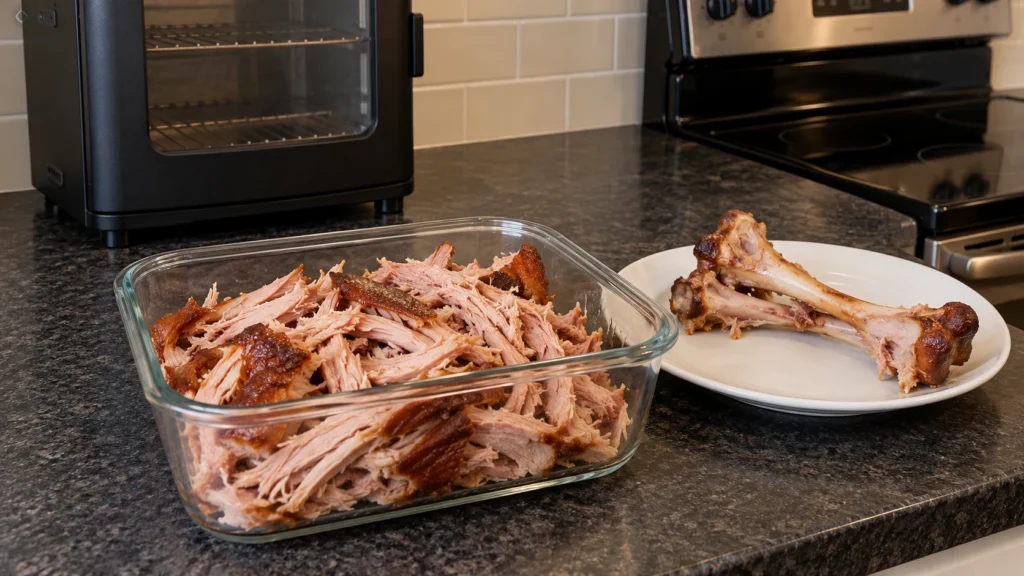
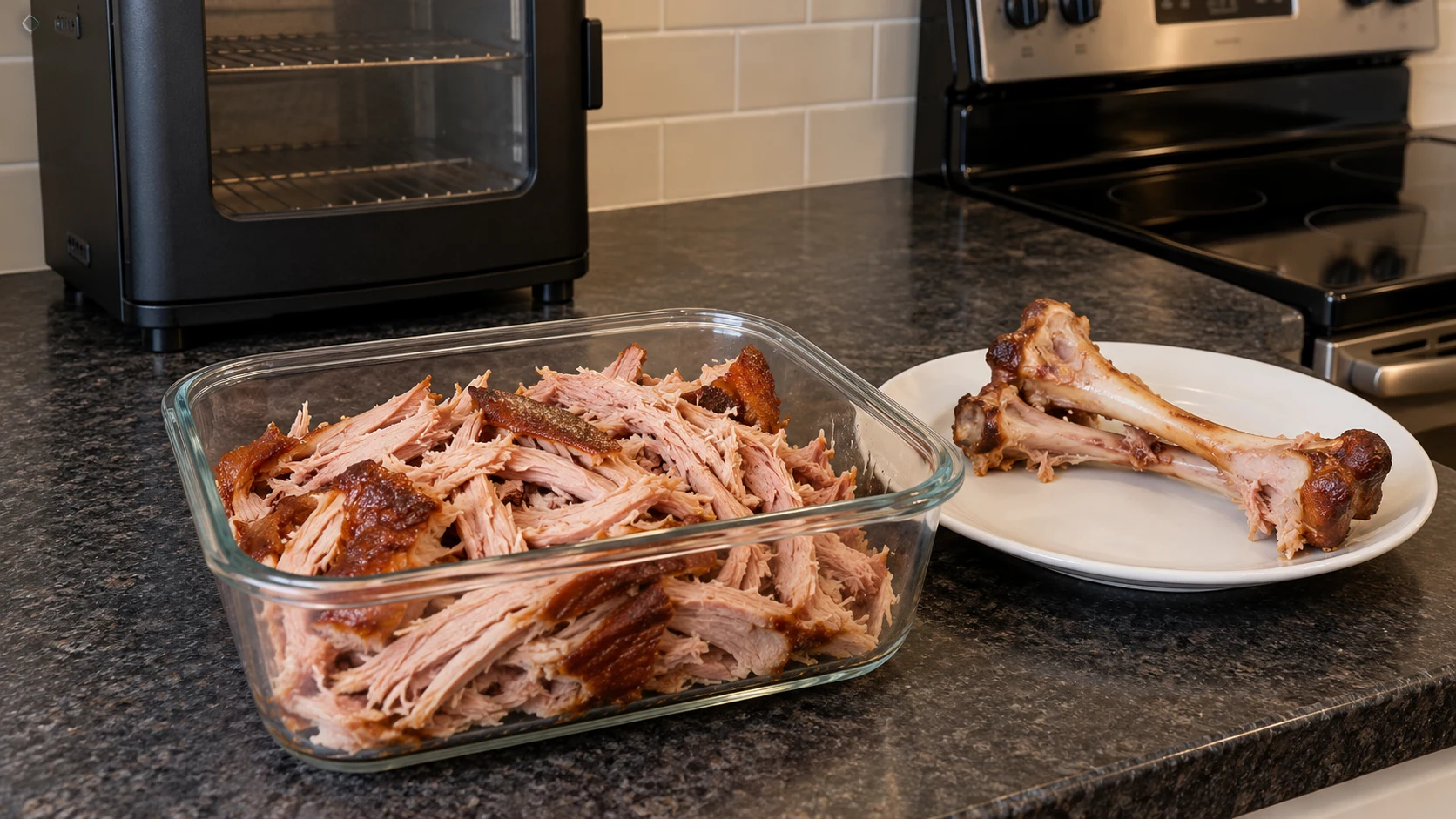
Pull the meat from the bone once it has cooled enough to handle and refrigerate it in a sealed container for three to four days, or keep legs whole if you prefer to reheat and carve closer to serving.
Reheat gently, covered, in a 300°F oven with a splash of bone broth or reserved pan drippings to keep it from drying further, until the center returns to 165°F. Smoked turkey leg also freezes well, pulled from the bone and stored in its own juices, for up to two months; thaw in the refrigerator before reheating. See our notes on how long cooked meat actually keeps for the broader storage math.
Frequently Asked Questions
Can I smoke just the drumstick without the thigh attached? Yes, though a drumstick alone has less meat and a different fat distribution than a whole leg, and will finish slightly faster. Start checking temperature around the 2½-hour mark instead of 3.
Do I need a water pan in the smoker? A water pan helps stabilize temperature swings and adds a small amount of ambient humidity that can help keep the surface from drying out too fast during a long cook, though it is not strictly required if your smoker already holds a steady temperature well.
Why is the meat near the bone still slightly pink even at 180°F? This is a common and harmless phenomenon in smoked poultry, caused by a reaction between myoglobin in the meat and combustion gases from the smoke, sometimes called smoke ring coloring. It is not a sign of undercooking as long as the internal temperature itself is accurate and verified with a properly calibrated thermometer.
Can I smoke frozen turkey legs without thawing them first? No. Thaw fully in the refrigerator before salting and smoking. A frozen or partially frozen leg spends too long in the temperature range where bacteria multiply fastest before the smoker’s low heat catches up, and it also prevents the overnight salt cure from penetrating evenly, since salt cannot move through ice the way it moves through thawed muscle.
How do I know if my smoker is actually holding 225–250°F and not drifting? Do not rely solely on a built-in lid thermometer, which often reads the air temperature well above the actual grate level where the meat sits. A separate oven-safe probe thermometer placed at grate height gives a far more accurate picture, and it is worth the small cost if you plan to smoke regularly. Guessing at temperature on a multi-hour cook like this one is where most home smoking disappointments start.
What should I do if one leg finishes well before the others? Pull it. Turkey legs are rarely perfectly uniform in size, and a smaller leg can finish 20 to 30 minutes ahead of a larger one on the same grate. Move finished legs to a cooler part of the smoker or wrap them loosely in foil to hold while the rest catch up, rather than leaving everything on the heat until the slowest piece is done and overcooking the smaller ones in the process.
A properly smoked turkey leg has nothing in common with the over-brined fairground version beyond the shape. Salted ahead, smoked low and patient, and carried well past the safety floor into genuinely tender territory, it is one of the better arguments for buying turkey in pieces rather than whole. Once you have run through the timing once on your own equipment, it becomes one of the more reliable low-effort projects to set going on a weekend morning while the rest of the day happens around it.
Visual steps